

A Federal Pacific panel is one of the best-known electrical findings in home inspections. However, the panel is only one part of the story.
A buyer may look at an electrical panel and see a gray box. Meanwhile, an inspector sees equipment that reveals information about the whole system.
During a home inspection, the electrical evaluation may include visible and accessible components throughout the property:
- Service equipment and electrical panels
- Breakers or fuses
- Visible conductors
- Receptacles, switches, and lighting components
- GFCI and other protective devices, where applicable
- Exterior and garage electrical components
- Attic or crawl-space wiring, where visible and accessible
The goal is not to find something scary. Instead, it is to observe the system responsibly, document relevant conditions, and recommend appropriate next steps.
What Electrical Defects Do Home Inspectors Flag?
An inspector may identify visible electrical conditions involving service equipment, panels, breakers, wiring, and receptacles. In addition, switches, grounding observations, and protective devices may be evaluated within scope.
For example, findings can include:
- Damaged components
- Loose or missing covers
- Open electrical openings
- Visible wiring concerns
- Breaker or conductor conditions
- Receptacle concerns
- Missing or nonfunctional protective devices, where applicable
- Evidence of overheating or damage
- Older or notable equipment that deserves further evaluation
The home inspector documents the condition. When appropriate, a qualified electrical professional may then be recommended for evaluation or correction.
Captain Obvious: “Usually I’d have a joke here.”
Inspector Hindsight: “Not this time.”
Captain Obvious: “Electrical panel?”
Inspector Hindsight: “Electrical panel.”
Why Electrical Conditions Deserve Careful Language
Electrical concerns can have real safety implications. For that reason, precise language matters.
An inspector should not see a defect and announce, “This house is going to catch fire.” That is a prediction, and it is unnecessary.
Instead, if a condition is improper, damaged, or potentially hazardous, the report can say so directly.
Inspector Hindsight: “The goal isn’t fear. The goal is clarity.”
For electrical concerns, clarity means explaining:
- What is visible, and where it is
- Why the condition deserves attention
- What the inspection cannot determine
- What next step is appropriate
What Does a Home Inspector Look At in an Electrical Panel?
When the panel is safely accessible, an inspector may consider visible conditions involving:
- The panel enclosure and cover
- Breakers or fuses
- Visible conductors and connections
- Openings and labels
- Evidence of damage or overheating
- Corrosion or moisture-related conditions
The exact procedure depends on the inspection scope and whether conditions are safe. Above all, safety comes first.
Therefore, an inspector should not remove a cover when doing so would create unreasonable risk.
What Is a Federal Pacific Panel?
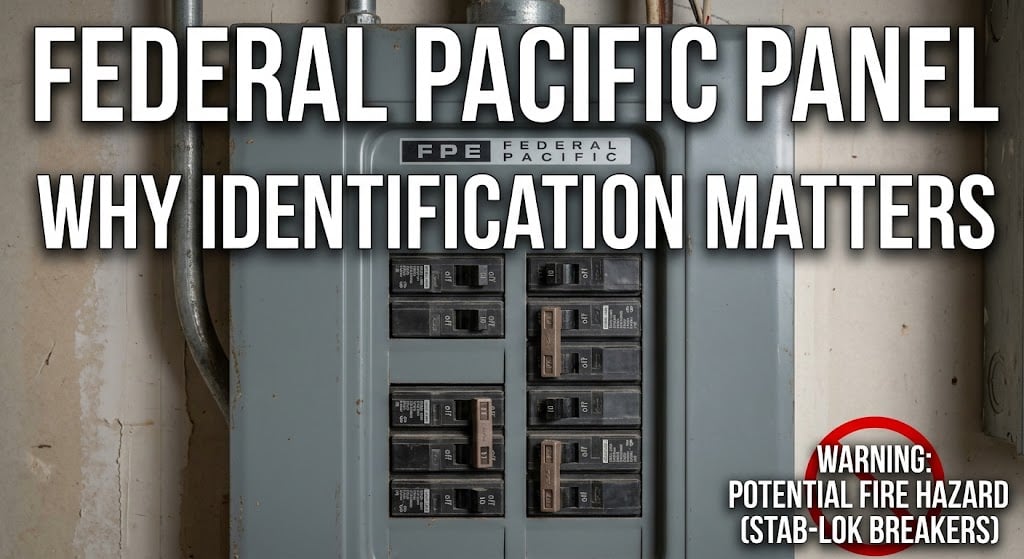
Federal Pacific Electric, often called FPE, manufactured electrical equipment still found in some older homes. One commonly discussed product line carries the Stab-Lok name.
If an inspector finds a Federal Pacific panel, the key step is accurate identification. In other words, the brand name should not become a dramatic prediction.
For example, a responsible report might say the equipment appears to be Federal Pacific. Then it would recommend evaluation by a qualified electrical professional because of known concerns.
That is very different from saying, “This panel is definitely going to fail.” The first communicates a legitimate concern. The second predicts an outcome no inspector can know.
Is a Federal Pacific Panel a Problem?
Certain Federal Pacific equipment, particularly Stab-Lok, has a well-documented history of concern. As a result, identifying it during a home inspection matters.
Even so, sensational language doesn’t help. Instead, the appropriate response is to:
- Identify the equipment
- Document its condition
- Communicate the concern
- Recommend qualified electrical evaluation when appropriate
Buyers don’t benefit from minimizing a legitimate electrical concern. Likewise, they don’t benefit from unsupported catastrophe.
Captain Obvious: “So we take it seriously.”
Inspector Hindsight: “Yes.”
Captain Obvious: “Without turning the inspection report into an action movie.”
Inspector Hindsight: “Exactly.”
Does a Federal Pacific Panel Have to Look Damaged to Be a Concern?
No. Visible damage is not the only reason a Federal Pacific panel may deserve further evaluation.
This matters because a buyer may see a clean enclosure and think, “It looks fine.” However, appearance doesn’t answer every equipment-history question.
Instead, the inspector considers equipment identification, visible condition, and observed defects. Known equipment concerns and inspection limitations also matter. Then the inspector communicates the right recommendation.
Inspector Hindsight: “Clean isn’t the same thing as evaluated.”
Can a Home Inspector Test Whether Every Breaker Will Work Correctly?
No. A standard home inspection is not laboratory performance testing of every circuit breaker.
Instead, the inspector evaluates accessible conditions within the inspection scope. That is different from guaranteeing future breaker performance.
This matters most with equipment that has known historical concerns. So a visual inspection cannot promise that every breaker was proven safe. Nor can it promise the panel will perform correctly in every fault condition.
What Is a Double-Tapped Breaker?
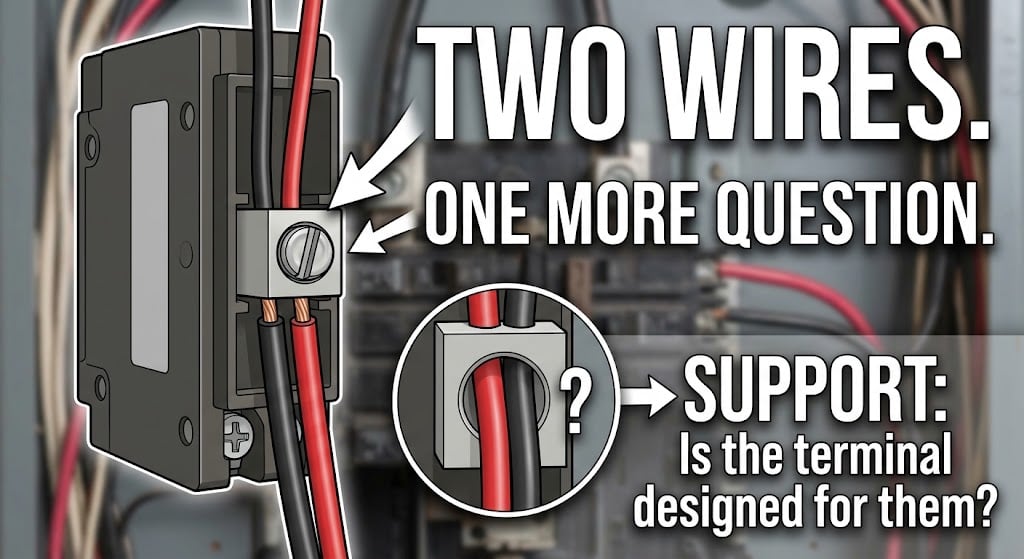
“Double-tapped breaker” is a common inspection phrase. It describes more than one conductor connected at a single breaker terminal.
However, there is an important technical point. The number of conductors alone does not decide whether the connection is improper.
Rather, the breaker must be evaluated against its listing, labeling, and intended configuration. Some terminals are designed for more than one conductor, while others are not.
Captain Obvious: “Two wires.”
Inspector Hindsight: “Yes.”
Captain Obvious: “Double tap.”
Inspector Hindsight: “First we determine whether that terminal is designed for two conductors.”
Captain Obvious: “Fine print strikes again.”
Are Double-Tapped Breakers Always Wrong?
No. People use “double-tapped” broadly. However, whether it is a defect depends on the specific equipment and its approved configuration.
So the better question is this: is the terminal designed and listed for the conductors connected to it? If not, the condition may need correction.
In short, check the equipment. Don’t judge from the wire count alone.
Why Can an Improper Breaker Connection Matter?
Electrical terminations are designed to maintain a proper connection between conductors and equipment. When a connection doesn’t match the intended configuration, it may not perform as designed.
However, the inspector’s job is not to teach homeowners how to rewire it. Instead, the inspector documents the condition and recommends professional correction or evaluation.
Captain Obvious: “So no tutorial called ‘Fix Your Breaker Panel Before Lunch’?”
Inspector Hindsight: “Absolutely not.”
Should a Homeowner Open an Electrical Panel to Check?
No. You never need to remove a panel cover to follow along with an inspection article.
Electrical panels can contain energized components. Contact with them can cause serious injury.
So if you are concerned about conditions inside a panel, contact a qualified professional. This article is educational. It is not a DIY electrical procedure.
Do Home Inspectors Remove Electrical Panel Covers?
An inspector may remove a panel cover when it is within the inspection procedure and can be done safely. However, some conditions make removal inappropriate, such as:
- Unsafe access or obstructions
- Damaged equipment
- Evidence that removal would create unreasonable risk
- Other site-specific safety concerns
When a component cannot be safely evaluated, the limitation should be communicated. After all, an inspector doesn’t need to take unnecessary risks to prove thoroughness.
What Else Can an Inspector See Inside a Panel?
Depending on access and scope, visible panel observations can include:
- Conductors and breaker connections
- Neutral and grounding arrangements
- Panel openings
- Corrosion or damage
- Signs of overheating
- Improperly installed components
Importantly, conclusions should rest on what is actually observed. A condition that simply “looks wrong” still needs proper evaluation before anyone labels it a code violation.
What About Missing Breaker Knockouts or Openings?
Openings in electrical equipment can expose areas meant to stay enclosed. Therefore, an inspector may document missing fillers, open knockouts, or damaged covers.
The report explains the visible concern and recommends correction. Meanwhile, the homeowner never needs to reach into the panel to investigate.
Captain Obvious: “Hole in electrical panel.”
Inspector Hindsight: “Yes.”
Captain Obvious: “Hand goes in?”
Inspector Hindsight: “No.”
Captain Obvious: “Strong educational segment.”
What Does Overheating Look Like in an Electrical Panel?
Possible signs of overheating include discoloration, damaged insulation, melted components, or scorching. However, appearance still needs responsible interpretation.
For example, a dark mark is not automatically an electrical fire. Instead, the inspector evaluates the condition and the surrounding evidence.
Potentially significant damage may warrant prompt evaluation by a qualified electrical professional. Also, never touch damaged electrical components to investigate them.
What If There Is Rust or Corrosion in the Electrical Panel?
Visible rust or corrosion matters because electrical equipment should not have unexplained moisture. Accordingly, an inspector may consider:
- Where the corrosion is and how extensive it appears
- Whether moisture evidence is present
- Whether equipment is visibly damaged
- Whether further electrical evaluation is appropriate
The inspector may also look for clues about the moisture source. Still, a source should not be assigned without evidence.
Inspector Hindsight: “Water and electrical equipment are both worth understanding. Especially when they’re in the same sentence.”
Can Water Get Into an Electrical Panel?
Yes. Moisture can reach electrical equipment through different property conditions. If moisture evidence is observed, the inspector should document:
- The visible moisture condition
- Affected electrical components
- Related accessible building conditions
- Any limitations and recommendations
However, the inspector should not invent the water’s path. After all, water travels, and the visible location may not be the entry point.
What Does an Inspector Look For at Receptacles?
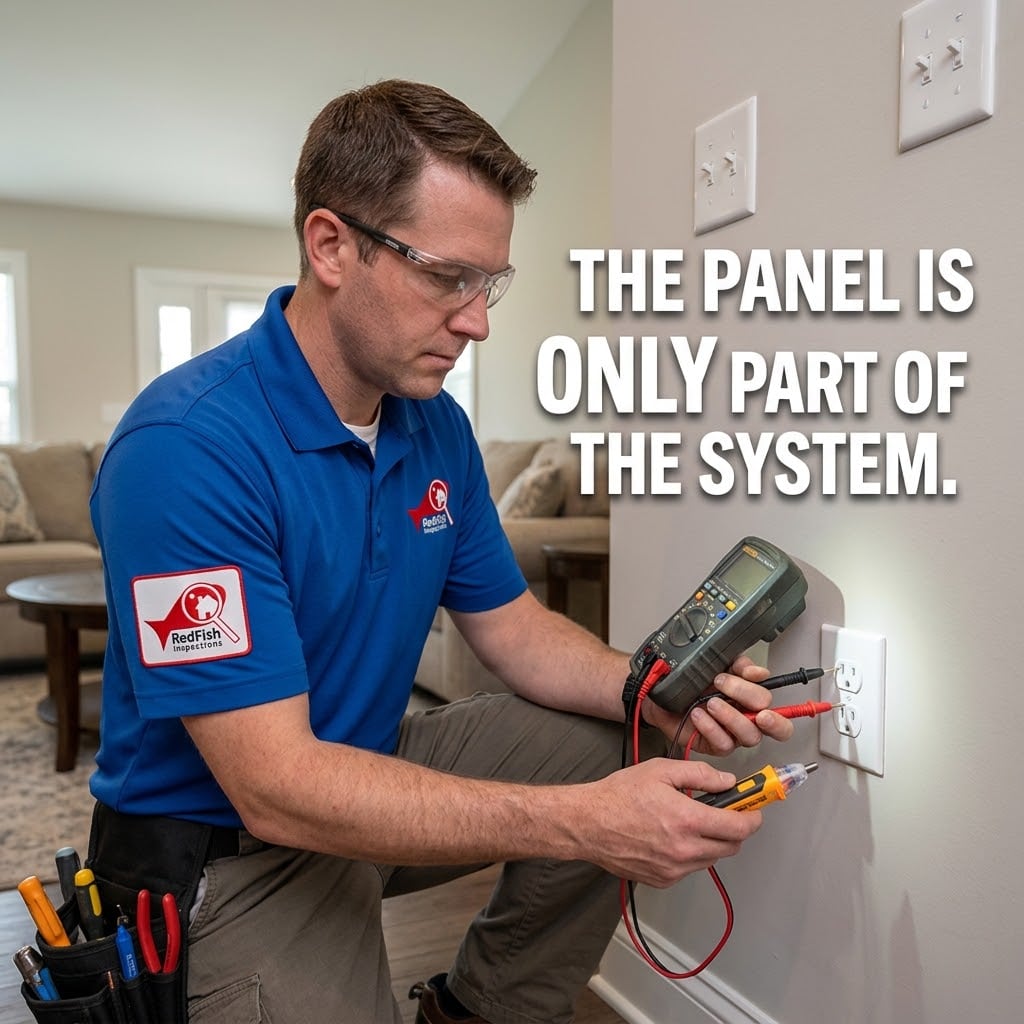
Electrical evaluation doesn’t stop at the panel. In fact, inspectors may test a representative number of accessible receptacles within scope.
Possible observations include:
- Physical damage or loose components
- Missing covers
- Unusual operation
- Wiring indications found through appropriate inspection methods
- Protective-device operation, where applicable
However, furniture, stored belongings, and other obstructions can limit access. So no inspector can claim every receptacle was evaluated.
What Is a GFCI?
A ground-fault circuit interrupter, or GFCI, is a protective device. It is intended to reduce the risk from certain ground-fault conditions.
Most people recognize GFCI receptacles by their TEST and RESET buttons. However, GFCI protection can also come from other equipment, such as a breaker or an upstream device.
Therefore, a receptacle without a test button doesn’t automatically lack GFCI protection. Instead, the inspector evaluates the actual condition rather than relying on appearance.
Where Might GFCI Protection Be Relevant?
GFCI protection is commonly associated with locations where water or damp conditions increase shock risk.
However, specific requirements depend on location, installation details, applicable standards, and when work was performed.
For that reason, no single room-by-room checklist applies to every home. Instead, the inspector reports the actual condition of the property.
What Is an AFCI?
An arc-fault circuit interrupter, or AFCI, is a protective device. It is intended to respond to certain electrical arcing conditions.
AFCI requirements have changed over time. Consequently, an inspector should avoid casually saying an older house “violates today’s code.”
Instead, the useful questions are: What protection is present? What condition is observed? Does it warrant evaluation or improvement?
Does an Older House Have to Meet Every Current Electrical Standard?
Not necessarily. A home inspection is not automatically a comprehensive code-compliance inspection.
Homes were built under different standards and altered over time. Even so, an inspector may identify safety concerns, damaged equipment, or improper installations. Upgrade considerations may also come up.
However, an older installation isn’t automatically a current code violation.
Inspector Hindsight: “Old doesn’t automatically mean defective.”
Captain Obvious: “And new doesn’t automatically mean correct.”
Inspector Hindsight: “Exactly.”
Does New Construction Have Electrical Defects?
Yes, it can. “New” describes age, but it doesn’t guarantee installation quality.
For example, an inspector may find issues with panels, breakers, receptacles, covers, protective devices, wiring, or fixtures.
Inspector Hindsight: “New construction is still construction.”
Either way, the report documents the actual condition. It doesn’t criticize the electrician, builder, or trade. In other words, the problem is the condition, not the person.
What About Exposed Wiring?
Visible wiring can deserve attention depending on its location, type, protection, and termination.
However, never touch, move, or reconnect a wire. Likewise, don’t try to test whether it is energized. Electrical investigation can expose people to serious hazards.
Instead, document the condition, keep your distance, and use qualified professionals where needed.
What About Open Junction Boxes?
Electrical connections meant to be enclosed deserve attention when covers are missing or damaged.
So an inspector may document an accessible open junction box or exposed connection. Then the report recommends appropriate correction.
Captain Obvious: “Usually I’d say, ‘Well, there’s your problem.'”
Inspector Hindsight: “Today we’re just documenting it.”
Captain Obvious: “Agreed.”
What About Extension Cords Used as Permanent Wiring?
Extension cords have intended uses. However, they are not substitutes for permanent building wiring.
If an inspector sees a setup that appears inappropriate for permanent use, it may be documented. Then further evaluation or correction may be recommended.
In the end, the takeaway is awareness, not repair.
Can an Inspector Find Electrical Problems in the Attic?
Yes, when attic areas are visible and safely accessible. For example, an inspector may observe visible wiring, junction boxes, connections, or damage.
However, insulation and construction can conceal wiring.
Captain Obvious: “Why is it always the attic?”
Inspector Hindsight: “You were allowed one.”
Captain Obvious: “I used it wisely.”
Therefore, no inspection can guarantee finding every concealed electrical defect.
Can a Home Inspector See Wiring Inside Walls?
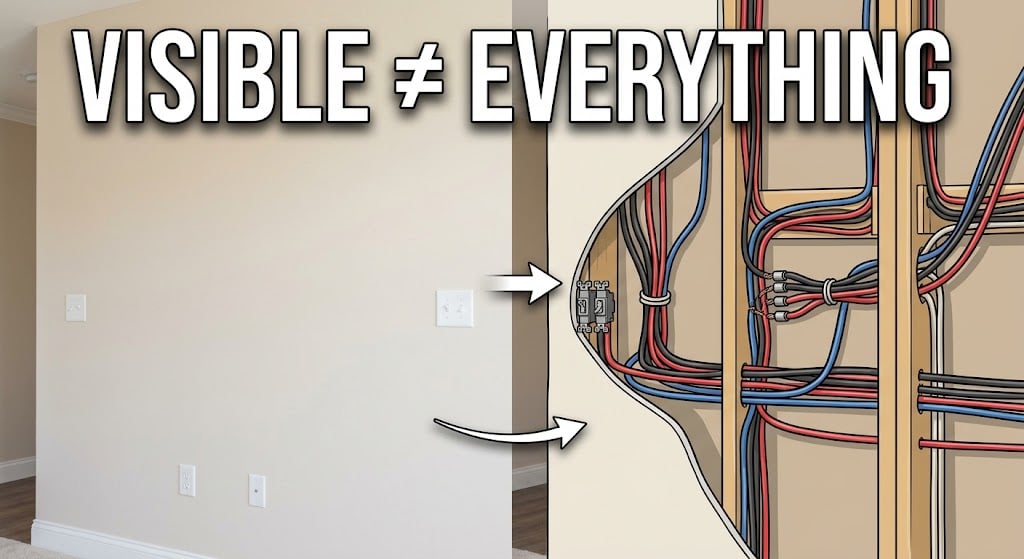
Not during a standard visual inspection. Finished walls conceal wiring. Similarly, ceilings, floors, cabinetry, and insulation hide it too.
An inspector evaluates what is visible and accessible. However, that doesn’t reveal the condition of every concealed conductor.
For this reason, no one can honestly claim a home’s electrical system has no hidden problems. That conclusion exceeds what a visual inspection can establish.
Does a Home Inspection Prove the Electrical System Is Safe?
No. A home inspection provides information about visible and accessible conditions within scope. However, it is not a guarantee that:
- Every electrical component is defect-free
- Every concealed conductor is properly installed
- Every breaker will perform perfectly
- No future electrical problem will occur
Rather, the inspection is valuable because it improves your understanding of observable conditions. It does not eliminate all uncertainty.
What If the Electrical Panel Has Been Modified?
Visible modifications can deserve attention. For example, an inspector may find:
- Added or replacement breakers
- Altered wiring
- Unused openings
- Different equipment
- Labels suggesting previous work
A modification isn’t automatically defective. However, if it raises questions about compatibility, workmanship, or condition, further evaluation may be appropriate.
Can the Panel Brand Matter?
Yes. Manufacturers, product lines, and equipment histories differ. As a result, identification can matter.
Still, inspectors should not treat every older brand as defective. Instead, the responsible process is to identify, observe, understand equipment history, document, and recommend when appropriate.
In fact, a Federal Pacific panel is a clear example of why equipment identification can be meaningful.
What If the Panel Label Is Missing or Hard to Read?
Missing or illegible labels can limit the inspector’s ability to confirm equipment information. Therefore, that limitation should be communicated rather than guessed around.
For example, a panel should never be identified because “it looks like one online.” Instead, use available evidence. If identification can’t be confirmed, the report should say so.
What About the Electrical Service Outside the House?
Depending on the property and scope, the inspector may also evaluate accessible exterior components, such as:
- Service equipment and meter enclosures
- Exterior disconnects
- Exterior receptacles
- Electrical penetrations
However, service configurations vary by property. So no one should assume every home is arranged the same way.
What About Electrical Conditions in the Garage?
Garages often contain several electrical components. For instance, an inspector may encounter:
- Receptacles and lighting
- Door-opener equipment
- Panels or subpanels
- Wiring and junction boxes
- Appliance or equipment connections
Again, there’s no list of things that “must” exist in every garage. Rather, the inspector evaluates the actual property.
Can a Home Inspector Tell Who Did Bad Electrical Work?
Usually not. A visible defect rarely shows who performed the work. Besides, that isn’t the point of the inspection.
So responsible reports avoid blaming the homeowner, contractor, or builder without reliable evidence. Instead, inspection reports focus on the condition, not on people.
Captain Obvious: “Can I say somebody made an interesting choice?”
Inspector Hindsight: “You can say the installation deserves evaluation.”
Captain Obvious: “Very diplomatic.”
What If the Seller Says the Electrical System Was Updated?
“Updated” is not a technical description. Therefore, buyers should ask:
- What was replaced, and when?
- Who performed the work?
- Are permits or documentation available, where applicable?
- Was the panel replaced?
- Were branch circuits or receptacles changed?
- Were protective devices added?
- Was only part of the system updated?
An inspector evaluates what is visible today. Meanwhile, documentation helps explain the property’s history.
Inspector Hindsight: “Updated tells you something happened. Documentation tells you what.”
What If an Electrician Previously Repaired the Panel?
Previous professional work is useful history. Still, the home inspector evaluates current visible conditions.
Helpful documentation may include:
- Invoices and scope of work
- Permits, where applicable
- Equipment information
- Previous evaluations
However, an electrician’s visit doesn’t mean every condition in the house was evaluated and corrected. So understand the actual scope of that work.
Should Buyers Be Scared by Electrical Findings?
Fear is not the goal. Instead, the goal is to tell apart:
- A minor maintenance item
- A condition requiring correction
- A condition requiring qualified electrical evaluation
- A potentially significant safety concern
- An inspection limitation
Different findings deserve different responses. That is why inspection reports need context.
Captain Obvious: “So not every electrical comment gets flashing red lights?”
Inspector Hindsight: “No.”
Captain Obvious: “But serious ones stay serious.”
Inspector Hindsight: “Exactly.”
When Should an Electrician Evaluate an Inspection Finding?
A qualified electrical professional may be appropriate when a condition requires specialized expertise, testing, or correction. For example:
- Potentially significant panel concerns
- Damaged electrical equipment
- Evidence of overheating
- Questionable conductor or breaker configurations
- Unsafe exposed electrical conditions
- Moisture-related electrical damage
- Equipment compatibility questions
The inspector doesn’t need to design the repair. Rather, the inspector recognizes when another professional should take the next step.
What Should Buyers Ask About an Electrical Finding?
Good questions include:
- What exactly did you observe, and where?
- Why does it matter?
- Is this an observed defect or a limitation?
- Is there visible damage?
- Is the equipment identifiable?
- Is further electrical evaluation recommended?
- Is previous electrical documentation available?
- Were any areas inaccessible?
- Is the condition isolated, or are related observations present?
After all, these questions are far more useful than “Is the electrical bad?”
Should You Buy a House With Electrical Defects?
A home inspector should not make that decision for you. Besides, electrical findings vary widely.
For example, one house may have straightforward correction items. Another may need specialized evaluation before you fully understand the system.
So the inspection should help you understand:
- What was observed, and why it matters
- What remains unknown
- What further evaluation is recommended
- What documentation exists
Then you can decide with the right professionals involved in the transaction.
Inspector Hindsight: “An inspection doesn’t make the decision for you. It gives you better information to make it.”
The Inspector’s Eye: The Panel Is Only the Beginning
A buyer sees the panel. Meanwhile, an inspector thinks through a longer list:
- What equipment is this, and what condition is it in?
- What is visible inside, when safely accessible?
- What are the breaker and conductor conditions?
- Are openings properly enclosed?
- Is there damage or moisture?
- What do the receptacles show?
- What protective devices are present?
- What conditions appear elsewhere in the house?
- What is concealed?
- What requires a qualified electrician?
That is the Inspector’s Eye. It isn’t finding one strange breaker and declaring the house unsafe.
Instead, it means observing, identifying, and documenting. Then the inspector puts findings in context and recommends the right next step.
Federal Pacific Panels & Electrical Defects: The Simple Answer
A home inspector may identify visible conditions involving panels, breakers, conductors, receptacles, and switches. In addition, protective devices, enclosures, visible wiring, and exterior components may be evaluated.
Above all, remember these points:
- A Federal Pacific panel deserves accurate identification and appropriate evaluation.
- A double-tapped breaker deserves more analysis than counting conductors.
- Visible damage deserves attention.
- Electrical safety concerns deserve serious language.
- Concealed wiring remains concealed.
Captain Obvious: “So what’s the rule?”
Inspector Hindsight: “Don’t guess with electrical systems.”
Captain Obvious: “That is unusually obvious.”
Inspector Hindsight: “Good.”
Captain Obvious: “It was obvious.”
Inspector Hindsight: “Until it wasn’t.”
Federal Pacific Panel & Electrical Defect FAQs
What electrical problems do home inspectors look for?
Inspectors may identify visible conditions involving panels, breakers, wiring, receptacles, switches, and protective devices. Electrical enclosures and other components within scope may also be evaluated.
What is a Federal Pacific panel?
Federal Pacific Electric made electrical equipment still found in some older homes. Certain Stab-Lok equipment has a documented history of concern and may warrant evaluation by a qualified electrician.
Is a Federal Pacific panel automatically going to fail?
No inspector can responsibly predict that a specific panel will fail. Instead, the equipment should be identified, its condition documented, and electrical evaluation recommended.
What is a double-tapped breaker?
It usually means more than one conductor is connected at a breaker terminal. Whether that is improper depends on whether the equipment is designed and listed for it.
Are double-tapped breakers always defective?
No. Some breaker terminals are designed for more than one conductor. So the equipment’s approved configuration matters.
Do home inspectors open electrical panels?
An inspector may remove a panel cover when it is within procedure and safe to do so. However, unsafe conditions can limit the inspection.
Do home inspectors test outlets?
Inspectors may test accessible receptacles within the inspection scope. However, obstructions and other conditions can limit access.
What is GFCI protection?
GFCI protection is intended to reduce risk from certain ground-fault conditions. It can be provided through different equipment configurations.
Can a home inspector see electrical wiring inside walls?
Not during a standard visual inspection. Finished walls, ceilings, and floors conceal wiring.
Does a home inspection guarantee the electrical system is safe?
No. It evaluates visible and accessible conditions within scope. It cannot guarantee the condition or future performance of every component.
Does an old house have to meet every current electrical standard?
Not necessarily. Homes were built and modified at different times. Also, a standard home inspection is not a full code-compliance inspection.
Can new homes have electrical defects?
Yes. New construction can still contain installation defects.
When should an electrician be called after a home inspection?
Call one when the inspector finds conditions needing specialized testing, repair, or expertise beyond the inspection scope.
Schedule Your RedFish Home Inspection
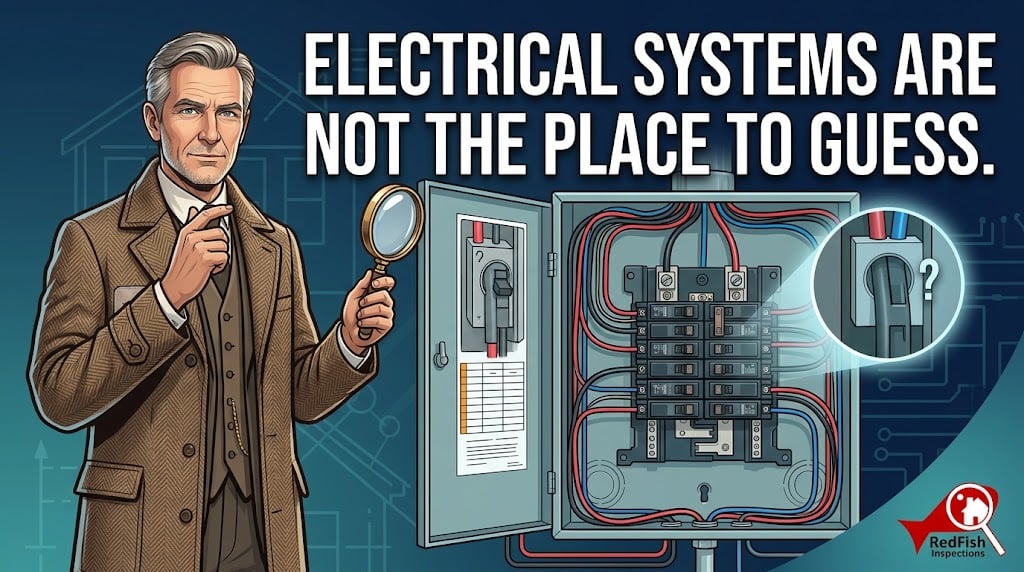
Electrical systems are not the place to guess. See the condition, understand why it matters, and know when another professional should take the next step.
Schedule your RedFish home inspection.
RedFish Inspections
Inspecting To A Higher Standard.
Call (866) 218-6699
