

Who pays for the home inspection, the buyer or seller? In a typical home purchase, the buyer commonly arranges and pays for the inspection they order. However, the exact responsibility can depend on the contract and any negotiated arrangements.
That’s the short answer. The more useful answer is understanding why.
The buyer is usually the party seeking independent information about the property before making decisions. A home inspection helps that client understand visible and accessible conditions within the inspection scope.
Still, real estate transactions vary. Contracts vary, negotiated arrangements vary, and seller-ordered inspections also happen. So before assuming who pays for what, review your transaction documents. When you need contract guidance, ask the appropriate real estate or legal professional.
Captain Obvious: “So the person ordering the inspection usually expects to pay for the inspection?”
Inspector Hindsight: “Commonly, yes. But ‘usually’ and ‘always’ are very different words.”
That distinction is the heart of this article.
Does the Buyer Usually Pay for the Home Inspection?
Yes. The buyer commonly pays for a home inspection they order to evaluate a property. After all, the inspection is performed for the client who wants information about the home.
For a buyer, that information may help answer questions such as:
- What condition is the property in?
- Which systems or components deserve attention?
- Are there maintenance items to understand?
- Were conditions observed that may warrant repair?
- Is further evaluation by a qualified professional recommended?
However, the inspection doesn’t decide whether you should buy the home. Instead, it provides information for your decision.
Inspector Hindsight: “The inspection doesn’t make the decision. It helps you make the decision with more information.”
Can the Seller Pay for a Home Inspection?
Yes, in some circumstances. For example, a seller may choose to have the property inspected before or during the selling process.
However, that’s different from assuming the seller automatically pays for the buyer’s inspection. In some transactions, inspection-related expenses may also be addressed through negotiation.
Because those arrangements involve contracts, please note that this article is general education, not legal or contract advice. So if your question is “What does my contract say about who pays?”, ask the professionals advising you on that contract.
Captain Obvious: “Read the agreement you actually signed.”
Inspector Hindsight: “That may be the least exciting and most useful advice in this article.”
Who Chooses the Home Inspector?
Generally, the party hiring the inspector selects them, subject to the transaction’s rules and agreements.
For buyers, this choice matters. So don’t base it only on who can arrive fastest, who promises the shortest inspection, or who says the house will “pass.” Likewise, be wary of anyone claiming they can find absolutely everything.
A professional inspection has a defined scope and limitations. Therefore, when comparing inspection companies, consider:
- Clear communication
- A professional inspection process
- Quality of reporting
- Ability to explain findings
- An appropriate inspection scope
- Responsiveness to questions
- Verified qualifications, where applicable
- Available services suited to the property
After all, the goal isn’t just hiring someone to walk through the house. Rather, it’s receiving useful inspection information.
Why Does It Matter Who Hires the Inspector?
It matters because the inspector works for a client under an inspection agreement and a defined scope. That relationship sets expectations around the inspection, its scope and limitations, the report, communication, and access.
So understand what you’re ordering before inspection day. Ask questions, read the agreement, and learn what is and isn’t included. Also, don’t assume every company, property, or add-on service works the same way.
Inspector Hindsight: “Understanding the inspection starts before the inspector arrives.”
Is the Home Inspection Part of Closing Costs?
Don’t assume so. How and when inspection services are paid can vary by transaction and provider. In fact, this is exactly where general internet advice can mislead.
A buyer may face several expenses during a transaction, but they aren’t all handled the same way. So confirm inspection arrangements directly when you schedule.
For questions about how your contract handles expenses, ask your real estate, title, lending, or legal professional. In short, RedFish can explain the inspection. Meanwhile, the professionals handling your transaction should explain the transaction.
When Does the Buyer Schedule the Home Inspection?
Timing depends on your transaction and any contractual deadlines. That makes timing important. However, it calls for organization, not panic.
So once you’re ready to schedule, understand your timeline and coordinate with the right parties. Don’t rely on a generic blog to tell you how many days you have. Instead, your contract determines that.
Captain Obvious: “So the deadline is whatever the internet says?”
Inspector Hindsight: “No.”
Captain Obvious: “Whatever the contract says?”
Inspector Hindsight: “Now we’re getting somewhere.”
What Is the Buyer Actually Paying For?
The buyer pays for the professional inspection service described in the inspection agreement. However, that’s not a guarantee the house has no problems.
In other words, a home inspection is not:
- A warranty
- A guarantee of future performance
- A promise to find every concealed condition
- A pass-or-fail certificate
- A prediction of every future repair
- A substitute for every specialist
Instead, it provides professional observations of visible and accessible conditions at the time of inspection. That information helps you understand the property. So the value isn’t certainty. It’s clarity.
Does Paying for a Home Inspection Guarantee the House Is Good?
No. Paying for an inspection doesn’t guarantee the property is problem-free or that every condition will be found.
Existing homes have systems, materials, repairs, concealed areas, and changing conditions. So some conditions may be:
- Concealed or inaccessible
- Intermittent, or not present at the time of inspection
- Outside the agreed scope
- Better suited to another qualified professional
That’s why responsible inspection language matters. The goal isn’t “Tell me this house is perfect.” Rather, it’s “Help me understand what you can responsibly observe.”
Who Pays for Repairs After a Home Inspection?
A home inspection doesn’t decide who pays for repairs. Instead, repair responsibilities depend on the transaction, the contract, and the parties’ decisions.
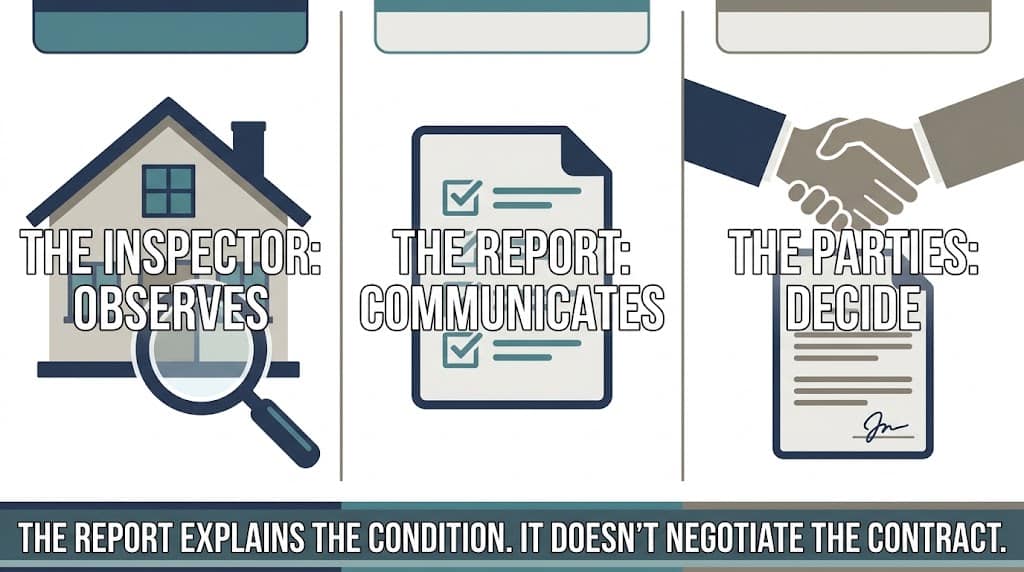
Here’s the distinction:
- The inspector observes and documents conditions within scope.
- The inspection report communicates those observations.
- The parties to the transaction decide how to respond, based on their agreement and professional advice.
An inspector may recommend repair or further evaluation. However, that doesn’t mean the inspector decides who pays. In other words, an inspector stays in their lane here. Inspection expertise, yes. Contract negotiation, no.
Inspector Hindsight: “The report explains the condition. It doesn’t negotiate the contract.”
Does the Seller Have to Fix Everything in the Inspection Report?
No. No general rule says the seller must repair every item in an inspection report. Instead, what happens next depends on the transaction and the parties’ decisions.
Also, reports contain different kinds of observations. For example, some involve maintenance, monitoring, repair, general information, or further evaluation. So not every observation carries the same weight.
In short, a home inspection report is an inspection document, not a seller’s mandatory repair list. What the buyer and seller do with it is a separate question.
What If the Seller Already Had the Home Inspected?
A seller-provided report can be useful. However, buyers should decide with their own advisers whether they want an inspection performed for them. For example, consider:
- When was the previous inspection performed?
- What was its scope, and who was the client?
- Have conditions changed since then?
- Were repairs made afterward?
- Do you have questions the report doesn’t answer?
- Do you want an inspector working directly for you under your own agreement?
After all, a house isn’t frozen in time. Repairs happen, weather happens, and systems age.
Inspector Hindsight: “A previous report tells you what was observed then. Your decision is happening now.”
What Is a Pre-Listing or Seller Inspection?
A pre-listing or seller inspection is arranged by the owner before or during the sale to better understand the property’s condition.
Its purpose differs from a buyer’s inspection. For example, a seller may want information about visible conditions before listing or before a buyer’s inspection.
However, buyers shouldn’t assume a seller inspection replaces their own due diligence. If you’re a seller, see our guide on how to prepare for a home inspection.
Can a Buyer Ask the Seller to Pay for the Inspection?
A buyer can discuss transaction expenses with the right professionals. However, whether a seller can or will pay depends on the contract, negotiations, and circumstances.
That’s intentionally a careful answer. After all, contracts and financing can include details that don’t generalize well.
So if you’re considering a particular payment arrangement, talk with the professional advising you. The inspection company can explain its service. Meanwhile, your transaction professionals can explain what the transaction allows.
Should You Skip the Inspection to Reduce Home-Buying Expenses?
That’s ultimately your decision. However, understand what information you may give up before deciding not to inspect.
A walkthrough and a professional inspection aren’t the same. During a showing, buyers naturally notice floor plans, countertops, paint, bedrooms, storage, natural light, and backyards.
In contrast, an inspector looks at accessible components involving:
- Roofing and exterior conditions
- Structure
- Electrical and plumbing systems
- Heating and cooling equipment
- Attic areas
- Interior components, windows, and doors
Inspector Hindsight: “The question isn’t whether the house looks good. It’s whether you understand what you’re buying.”
Do New Homes Change Who Pays for the Inspection?
No. A newly built home doesn’t automatically change who orders and pays for an independent inspection. After all, new construction is still construction.
So don’t assume every visible component in a new home is perfect. If you order an independent inspection, confirm payment and scheduling as part of that process.
Also, verify any builder-specific requirements, access procedures, or timing for the actual property. In short, don’t assume. Ask.
What Should First-Time Buyers Know About Paying for an Inspection?
Treat the home inspection as its own professional service. So understand the agreement, scope, timing, and payment arrangements before inspection day.
A home purchase already has many moving pieces. For example, there are loan documents, insurance, the appraisal, title, the inspection, closing, and approximately 4,000 emails.
Captain Obvious: “There appears to be paperwork.”
Inspector Hindsight: “A historic amount of paperwork.”
The easiest way to reduce confusion is to separate the services. The lender, title company, real estate professional, and home inspector each have a distinct role. Understanding those roles makes the process easier.

Is a Home Inspection the Same as an Appraisal?
No. They serve different purposes. A home inspection focuses on observable property conditions within scope. In contrast, an appraisal relates to property valuation and the lending process.
That creates another payment lesson: paying for one property service doesn’t mean it includes another. They involve different professionals, purposes, and processes.
For a deeper comparison, see our guide on home inspection vs. appraisal.
What Should Buyers Confirm Before Scheduling a Home Inspection?
Before scheduling, confirm the property details, inspection scope, access, timeline, and any additional services. This checklist can help:
- ☐ Confirm the property address
- ☐ Understand your transaction timeline
- ☐ Choose the inspection company
- ☐ Review the inspection agreement
- ☐ Understand the inspection scope
- ☐ Ask about anything unclear
- ☐ Discuss any property-specific concerns
- ☐ Verify access arrangements
- ☐ Confirm any additional services needed and available
- ☐ Understand payment arrangements directly with the inspection company
- ☐ Plan time to review the findings and report
Notice what isn’t on the list: “Find the cheapest way to get someone through the house.” After all, the inspection is an information-gathering step, so treat it that way.
What Should Sellers Understand About the Buyer’s Inspection?
A buyer’s inspection helps the buyer learn about the property. It isn’t meant to produce a perfect-house certificate.
An inspector documents conditions, because that’s the job. However, findings don’t automatically mean the house is terrible or the seller did something wrong. Nor do they mean every condition needs immediate repair, the buyer will cancel, or catastrophe is coming.
After all, homes have conditions, and inspection provides information about them. So keeping the focus on the property, rather than assigning blame, is better for everyone. The house is the subject, not the seller.
Who Pays for the Home Inspection, Buyer or Seller? The Simple Answer
The buyer commonly pays for the home inspection they order. However, the exact arrangement can depend on the transaction, contract, and negotiations.
- Commonly: The buyer orders an inspection for their own information and pays for that service.
- Possibly: A seller may order their own inspection, or another arrangement may exist.
- Always: Confirm the actual terms of your inspection and transaction instead of assuming.
Who pays is important. Still, what you learn from the inspection is the bigger point.
Inspector Hindsight: “The best time to discover a problem is before you own it.”
Captain Obvious: “And preferably after we figured out who scheduled the inspector.”
Fair enough.
Who Pays for Home Inspection: Buyer or Seller FAQs
Who pays for the home inspection, buyer or seller?
The buyer commonly pays for an inspection they order. However, contracts and negotiated arrangements can affect a specific transaction.
Who pays for a home inspection, the buyer or seller?
In many transactions, the buyer hires and pays the inspector. Sellers may also order their own inspections, and other arrangements can occur.
Can a seller pay for the buyer’s home inspection?
Arrangements vary by transaction. So confirm any proposed arrangement with the professionals involved.
Who chooses the home inspector?
Generally, the party hiring the inspector selects the company, subject to the transaction’s agreements.
Does the seller have to fix everything the home inspector finds?
No. No general rule makes every finding a seller obligation. The inspector documents conditions, and the parties decide how to respond.
Who pays for repairs after the home inspection?
The inspection doesn’t decide that. Repair responsibilities depend on the transaction, contract, and the parties’ decisions.
What if the seller already has an inspection report?
It may be useful. Still, buyers should decide with their advisers whether they want their own inspection based on the current property.
Does paying for a home inspection guarantee there are no problems?
No. An inspection evaluates visible and accessible conditions within scope. It can’t guarantee a problem-free home or find every concealed condition.
Is a home inspection included with an appraisal?
No. They are separate services with different purposes.
When should I schedule my home inspection?
It depends on your transaction and contractual deadlines. So confirm your timeline with your transaction professional.
Can a seller order an inspection before listing?
Yes. Sellers may arrange an inspection to better understand the property before or during the selling process.
Schedule Your RedFish Inspection
Buying a home? Understand the property before it becomes yours.
Schedule your RedFish inspection.
RedFish Inspections
Inspecting To A Higher Standard.
Call (866) 218-6699
