

A thermal imaging inspection can produce impressive pictures. You see bright reds, deep blues, and sharp color differences. Suddenly, an ordinary wall looks like it belongs in a science-fiction movie.
That creates an understandable assumption: if the camera can see that, it must be seeing through the wall. However, it isn’t.
Thermal imaging is useful because it shows surface-temperature patterns. So it can help an inspector notice that an area looks different and ask why. That question is where the real inspection begins.
What Does a Thermal Imaging Inspection Show?
Thermal imaging shows differences in surface temperature. Those patterns may help an inspector identify areas worth a closer look, such as ceilings, walls, HVAC systems, electrical components, insulation, or plumbing.
However, a thermal camera doesn’t directly identify moisture, mold, leaks, or hidden damage. It shows temperature. Meanwhile, the inspector provides the interpretation.
Captain Obvious: “So it’s heat vision.”
Inspector Hindsight: “Temperature imaging.”
Captain Obvious: “Heat vision sounded better.”
Inspector Hindsight: “And less accurate.”
How Does Thermal Imaging Work?
A thermal camera detects infrared energy associated with surface temperature. Then it converts that information into a visual image, with colors or shades representing different temperatures.
The key word is temperature. In other words, a thermal image doesn’t tell you what caused a temperature difference. Possible explanations include:
- Moisture-related cooling or heating effects
- Air movement
- Sun exposure
- HVAC operation
- Insulation conditions
- Electrical loading
- Material differences
- Plumbing
- Outdoor temperature
Captain Obvious: “Blue spot.”
Inspector Hindsight: “Cooler surface.”
Captain Obvious: “Leak.”
Inspector Hindsight: “You skipped the investigation.”
Is a Thermal Imaging Inspection the Same as X-Ray Vision?
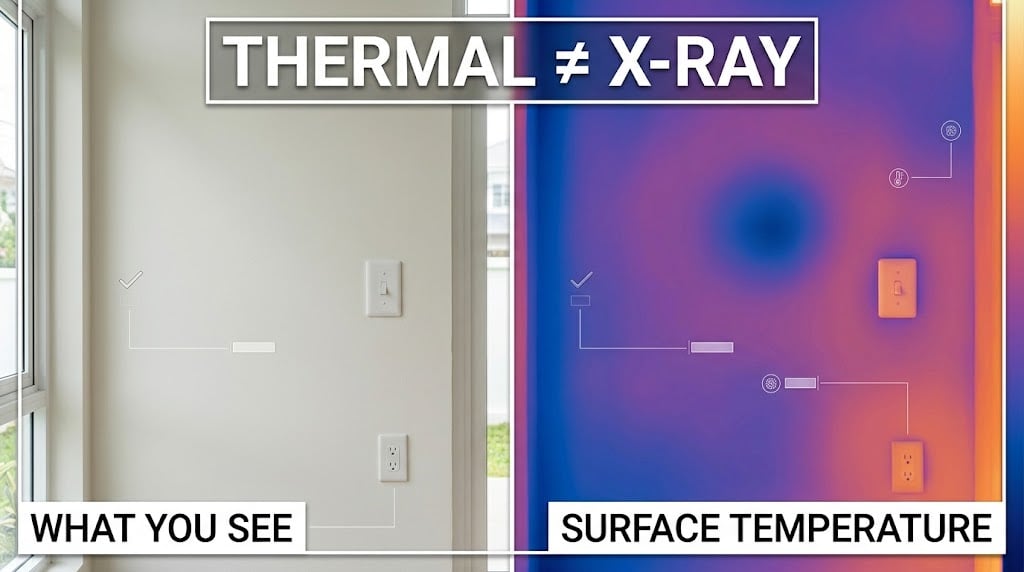
No. Thermal imaging doesn’t see through walls. Instead, it records surface-temperature patterns.
So a thermal camera can’t directly show a pipe inside a wall, mold behind drywall, termites inside framing, a broken wire behind a finished surface, or a roof leak traveling through hidden construction.
Rather, it may show a surface pattern suggesting an area deserves further attention.
Inspector Hindsight: “Thermal imaging helps you know where to ask another question.”
Can a Thermal Imaging Inspection Find Moisture?
Not directly. Moisture can sometimes affect surface temperatures, because evaporation, saturation, or air movement changes heat transfer. As a result, it can create a thermal anomaly.
However, a cool or warm area isn’t automatically wet. So an inspector may combine the thermal pattern with:
- Visual staining and material condition
- Moisture-meter readings, when appropriate
- Plumbing observations
- Roof or exterior conditions
- Weather history
- Other inspection evidence
In other words, a thermal pattern isn’t a moisture diagnosis. For more on moisture under the home, see crawl space moisture and what inspectors look for.
Can a Thermal Imaging Inspection Find a Roof Leak?
Not directly. A thermal image may show temperature differences on a ceiling or wall that justify closer evaluation.
However, the camera doesn’t identify where water entered, whether a roof leak exists, whether it’s active, how long it’s been happening, or what repair is needed.
So if a suspicious pattern appears, the inspector still looks at ceiling staining, attic conditions, the roof covering, flashing, and penetrations. Insulation, moisture readings, and recent weather matter too.
What Do Water Stains on a Ceiling Mean?
A water stain on a ceiling is evidence that needs context. However, it doesn’t automatically mean the roof is leaking now.
For example, possible sources include:
- Roof-related water intrusion
- Plumbing above
- HVAC condensate
- Previous water damage
- Condensation
- Another moisture source
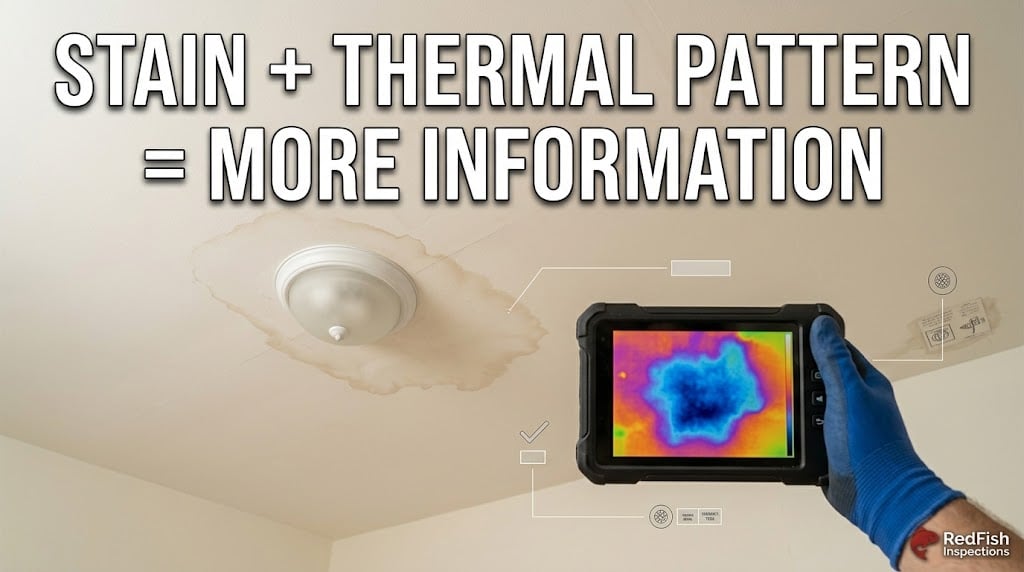
So an inspector may compare the visible stain with thermal patterns and other observations.
Captain Obvious: “Ceiling stain. Roof leak.”
Inspector Hindsight: “Ceiling stain.”
Captain Obvious: “We’ve done this before.”
Inspector Hindsight: “And somehow evidence still matters.”
Can Thermal Imaging Tell If a Ceiling Stain Is Active?
Not by itself. A temperature difference may suggest current conditions worth investigating. However, activity shouldn’t be judged from thermal appearance alone.
Instead, an inspector may consider the thermal pattern, moisture readings, recent rainfall, and plumbing or HVAC operation. Attic evidence, material condition, and property history also help.
In short, a thermal image can strengthen the investigation. It doesn’t replace it.
Can a Thermal Imaging Inspection Find Mold?
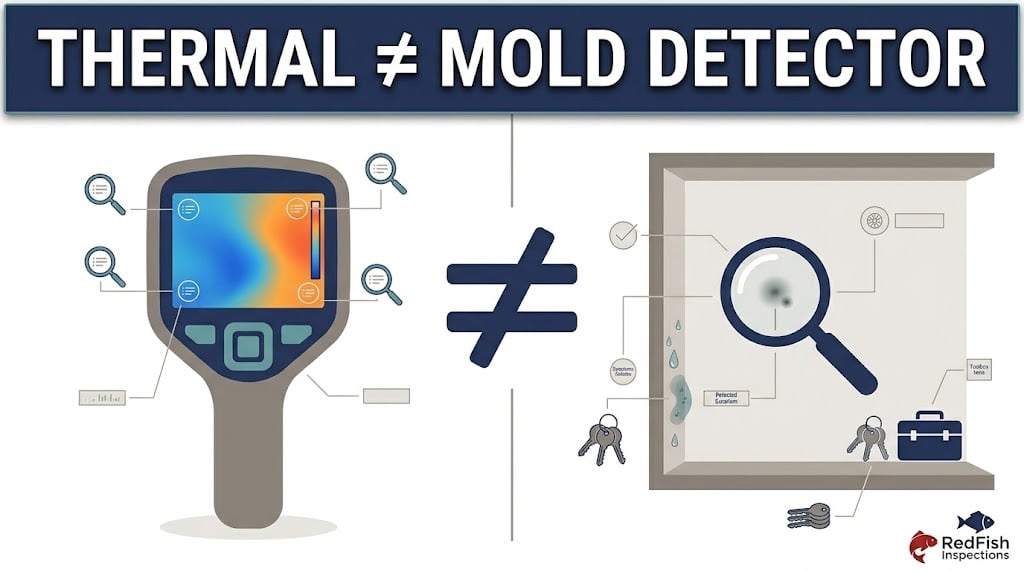
No. Thermal imaging doesn’t identify mold. So it can’t determine whether visible material is mold, what species is present, whether hidden mold exists, or whether something is a health hazard.
A temperature pattern may point to an area where moisture investigation makes sense. However, temperature and mold identification are different questions. For more, see our guide on black spots on your walls.
Captain Obvious: “So no mold detector.”
Inspector Hindsight: “No.”
Captain Obvious: “Moisture detector?”
Inspector Hindsight: “Also no.”
Captain Obvious: “Temperature patterns.”
Inspector Hindsight: “Now you’re getting it.”
Can Thermal Imaging Find Missing Insulation?
Under the right conditions, thermal patterns may suggest insulation or air-leakage differences. However, a temperature difference alone doesn’t prove that insulation is missing or damaged. Nor does it reveal a void’s exact size, the insulation type, or the repair needed.
After all, environmental conditions affect what the camera shows. For example, indoor-outdoor temperature differences, sun, wind, HVAC operation, material type, and time of day all influence the image.
Why Does Weather Matter for Thermal Imaging?
Thermal imaging is influenced by the environment. For example, a wall heated by afternoon sun may look warmer than another wall. Similarly, a recently shaded roof area may look different from one in direct sun.
Outdoor temperature also affects how much contrast appears between surfaces. So thermal imaging shouldn’t be read as though the building were in a laboratory. Context matters.
Inspector Hindsight: “The camera sees temperature. The inspector has to understand why the temperature may be different.”
Can Thermal Imaging Find Air Leaks?
Sometimes, thermal patterns suggest areas where air movement or insulation deserves a closer look. However, the camera doesn’t photograph moving air.
Instead, the inspector looks for surface patterns consistent with heat transfer or air leakage. So a blue line doesn’t automatically mean an air leak. Rather, it means this pattern deserves closer evaluation.
Can Thermal Imaging Help With HVAC Inspection?
It may add information about temperature patterns from accessible HVAC operation. For example, an inspector might compare supply and return areas, duct surfaces, registers, equipment, and nearby materials.
However, a thermal camera isn’t a complete HVAC diagnostic tool. It doesn’t replace system testing, pressure measurements, electrical testing, refrigerant evaluation, or qualified HVAC service.
Can Thermal Imaging Find a Duct Leak?
A temperature pattern near accessible ductwork may justify further investigation. However, a thermal image alone doesn’t prove the duct is leaking.
So the inspector considers duct condition, connections, insulation, airflow, temperature patterns, and location. The same rule applies: pattern first, conclusion only when supported.
Can a Thermal Imaging Inspection Find Electrical Problems?
It may reveal unusual temperature patterns at accessible electrical equipment under certain conditions. A warm component may deserve attention.
However, warm doesn’t automatically mean defective. Electrical load, equipment design, ambient conditions, and connections all affect temperature. So the actual condition may need evaluation by a qualified electrician. For more context, see electrical defects home inspectors flag.
Safety note: Homeowners should never open energized electrical panels or remove electrical covers to do their own thermal inspection.
Does a Hot Breaker Mean It Is Bad?
Not automatically. Electrical components can run at different temperatures depending on load and conditions.
An unusual pattern may justify investigation. So the inspector may consider relative temperatures, circuit loading where known, visible condition, signs of overheating, and connections where safely visible.
However, thermal imaging alone doesn’t determine whether a breaker needs replacement.
Can Thermal Imaging Find Plumbing Leaks?
Sometimes, thermal patterns point to areas worth investigating when a leak changes the temperature of a visible surface. For example, water from a concealed leak may affect nearby materials.
However, the camera doesn’t photograph the pipe behind the wall. So supporting evidence may include staining, moisture readings, fixture operation, water meter observations, and accessible plumbing.
Can Thermal Imaging See Water Inside a Wall?
No. A thermal camera sees the temperature of the wall’s surface. If hidden moisture affects that surface temperature, an anomaly may appear. However, that’s different from seeing the water itself.
Captain Obvious: “So we’re not seeing through the drywall.”
Inspector Hindsight: “No.”
Captain Obvious: “We’re seeing the drywall temperature.”
Inspector Hindsight: “Exactly.”
Captain Obvious: “Less superhero. More science.”
Inspector Hindsight: “Usually a good trade.”
What Does a Thermal Anomaly Mean?
A thermal anomaly simply means an area looks thermally different from its surroundings. It’s not a diagnosis.
Still, an anomaly may deserve investigation because of its location, shape, or temperature relationship. In addition, any associated visible condition, connection to building systems, and environmental context all matter.
Inspector Hindsight: “Different is useful. Different is not automatically defective.”
Can a Thermal Imaging Inspection Find Hidden Damage?
It may provide clues that lead toward conditions that aren’t immediately obvious. However, it can’t guarantee finding hidden damage.
After all, it can’t see behind every surface. It can also miss conditions that don’t create a meaningful temperature difference at the time. In addition, environmental conditions can hide or create patterns. So no responsible inspection should promise thermal imaging finds everything behind the walls.
Can Thermal Imaging Find Termites?
No. A thermal pattern can’t establish insect species, activity, damage extent, or treatment needs.
So if insect-related evidence is suspected, a specialized wood-destroying insect (WDI) evaluation may be appropriate.
Can Thermal Imaging Find Foundation Problems?
No. Thermal imaging doesn’t diagnose foundation movement or structural failure.
Instead, structural questions require structural evidence, such as cracking, displacement, floor conditions, door and window alignment, and foundation observations. In short, a thermal image can’t support a structural diagnosis that the structural evidence doesn’t.
Can a Thermal Image Tell How Old a Leak Is?
No. A thermal image reflects surface temperatures at the moment it’s taken. So it can’t determine a leak’s age, how often it happened, when water first entered, or whether it will recur.
Instead, history comes from previous photos, repair records, seller information, and previous reports.
What If the Thermal Image Looks Normal?
A normal-looking image doesn’t guarantee there are no hidden defects. For example, a condition may:
- Not be active at the time
- Not create enough temperature difference
- Be too deep within the assembly
- Be masked by environmental conditions
- Exist outside the scanned area
- Be hidden by materials that don’t show a useful pattern
In other words, no thermal anomaly doesn’t mean no hidden condition.
Why Does Inspector Experience Matter?
Because the camera is a tool. It produces data, and the inspector decides what that data means in context.
For example, two walls can have different temperatures for completely normal reasons. A ceiling pattern might come from insulation, sun, airflow, moisture, HVAC, or material differences. The camera doesn’t know which is correct. So the inspector has to investigate.
Captain Obvious: “So the expensive camera doesn’t replace the inspector.”
Inspector Hindsight: “Correct.”
Captain Obvious: “Good for job security.”
Inspector Hindsight: “Good for accuracy.”
Is Thermal Imaging Better Than a Moisture Meter?
They answer different questions. A thermal camera shows surface temperatures across a wider area. Meanwhile, a moisture meter gives localized information about certain materials when used appropriately.
So one doesn’t replace the other. The right tool depends on what was observed, the material, the question, the access, and the inspection scope.
Can Thermal Imaging Prove a Wall Is Dry?
No. A uniform pattern simply means the scanned surface didn’t show a meaningful temperature difference under those conditions.
That’s useful information. However, it isn’t a moisture guarantee.
Can Thermal Imaging Be Used Outside?
Yes. However, exterior imaging is strongly influenced by sun, shade, wind, rain, surface materials, time of day, and outdoor temperature.
As a result, exterior images can be harder to interpret. Again, context matters.
Can a Thermal Camera Find a Roof Problem From Outside?
Under the right conditions, roof surface patterns may provide some information. However, the image doesn’t automatically identify a roof leak, wet insulation, damaged decking, a defective shingle, or the exact repair.
So roof evaluation still requires the broader inspection evidence.
Why Does the Inspector Take Normal Photos Too?
Because the two images answer different questions. A normal photo shows what an area looks like. Meanwhile, a thermal image shows surface-temperature differences.
Together, they document location, visible condition, thermal pattern, and context. In other words, they complement each other.
What Should a Buyer Ask About a Thermal Imaging Inspection?
Useful questions include:
- Was thermal imaging used?
- Is it included or supplemental?
- Which areas were scanned?
- What conditions limited imaging?
- Were anomalies observed, and how were they investigated?
- Was another tool used?
- Was a visible condition associated with the pattern?
- What remains uncertain?
- Is further evaluation recommended?
After all, the useful question isn’t “Did the camera find anything?” Rather, it’s “What did the thermal information add to the inspection?”
What Should a Homeowner Do With a Thermal Image?
Don’t interpret the colors by themselves. Instead, ask:
- What is this image showing?
- Which temperatures are being compared?
- Why is this area different?
- What visible evidence supports the interpretation?
- Was another inspection method used?
- Does the condition need further evaluation?
In fact, a thermal screenshot without context can create more confusion than clarity.
Do Thermal Colors Have Universal Meanings?
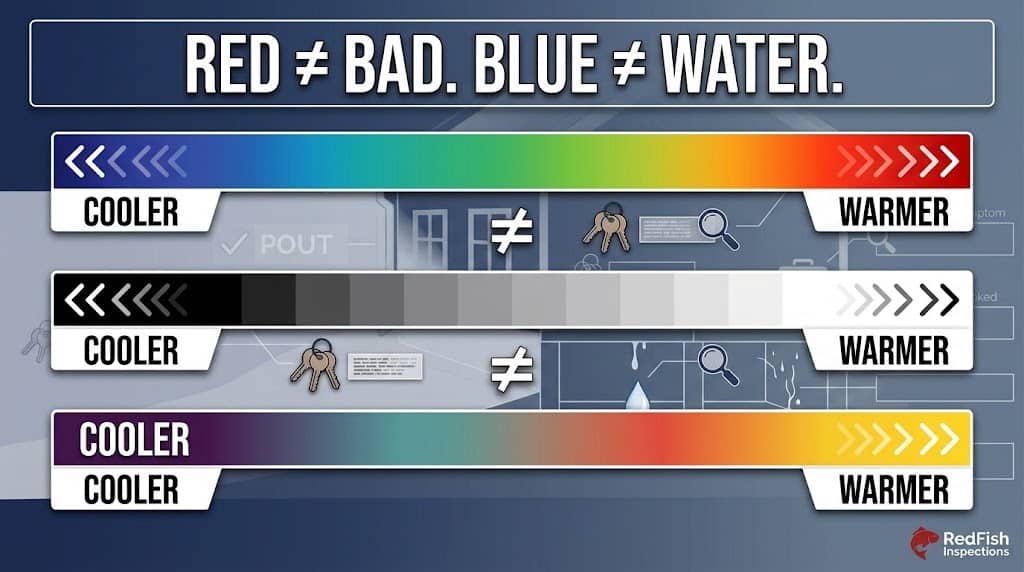
No. Red doesn’t always mean a hot problem, and blue doesn’t always mean water. Thermal palettes can be adjusted, and different cameras display temperatures differently.
So the useful information is the thermal relationship and context, not whether part of the picture looks dramatic.
Captain Obvious: “Red equals dangerous.”
Inspector Hindsight: “No.”
Captain Obvious: “Blue equals leak.”
Inspector Hindsight: “No.”
Captain Obvious: “Colors equal temperatures.”
Inspector Hindsight: “Much better.”
The Inspector’s Eye: A Ceiling Stain
Imagine an inspector sees a stain on a ceiling. Captain Obvious sees a roof leak.
Meanwhile, Inspector Hindsight asks more questions:
- What’s above this area: attic, bathroom, HVAC, plumbing, or roof?
- Does the stain look old or recently changed?
- What does the attic show?
- Has it rained recently?
- Does the thermal image show an anomaly?
- Does a moisture reading add information?
- What does the surrounding material show?
The thermal camera is useful because it may add one more layer of evidence. However, it doesn’t get to skip the rest of the investigation.
Captain Obvious: “So ceiling stain plus blue thermal spot equals leak?”
Inspector Hindsight: “Ceiling stain plus thermal anomaly equals more information.”
Captain Obvious: “And then?”
Inspector Hindsight: “We investigate.”
Captain Obvious: “It was obvious.”
Inspector Hindsight: “Until it wasn’t.”
Thermal Imaging Inspection: The Simple Answer
A thermal imaging inspection can be valuable because it reveals surface-temperature patterns your eyes may miss. As a result, it can direct attention toward moisture-related conditions, HVAC operation, insulation differences, air movement, electrical temperature patterns, and plumbing.
However, remember:
- Thermal imaging doesn’t see through walls.
- It doesn’t identify mold.
- It doesn’t directly identify moisture.
- It doesn’t prove a leak.
- It doesn’t diagnose foundation failure.
- A temperature anomaly isn’t automatically a defect.
- A normal image doesn’t guarantee there’s no hidden condition.
In short, the camera gives you another way to see the building. The inspector still has to understand what the image means.
For related reading, see our guides on why your house smells musty and humidity and moisture control in Texas homes.
Thermal Imaging Inspection FAQs
What does thermal imaging show in a home inspection?
It shows differences in surface temperature. Those patterns may help an inspector find areas that deserve further investigation.
Can thermal imaging find moisture?
Not directly. However, moisture can sometimes affect surface temperatures and create patterns worth investigating.
Can thermal imaging find mold?
No. It doesn’t identify mold or mold species.
Can a thermal camera see through walls?
No. It records surface-temperature patterns, not X-ray images.
Can thermal imaging find a roof leak?
It may show a pattern that supports further investigation. However, it can’t prove a roof leak on its own.
What does a water stain on a ceiling mean?
It indicates a moisture-related history or condition worth investigating. The source could be roofing, plumbing, HVAC condensate, condensation, or something else.
Can thermal imaging tell if a ceiling stain is active?
Not by itself. Thermal information should be weighed alongside other evidence.
Can thermal imaging find missing insulation?
Patterns may suggest insulation differences. However, the image alone doesn’t prove the exact condition.
Can thermal imaging find electrical problems?
It may reveal unusual temperature patterns at accessible equipment. Still, a qualified electrician may be needed to determine the cause.
Can thermal imaging find plumbing leaks?
A hidden leak may affect nearby surface temperatures. However, the camera can’t see the pipe itself.
Does red mean there’s a problem?
No. Colors represent temperature ranges based on camera settings, not defects.
Does blue mean water?
No. In many palettes, blue simply means a relatively cooler temperature.
Does a normal thermal image mean no hidden problems?
No. Conditions can exist without creating a detectable surface-temperature difference.
Is thermal imaging better than a moisture meter?
No. They provide different information, so one doesn’t replace the other.
Schedule Your RedFish Inspection
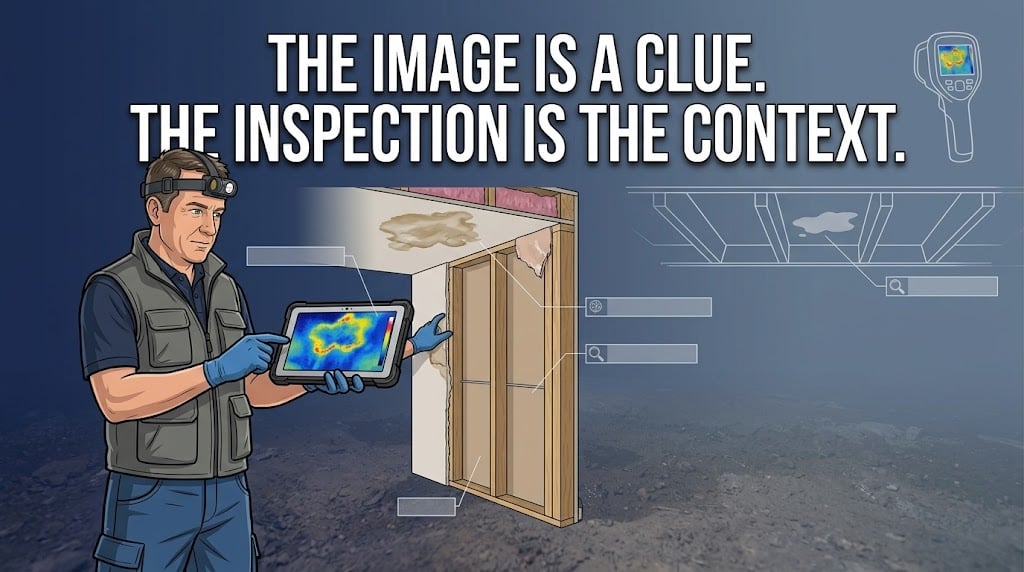
Thermal imaging can show you something your eyes may miss. However, the colorful picture isn’t the conclusion. It’s another clue, and the value comes from knowing what to investigate next.
Schedule your RedFish inspection.
RedFish Inspections
Inspecting To A Higher Standard.
Call (866) 218-6699
