

Captain Obvious: “The house is eleven months old.”
Inspector Hindsight: “Yes.”
Captain Obvious: “So we’re celebrating?”
Inspector Hindsight: “You can.”
Captain Obvious: “Cake?”
Inspector Hindsight: “After you find the warranty documents.”
Captain Obvious: “You really know how to ruin a party.”
Inspector Hindsight: “I prefer ‘improve the timing.'”
An 11-month warranty inspection makes the most of something you didn’t have on closing day: experience with the house.
By now, you’ve used the plumbing, run the HVAC, and operated the windows, doors, and appliances. You’ve also lived through rain and temperature changes. As a result, you may have noticed things that weren’t apparent when the house was first completed.
So if an applicable builder warranty is approaching a deadline, this can be an important time to look at the house again. For background on earlier stages, see our guide to new construction home inspections.
What Is an 11-Month Warranty Inspection?
An 11-month warranty inspection is a home inspection commonly scheduled near the end of the first year of ownership, when a homeowner has an applicable builder warranty or similar coverage.
It evaluates visible and accessible conditions within its scope. In addition, it gives you documentation that may help when reviewing the home before a warranty deadline.
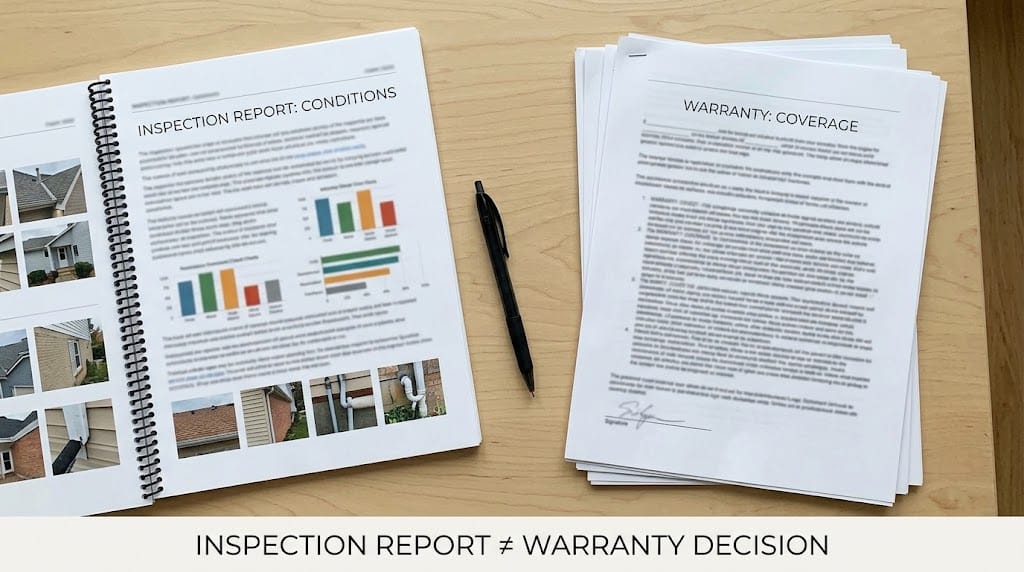
However, the inspection itself doesn’t determine whether an item is covered by the builder’s warranty.
Why Is It Called an 11-Month Warranty Inspection?
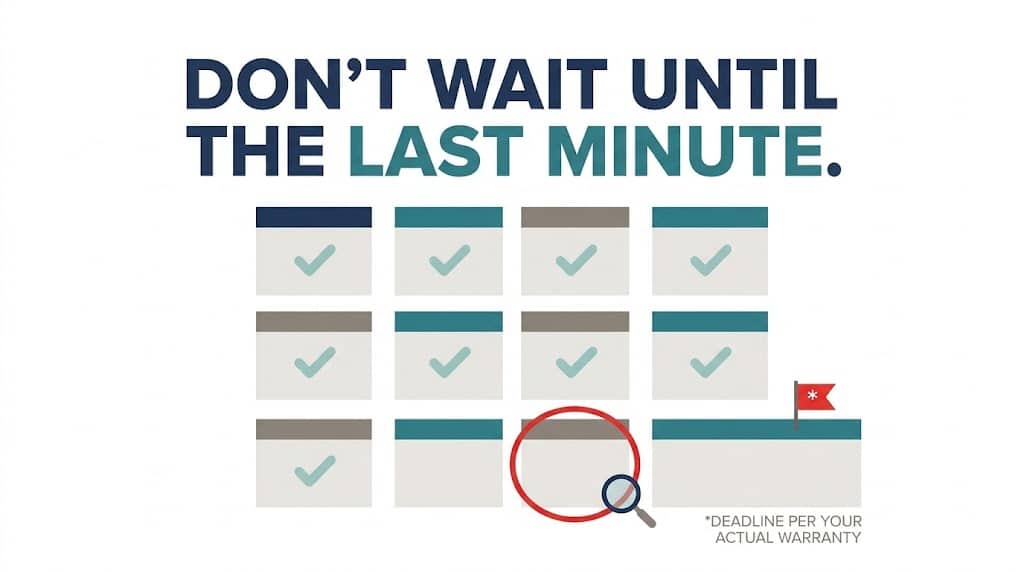
The term generally refers to scheduling an inspection before the end of an applicable first-year builder warranty period. The idea is simple: don’t wait until the last possible moment.
However, there’s an important distinction. “11 months” is a common inspection term. It isn’t a universal legal deadline for every new home. Warranty periods and procedures vary, and your actual documents control.
Do All New Homes Have a One-Year Builder Warranty?
Don’t assume so. Warranty terms can differ by builder, contract, property, component, coverage type, and jurisdiction.
So review the actual warranty documents for your home. In particular, look for:
- Coverage periods and exclusions
- Notice requirements and submission procedures
- Deadlines
- Required forms
- Contact information
Inspector Hindsight: “Don’t let a blog tell you what your contract says. Read your contract.”
Why Not Just Wait Until Exactly One Year?
Because waiting until the last moment can create unnecessary pressure. After all, you may need time to:
- Schedule an inspection
- Review the report and understand the findings
- Gather documentation
- Contact the appropriate party
- Follow the builder’s required procedure
- Meet an applicable deadline
The right timeline depends on your actual warranty.
Captain Obvious: “So eleven months isn’t magic.”
Inspector Hindsight: “No.”
Captain Obvious: “It’s planning.”
Inspector Hindsight: “Much less exciting. Much more useful.”
Why Inspect a Home That Was Already Inspected Before Closing?
Because the house isn’t in exactly the same condition anymore. Construction is complete, the home has been occupied, and systems have operated. Meanwhile, weather has occurred, materials may have changed, and some conditions may have become more visible.
So the two inspections answer different questions. Before closing, the question is: what condition does this new house present now? At 11 months, it’s: after months of use, what condition does the house present now?
Does an 11-Month Warranty Inspection Mean Something Is Wrong?
No. Scheduling an inspection doesn’t mean you expect defects. Rather, it means you want information.
A professional inspector shouldn’t assume the builder did something wrong. Instead, the goal is to evaluate the home as it exists.
Captain Obvious: “So we’re not hunting the builder.”
Inspector Hindsight: “We’re inspecting the house.”
Captain Obvious: “You say that a lot.”
Inspector Hindsight: “Because people keep trying to inspect motives.”
What Does an 11-Month Warranty Inspection Look At?
The exact scope depends on the inspection service. Generally, a residential inspection may evaluate visible and accessible conditions involving:
- Roofing and exterior components
- Structure and foundation
- Electrical and plumbing systems
- HVAC
- Interior components, windows, and doors
- Attic areas and visible insulation
- Appliances, where included
- Drainage
So confirm what’s included in the specific service you schedule.
What Should Homeowners Pay Attention To During the First Year?
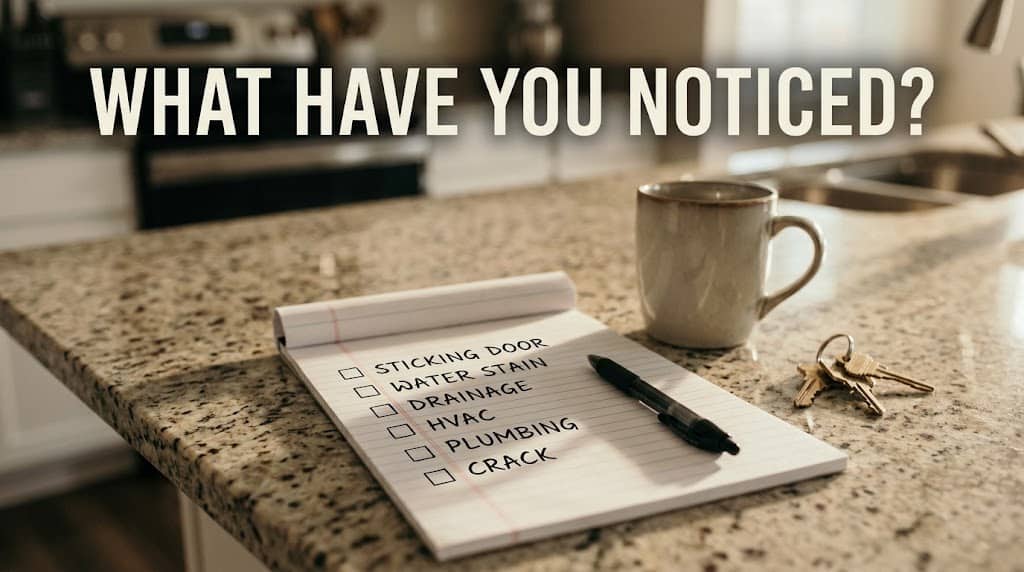
You live with the house every day, so your experience provides useful context. For example, watch for:
- Doors that become difficult to operate
- Windows that change in operation
- Recurring plumbing issues
- Water staining
- Unusual HVAC performance
- Recurring electrical issues
- Visible cracking
- Drainage concerns
- Roof, exterior, or moisture observations
- Appliance issues
However, not every change is a warranty defect. Rather, each observation can be documented and investigated.
What About Cracks That Appear During the First Year?
A crack is an observation. Its significance depends on location, pattern, direction, width, displacement, surrounding conditions, related observations, and history.
So a drywall crack doesn’t automatically mean structural movement. Likewise, a foundation crack doesn’t automatically mean foundation failure. Also, the inspector shouldn’t decide warranty coverage from a crack alone. For more on crack context, see slab foundation movement: settling vs. heave.
Inspector Hindsight: “Document the crack. Then understand the context.”
What About Doors That Start Sticking?
A sticking door deserves context. For example, causes may include door adjustment, humidity-related material changes, installation, frame movement, floor conditions, or structural movement.
However, one sticking door doesn’t automatically diagnose a foundation problem.
Captain Obvious: “Door sticks. Foundation.”
Inspector Hindsight: “Door sticks.”
Captain Obvious: “You’ve taken all the drama out of homeownership.”
Inspector Hindsight: “That’s not necessarily a bad thing.”
What About Windows?
Windows can be evaluated for operation, visible damage, hardware, accessible seals, water staining, and visible exterior relationships.
A window that’s hard to operate deserves documentation. However, the cause shouldn’t be guessed without supporting evidence.
What About Plumbing After Months of Use?
Months of normal use give plumbing conditions time to become apparent. So an inspection may identify leaks, fixture operation, drainage, water staining, and accessible supply and drain components. Water-heating equipment is also evaluated.
Recurring symptoms are especially useful to share. For example, “this bathroom drain backs up every few weeks” gives far more context than “the drain worked today.”
What About HVAC?
By 11 months, your HVAC has likely run through different weather conditions. So observable conditions may involve system operation, temperatures, accessible equipment, condensate management, visible ducts, and registers.
However, a home inspection doesn’t guarantee future HVAC performance or predict equipment life.
What About Water Stains That Appear After Closing?
Document them. A water stain may be linked to roof-related water, plumbing, HVAC condensate, condensation, or another source.
However, the stain’s location doesn’t identify where the water started. So inspection reasoning asks:
- What’s above it, and what’s beside it?
- When did it appear?
- Does it change after rain?
- Does it change when the HVAC runs?
- Is plumbing nearby?
- What other evidence exists?
What About Roof Conditions?
The roof has likely been through weather since completion. So an inspector may evaluate accessible roof coverings, visible flashings, penetrations, drainage components, and attic evidence.
Still, the inspector reports the condition observed. It’s not about blaming the builder or predicting failure without evidence.
What About Drainage Around a New Home?
Drainage is easier to understand after real rainfall and irrigation. For example, you may notice water collecting, persistent wet spots, erosion, downspout discharge patterns, or water near the foundation.
Those observations add useful context. However, one wet yard doesn’t automatically mean a foundation problem or drainage failure.
What About the Attic?
Accessible attic areas can reveal roof-related conditions, framing, insulation, and ventilation. HVAC equipment or ducts, electrical components, and moisture-related observations may also be visible.
Still, access and visibility matter. An inspector can’t report on concealed or inaccessible areas as though they were fully observed.
Can Thermal Imaging Help During an 11-Month Warranty Inspection?
Thermal imaging may be useful when it’s part of the inspection process. However, it detects surface-temperature patterns. It doesn’t directly identify moisture, mold, leaks, missing insulation, electrical defects, or hidden damage.
So a thermal anomaly may guide further investigation, but it doesn’t determine warranty coverage. For more, see what thermal imaging reveals in a home inspection.
What If the Homeowner Already Has a List of Problems?
Bring it. Your experience provides useful information. So consider documenting:
- What happened, where, and when
- Whether it recurs
- What conditions seem related
- Whether repairs have been attempted
- Photos or videos, when appropriate
- Relevant builder communications
However, a homeowner observation and an inspector finding aren’t the same thing. Instead, they can support one another.
Should the Inspector Only Look at Items the Homeowner Noticed?
No. Your list provides context, but the inspection still follows its scope.
For example, you may notice a sticking door. Meanwhile, the inspector may find an unrelated plumbing, attic, or exterior condition, or nothing significant related to the door at all. In short, the inspection stays systematic.
Does the Inspector Decide Whether Something Is Covered by the Builder Warranty?
No, and this distinction is critical. The inspector reports observable conditions. Meanwhile, the warranty documents determine coverage under their terms.
An inspection report can provide useful documentation. However, the inspector shouldn’t promise that something is covered, that the builder has to fix it, that a claim will be approved, or that it’s legally the builder’s responsibility. Those are different questions.
Does the Inspection Force the Builder to Make Repairs?
No. An inspection report documents conditions within its scope. What happens next depends on warranty terms, contract terms, procedures, the builder’s response, and possibly other professional advice.
So no inspection can guarantee repair outcomes.
Is the Inspection Report a Warranty Claim?
Not necessarily. The report and the warranty-claim process are different things. For example, a builder may require specific forms, a portal, written notice, photos, or deadlines.
So follow the actual warranty procedure.
Captain Obvious: “So emailing the inspection report automatically files the claim?”
Inspector Hindsight: “Don’t assume that.”
Captain Obvious: “Read the warranty.”
Inspector Hindsight: “You’re learning.”
What Documents Should Homeowners Gather?
Before the inspection, consider locating:
- The builder warranty
- Closing documents
- Previous inspection reports
- Repair and builder service records
- Photos of recurring conditions
- Emails or other communications about previous work
- Manufacturer warranties, where relevant
These records help establish history. However, they don’t change what the inspector actually observes.
What If the Builder Already Repaired Something?
Previous repair is useful information. However, it doesn’t automatically mean the repair failed, the problem remains, the condition is fully resolved, or the builder did something wrong.
Instead, the inspector evaluates the current visible condition. Meanwhile, documentation helps explain what was done before.
What If Everything Looks Fine?
That’s useful information too. An inspection doesn’t need to find a dramatic problem to have value.
After all, the purpose isn’t to find something expensive. Rather, it’s to evaluate the property. A house doesn’t owe the inspector a defect.
Can an 11-Month Warranty Inspection Find Hidden Defects?
A visual inspection can’t guarantee finding concealed conditions. It evaluates visible and accessible areas within scope.
For example, conditions may exist behind walls, below flooring, inside cavities, under finishes, or in inaccessible attic areas. In short, eleven months of ownership doesn’t give the inspector X-ray vision.
Does an Inspection Guarantee Nothing Will Break After the Warranty?
No. An inspection describes observable conditions at the time of inspection. So it can’t guarantee future performance, remaining service life, or freedom from future leaks, movement, or electrical and HVAC problems.
After all, a home keeps changing after the inspection. For more on electrical conditions, see electrical defects home inspectors flag.
What Should Homeowners Do Before the Inspection?
- Find the warranty documents. Know the actual deadline and process.
- Make an observation list. Write down recurring or unusual conditions.
- Gather repair history. Include previous builder service, where available.
- Provide access. Make accessible areas reasonably available, where safe.
- Don’t hide conditions. Last-minute cosmetic work can remove useful context.
- Keep expectations realistic. The inspector evaluates the house but doesn’t administer the warranty.
For more on the process, see our guide on what to expect at your home inspection.
What Should Homeowners Do After the Inspection?
Review the report carefully. Then separate observed property conditions from warranty coverage questions.
Next, review your warranty documents and follow the required procedure within the required timeline. If a finding needs specialized evaluation, get the appropriate professional input. Similarly, if a warranty question needs legal interpretation, seek appropriate guidance.
Above all, don’t rely on assumptions about what “should” be covered.
What Are the Biggest 11-Month Warranty Inspection Mistakes?
- Assuming every warranty ends at exactly one year. Read the actual documents.
- Waiting until the last minute. Leave time for inspection, review, and required notice.
- Assuming every finding is a warranty item. Findings and coverage are different questions.
- Only reporting cosmetic items. The house contains systems beyond paint and trim.
- Assuming a previous repair is automatically bad. Evaluate the current condition.
- Expecting the inspector to force repairs. The inspector documents the property.
- Expecting the inspection to find everything. Visibility and scope still apply.
The Inspector’s Eye: “It’s Been Fine for Eleven Months”
Imagine a homeowner says, “We’ve lived here almost a year. Everything seems fine.” That’s good information.
However, Inspector Hindsight asks what “fine” means:
- Any recurring drain issues?
- Any water staining?
- Do doors change with the seasons?
- Do windows operate normally?
- Any breaker issues or unusual HVAC behavior?
- Any drainage observations after heavy rain?
- Any repairs already performed?
- Any cracks that changed?
- Any attic concerns?
- Any conditions you’ve simply gotten used to?
Captain Obvious: “Wait. You can get used to a problem?”
Inspector Hindsight: “People adapt surprisingly quickly.”
Captain Obvious: “So the weird door you’ve been lifting while turning the handle for eight months—”
Inspector Hindsight: “Is worth mentioning.”
Captain Obvious: “That feels personal. It was obvious.”
Inspector Hindsight: “Until it wasn’t.”
11-Month Warranty Inspection: The Simple Answer
An 11-month warranty inspection lets you evaluate a newer home after living in it, and before an applicable warranty milestone passes. It documents visible conditions, helps organize your questions, and gives you useful information before you contact a builder.
However, remember:
- 11 months isn’t a universal legal deadline.
- Not every home has the same warranty.
- Not every finding is a warranty item.
- The inspector doesn’t determine coverage or force repairs.
- The inspection doesn’t guarantee every condition will be found.
- The report doesn’t automatically file a warranty claim.
In short, start with the house. Then read the warranty. Then follow the actual process.
Inspector Hindsight: “The best time to discover a problem is before you own it. And if you already own it? Before an important deadline is a pretty good second choice.”
For related reading, see our guide on foundation cracks and what they mean in Texas.
11-Month Warranty Inspection FAQs
What is an 11-month warranty inspection?
It’s an inspection commonly scheduled near the end of a new home’s first year, when an applicable builder warranty may be approaching a deadline.
Why is it done at 11 months?
Scheduling before a deadline gives you time to inspect, review findings, and follow the required warranty procedure.
Does every builder warranty last one year?
Don’t assume so. Terms, coverage periods, procedures, and deadlines vary, so review your actual warranty documents.
What does an 11-month inspection include?
It depends on the service. Generally, a residential inspection evaluates visible and accessible systems and components within its scope.
Is an 11-month inspection only for cosmetic problems?
No. A home inspection looks at property systems and conditions, not just cosmetic completion items.
Does the inspector determine what the builder has to fix?
No. The inspector reports conditions. Coverage and builder obligations depend on your warranty documents and procedures.
Does the inspection report automatically file a warranty claim?
Don’t assume so. Follow the claim or notice procedure in your warranty documents.
What should I bring to an 11-month inspection?
Your builder warranty, previous inspection reports, repair records, photos, and a list of recurring conditions you’ve noticed.
What if the builder already repaired something?
Tell the inspector and share any documentation. A previous repair is context, not proof of current failure.
Can an 11-month inspection find hidden defects?
It can’t guarantee it. A home inspection evaluates visible and accessible components within scope.
Should I wait until the last day of my warranty?
That may leave little time to inspect, review findings, and follow the required procedure. So plan using your actual warranty documents.
Does a clean inspection mean nothing can go wrong later?
No. An inspection describes conditions at the time of inspection and doesn’t guarantee future performance.
Schedule Your RedFish Inspection
Your house has had almost a year to show you how it performs. So before an applicable warranty deadline approaches, it may be a good time to look at the property again.
Find your warranty documents. Know your deadline. Understand your house.
Schedule your RedFish inspection.
RedFish Inspections
Inspecting To A Higher Standard.
Call (866) 218-6699

