

Captain Obvious: “So it’s a home inspection… but bigger.”
Inspector Hindsight: “Not exactly.”
Captain Obvious: “Bigger roof.”
Inspector Hindsight: “Possibly.”
Captain Obvious: “Bigger electrical system.”
Inspector Hindsight: “Possibly.”
Captain Obvious: “Bigger problems?”
Inspector Hindsight: “Different property. Different systems. Different scope.”
That’s the better place to start. Many buyers search for a commercial building inspection checklist. However, a small retail building and a large warehouse are both commercial properties, and that doesn’t make them the same building.
Likewise, neither is necessarily comparable to an office, restaurant, medical office, industrial property, or mixed-use building.
So before asking what’s on the checklist, ask a better question: what property are we actually inspecting?
What Does a Commercial Property Inspection Include?
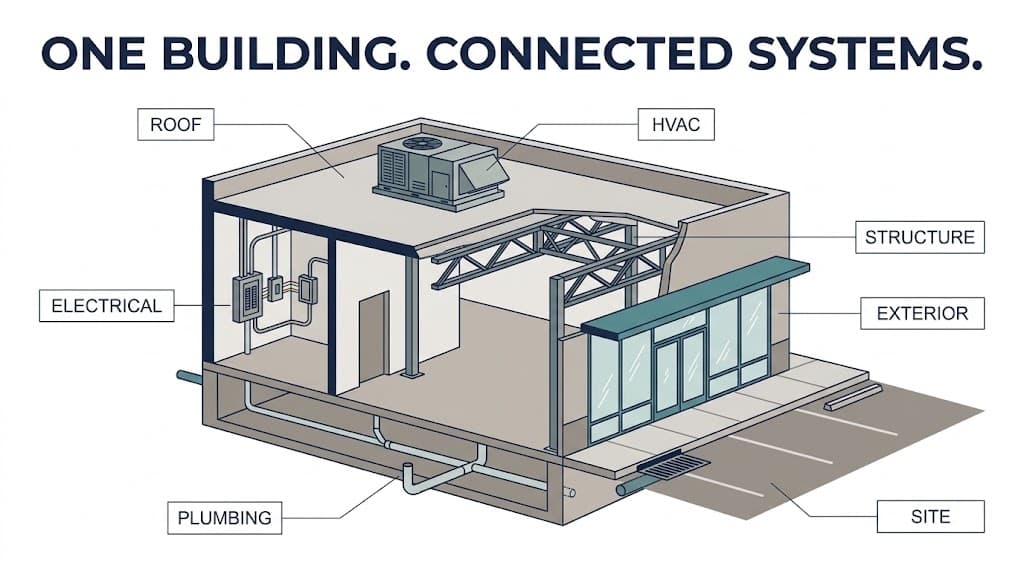
A commercial property inspection evaluates the building and site according to the agreed scope. Depending on the property, that may include visible conditions of the roof, exterior, structure, electrical, plumbing, HVAC, interiors, and site components.
The exact scope depends on the property and the inspection agreement. However, a commercial inspection doesn’t guarantee that every concealed condition, code issue, environmental condition, or future failure will be found.
What Is a Commercial Property Inspection?
It’s an evaluation of property conditions according to an agreed scope. The inspector observes accessible components and systems within that scope and documents relevant conditions.
The goal isn’t to predict every future expense, guarantee the building, or decide whether you should buy. Rather, it’s to provide useful information about observable conditions.
Inspector Hindsight: “Before you make assumptions about the building, understand the building.”
Why Are Commercial Inspections Different From Residential Inspections?
Commercial properties can contain systems that are uncommon in houses. For example:
- Larger electrical services
- Multiple HVAC units
- Flat or low-slope roofs
- Commercial kitchens
- Loading areas and large parking surfaces
- Fire-related systems
- Multiple tenant spaces
- Elevators or specialized equipment
- Roof-mounted equipment
- Different structural systems and occupancy uses
Not every commercial property has all of these. That’s exactly the point: the property determines the questions.
What Should Be on a Commercial Building Inspection Checklist?
There’s no universal checklist that guarantees the same inspection for every commercial property. However, depending on the property and agreed scope, planning may consider:
- Site and drainage
- Building exterior
- Roofing
- Structure
- Electrical, plumbing, and HVAC
- Interior areas, doors, and windows
- Accessible attic or roof spaces
- Parking and walking surfaces
- Other property-specific systems
In short, the key phrase is “depending on the property and agreed scope.”
What Does an Inspector Look For Around the Site?
The site provides important context for the building. For example, observable conditions may involve surface drainage, parking areas, walkways, and exterior stairs. Retaining components, vegetation, exterior lighting, and site structures also matter.
Throughout, the inspector documents the conditions observed rather than predicting future consequences.
Why Does Drainage Matter at a Commercial Property?
Water doesn’t care whether a property is residential or commercial. After all, roof runoff and surface water still have to go somewhere.
So an inspector may consider roof drainage, downspouts, scuppers, drains, grade, parking surfaces, low areas, building entrances, and foundation areas.
Captain Obvious: “Water again.”
Inspector Hindsight: “Gravity remains remarkably consistent.”
What Does a Commercial Exterior Inspection Look At?
Depending on construction and scope, an inspector may look at wall surfaces, cladding, masonry, sealants, windows, doors, and penetrations. Trim, flashings, exterior stairs, and railings are also included.
As a result, the report may document damage, deterioration, openings, staining, displacement, or incomplete components.
What Do Inspectors Look For on a Commercial Roof?
Commercial roofing varies widely. For example, a property may have low-slope, metal, or steep-slope roofing, or multiple roof sections with mechanical equipment.
When the roof is safely accessible and within scope, an inspector may evaluate covering materials, flashings, penetrations, drainage, and visible deterioration. Previous repairs and the relationships around roof-mounted equipment matter too.
Does a Ceiling Stain Mean the Roof Is Leaking?
Not automatically. A stain is evidence of a moisture-related condition or history, but the source may need further investigation. So useful questions include:
- Where is the stain, and what’s above it?
- Which roof components or mechanical equipment are nearby?
- Is plumbing nearby?
- Has it rained recently?
- Does the area appear active?
- Are there other moisture clues?
For more on reading these clues, see what thermal imaging reveals in a home inspection.
Inspector Hindsight: “Find the evidence before naming the source.”
What About Commercial HVAC Systems?
Commercial HVAC ranges from simple setups to multiple units serving different areas. Depending on scope and access, an inspection may consider equipment, operation, distribution components, condensate management, and visible damage or deterioration.
However, a general inspection isn’t a substitute for every specialized HVAC diagnostic procedure.
Can the Inspector Predict How Long the HVAC Will Last?
Not with certainty. Age and visible condition provide context. However, remaining life depends on equipment history, maintenance, usage, environment, installation, operating conditions, and repairs.
So an inspection shouldn’t become an unsupported countdown clock.
What Does a Commercial Electrical Inspection Look At?
Depending on scope, accessible observations may involve service equipment, panels, distribution components, visible wiring, receptacles, lighting, and disconnects.
Commercial electrical systems can also involve equipment that requires specialized expertise. So significant concerns may warrant a qualified professional. For more, see electrical defects inspectors flag.
Can a Commercial Inspector Guarantee the Electrical System Meets Code?
No. In fact, RedFish’s commercial inspection agreement specifically identifies building, municipal, and other code-compliance review as a limitation.
In other words, the inspector evaluates the property according to the inspection agreement. That’s different from certifying compliance with every code or ordinance.
What Does a Commercial Plumbing Inspection Look At?
Depending on property type and scope, accessible observations may involve supply and drainage components, fixtures, water-heating equipment, visible piping, leaks, and drainage performance.
However, some commercial properties have specialized plumbing systems outside a general scope. Again, the property determines the questions.
What About the Building Structure?
Visible structural components provide important information. Depending on construction, an inspector may observe foundation components, columns, beams, walls, and floor and roof structures. Connections, cracking, displacement, deterioration, and previous modifications also matter.
However, not every crack is a structural failure.
Do Cracks in a Commercial Building Mean Structural Failure?
No. Cracking deserves context. So an inspector may consider location, direction, pattern, displacement, surrounding materials, related conditions, and previous repairs.
Some conditions may warrant further structural evaluation. Still, the inspection identifies what the evidence supports without jumping ahead of it. The same evidence-first approach is explained in slab foundation movement: settling vs. heave.
What About the Building Interior?
Interior observations may include walls, ceilings, floors, doors, windows, stairs, railings, tenant spaces, and restrooms within scope.
However, commercial interiors often contain tenant improvements, specialized equipment, storage, or furnishings. As a result, visibility and access can be limited.
Why Does Access Matter?
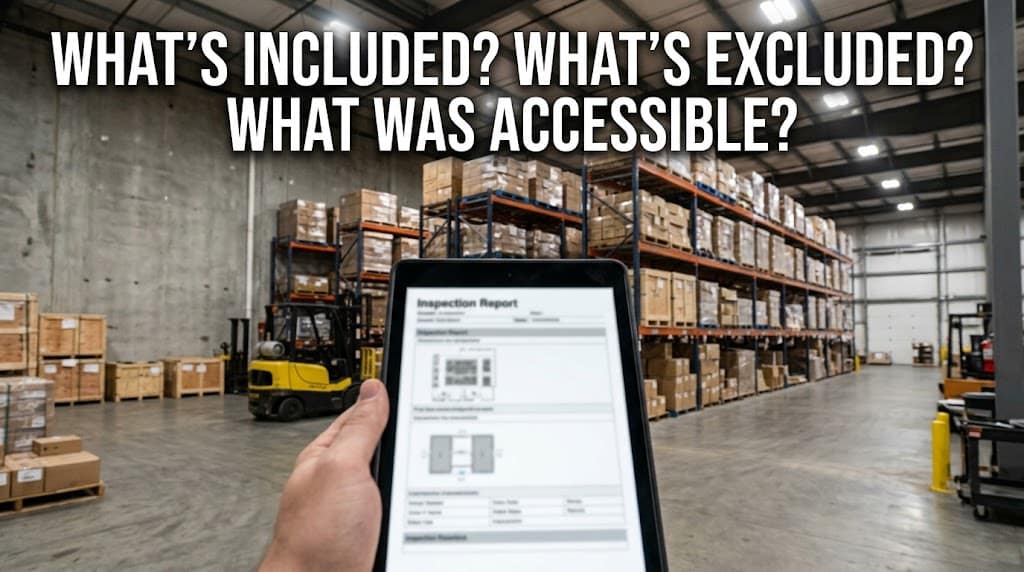
Because an inspector can’t evaluate what can’t reasonably be observed. For example, access may be limited by:
- Locked rooms or tenant spaces
- Stored inventory or equipment
- Ceiling construction
- Roof access
- Safety conditions or restricted areas
- Furniture or other obstructions
- Mechanical spaces
RedFish’s commercial agreement specifically recognizes these limitations, and it doesn’t require inspectors to dismantle equipment, items, or systems. For more on access limits, see crawl space moisture and what inspectors look for.
Captain Obvious: “So if there’s a machine in front of the wall—”
Inspector Hindsight: “We don’t dismantle the machine to inspect behind it.”
Captain Obvious: “Less dramatic than my plan.”
Inspector Hindsight: “Also substantially safer.”
Do Commercial Inspectors Open Walls?
No. A standard visual commercial inspection isn’t destructive investigation. RedFish’s commercial agreement sets limits on dismantling equipment and systems.
Similarly, concealed conditions can’t be reported as though they were visible. So if determining a condition’s extent requires invasive investigation, specialized evaluation may be appropriate.
Can an Inspection Find Every Hidden Problem?
No. Commercial buildings can hide conditions behind walls, ceilings, roof assemblies, flooring, equipment, stored materials, and finished surfaces.
An inspection provides valuable information. However, it can’t guarantee discovery of every concealed condition.
What Is a Property Condition Assessment?
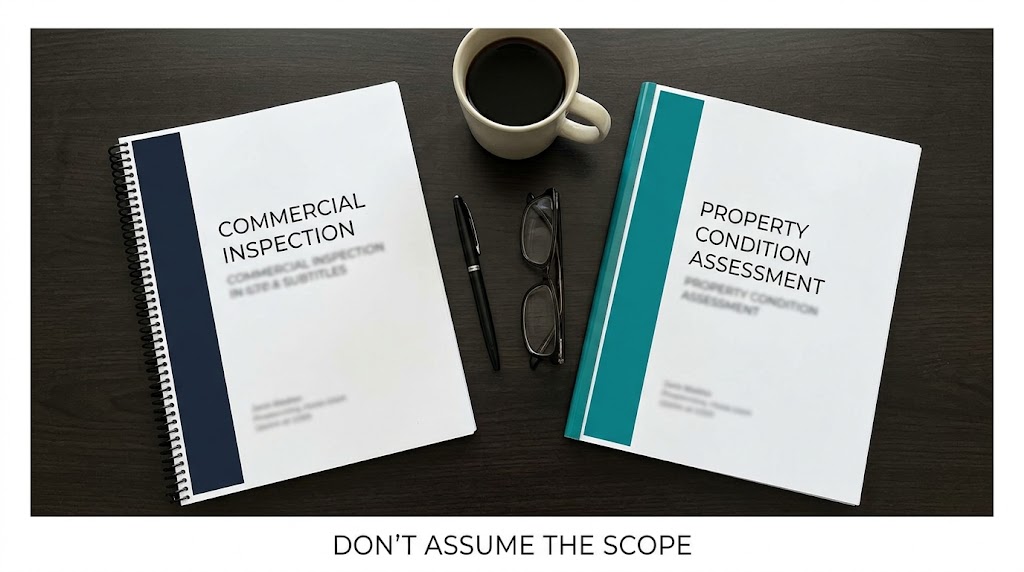
“Property condition assessment” is a common commercial real estate term. However, its exact meaning and scope shouldn’t be assumed from the name alone.
For example, different engagements may involve different standards, scopes, reporting requirements, client objectives, specialists, and documentation. So ask which service and standard apply to your engagement.
In practice, the key question is: what exactly are we hiring the inspector to evaluate?
Is a Property Condition Assessment the Same as a Commercial Inspection?
Don’t assume so. The terms can describe different scopes or standards, depending on the engagement. Instead, the written agreement defines the actual work.
This matters in commercial real estate. One client may need a general property inspection, while another transaction may require a more specifically defined assessment.
What About Environmental Concerns?
Environmental due diligence isn’t automatically part of a general commercial building inspection. In fact, RedFish’s commercial agreement lists environmental and health matters among the limitations of general inspection testing and sampling.
So a separate environmental assessment may be needed, with a very different purpose and scope.
Is a Phase I Environmental Site Assessment the Same as a Commercial Building Inspection?
No. A Phase I Environmental Site Assessment (ESA) is a separate service focused on environmental due diligence.
Meanwhile, a commercial building inspection focuses on the building and property conditions defined by its own scope. So the two serve different purposes.
Does a Commercial Inspection Test for Hazardous Materials?
Don’t assume so. RedFish’s commercial agreement limits testing and sampling for environmental and health-related conditions, unless they’re addressed through an appropriate separate service.
So depending on the property and transaction, environmental concerns may require specialized evaluation.
Does a Commercial Inspection Review Zoning?
No, not as part of the general inspection scope in RedFish’s commercial agreement. Zoning, municipal records, and permitting questions may require separate research or professional review.
In other words, a building inspection doesn’t establish that a use is legally permitted. Those are different questions.
Can the Inspector Tell Me Whether I Should Buy the Property?
No. The inspection provides information, and you make the investment decision.
After all, a commercial purchase involves much more than the inspection. For example, financing, lease structure, business plans, renovation plans, location, insurance, environmental due diligence, legal issues, operating expenses, and capital planning all play a role.
So the inspector’s role isn’t “buy” or “don’t buy.” Rather, it’s “here’s what we observed.”
Can the Inspector Tell Me What Every Repair Will Cost?
No. An inspection isn’t a repair estimate. Repair costs vary widely with scope, materials, access, contractor, design, location, damage extent, and permits.
Instead, the inspection focuses on property condition and appropriate next steps.
What Should a Commercial Buyer Provide Before the Inspection?
Useful information may include:
- Property address and type
- Building size, where known
- Occupancy and tenant access details
- Known access restrictions and roof-access information
- Maintenance records and previous inspection reports
- Known repair history
- Areas of particular concern
The better the property and objective are understood, the better the inspection can be planned.
What Records Can Help With Commercial Due Diligence?
Depending on the transaction, useful records may include previous inspection reports, roof records, and HVAC service records. Electrical and plumbing documentation, renovation and maintenance records, environmental reports, and available plans can also help.
Records provide context. However, they don’t replace current observation.
Should the Inspector Review Previous Repairs?
Previous repair information is useful, and an inspector may observe the current condition of a repaired area within scope.
However, a previous repair doesn’t automatically mean the problem still exists, the repair failed, the contractor did something wrong, or the condition is permanently solved. Instead, current evidence matters.
What If the Building Is Occupied?
Occupied buildings add practical considerations. For example, access may be affected by tenants, business operations, security, inventory, sensitive spaces, working equipment, customer areas, and restricted rooms.
So the inspection respects access requirements and avoids unnecessary disruption or unsafe conditions.
What If Specialized Equipment Is Present?
Commercial properties may contain equipment beyond a general inspection’s scope. For example, manufacturing, restaurant, medical, industrial, or communications systems may be present.
However, the presence of equipment doesn’t mean every internal component is evaluated. So specialist evaluation may be appropriate.
When Might a Specialist Be Needed?
Further evaluation may be appropriate for conditions needing expertise beyond the inspection scope. Depending on the finding, that might mean a qualified structural professional, electrician, plumber, HVAC professional, roofer, or environmental professional.
In short, the recommendation follows the observed condition, not a predetermined referral list.
What Should Commercial Buyers Ask the Inspector?
Good questions include:
- What’s included, and what’s excluded?
- Which areas were inaccessible?
- Which systems are present?
- Were all tenant spaces accessible?
- Was the roof accessible?
- Were major systems operating?
- Which conditions deserve further evaluation?
- What documentation would add context?
- Are specialist evaluations appropriate?
- What remains unknown?
After all, these questions are far more valuable than “Did the building pass?”
Do Commercial Buildings Pass or Fail an Inspection?
No. Buildings are more complicated than pass or fail. Instead, an inspection may identify conditions needing attention, maintenance items, limitations, areas for specialist evaluation, deterioration, and components operating as observed.
You then use that information as part of broader due diligence.
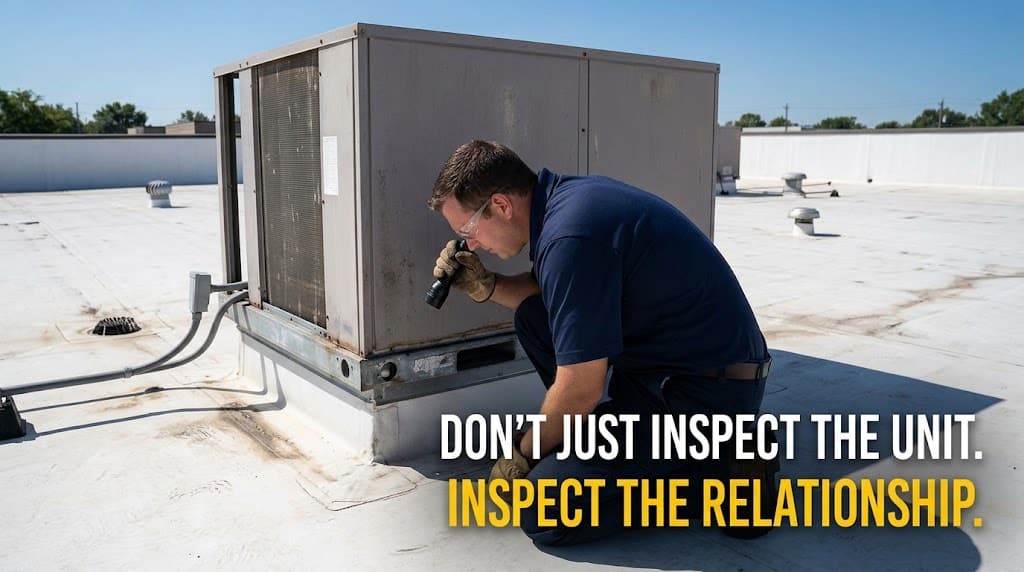
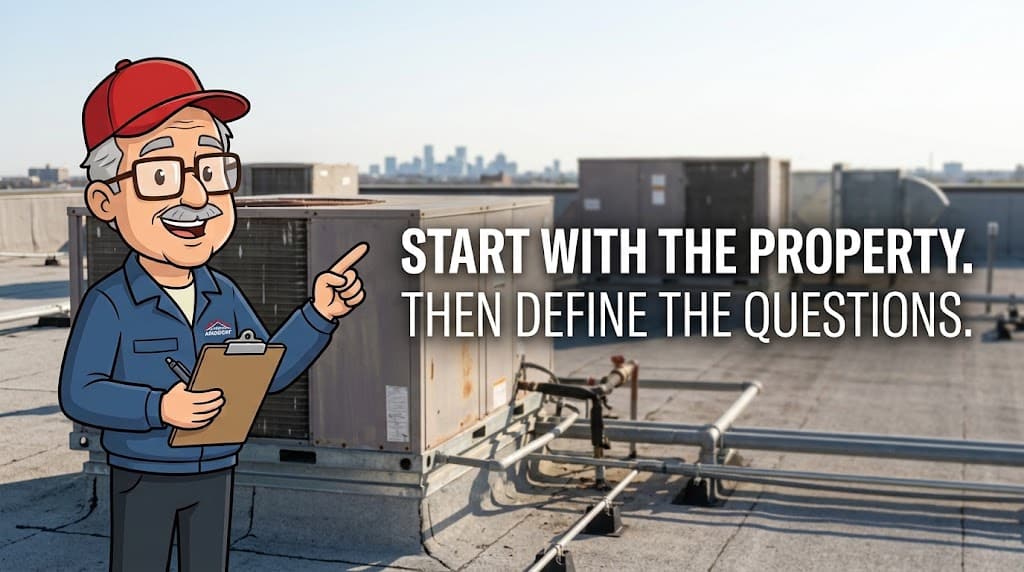
The Inspector’s Eye: The Roof-Mounted Unit
Imagine an inspector walks onto a commercial roof. Captain Obvious sees a big air conditioner.
Meanwhile, Inspector Hindsight sees the equipment, the roof penetrations, and the drainage relationships. Hindsight also notices electrical connections, condensate, roofing around the unit, supports, deterioration, and previous repairs. Most of all, Hindsight sees how they relate to one another.
Captain Obvious: “So we’re inspecting the air conditioner.”
Inspector Hindsight: “And its relationship with the building.”
Captain Obvious: “Meaning?”
Inspector Hindsight: “What happens when water drains from it? How is it supported? What’s happening around the penetration? What does the roof surface show? What is visible at the electrical connection?”
Captain Obvious: “So one machine creates five questions.”
Inspector Hindsight: “Welcome to commercial property.”
Captain Obvious: “It was obvious.”
Inspector Hindsight: “Until it wasn’t.”
Commercial Building Inspection Checklist: The Simple Answer
A commercial property inspection helps buyers, owners, and other clients understand observable building conditions within an agreed scope. Depending on the property, that may cover site conditions, roofing, exterior, structure, electrical, plumbing, HVAC, interiors, drainage, and property-specific components.
However, remember:
- Not every commercial property has the same systems.
- Not every commercial inspection has the same scope.
- The inspector doesn’t dismantle equipment to find concealed conditions.
- A general commercial inspection isn’t a comprehensive code review.
- A commercial building inspection isn’t a Phase I Environmental Site Assessment.
- No inspection can guarantee every hidden condition will be found.
- The inspector doesn’t decide whether you should buy.
In short, start with the property. Define the scope, inspect the evidence, and understand the limitations. Then decide what information you need next.
Commercial Building Inspection Checklist FAQs
What is a commercial property inspection?
It evaluates observable conditions at a commercial building and site according to the agreed inspection scope.
What is included in a commercial building inspection?
It depends on the property and agreement. Generally, visible conditions of roofing, exterior, structure, electrical, plumbing, HVAC, interiors, and site features may be evaluated.
What should be on a commercial building inspection checklist?
A useful checklist reflects the actual property, systems, scope, access, and client objectives, rather than assuming every commercial building is the same.
What is a property condition assessment?
It can refer to a specifically defined commercial assessment. However, its scope should come from the actual agreement or standard, not the name alone.
Is a property condition assessment the same as a commercial inspection?
Not necessarily. They may involve different scopes, standards, or reporting requirements.
Does a commercial inspection include the roof?
It depends on the agreed scope, roof configuration, access, and safety conditions.
Does a commercial inspection include HVAC?
Accessible HVAC conditions may be included, depending on the property and scope.
Does a commercial inspection check building code?
No. RedFish’s commercial agreement doesn’t present the general inspection as a comprehensive code-compliance review.
Does a commercial inspection include environmental testing?
Don’t assume so. Environmental assessment and testing can require separate services.
Is a Phase I ESA a commercial building inspection?
No. A Phase I Environmental Site Assessment has a distinct environmental due-diligence purpose.
Can a commercial inspection find every problem?
No. Concealed, inaccessible, or intermittent conditions may not be found during a visual inspection.
Does a commercial property pass or fail an inspection?
Generally, no. An inspection provides findings and information rather than a simple pass/fail result.
Can the inspector tell me whether to buy the property?
No. The inspection provides condition information, and you make the investment decision.
How do I get a quote for a commercial property inspection?
Commercial inspection needs vary with the property and scope. So contact RedFish Inspections at (866) 218-6699 to discuss your specific property.
Contact RedFish Inspections
Commercial buildings aren’t interchangeable, and neither are commercial inspections.
So the right starting point is understanding the property, the systems, the scope, the access, the observed conditions, and the limitations. Before making assumptions about a commercial property, get better information about the building you’re evaluating.
Contact RedFish Inspections about your commercial property.
RedFish Inspections
Inspecting To A Higher Standard.
Call (866) 218-6699

