

Bluffview is a Dallas residential enclave known for distinctive topography, mature landscaping, and architecturally individual homes.
For buyers searching for a Bluffview home inspector, that makes the inspection a property-specific exercise. No two lots behave the same way, and no two custom homes follow the same floor plan.
Why Hire a Bluffview Home Inspector?
A Bluffview home inspection helps buyers understand visible and accessible conditions before ownership. The inspection evaluates accessible roofing, attic areas, electrical, plumbing, heating and cooling, exterior and interior components, and structural elements within the inspection scope.
However, in a neighborhood with changing elevation and individual architecture, the relationship between the house and its lot deserves special attention. For a full breakdown, see what is checked during a home inspection.
Topography Makes Site Conditions Worth Understanding
On a property with changing elevation, the house and the land interact in ways a flat lot doesn’t. For example:
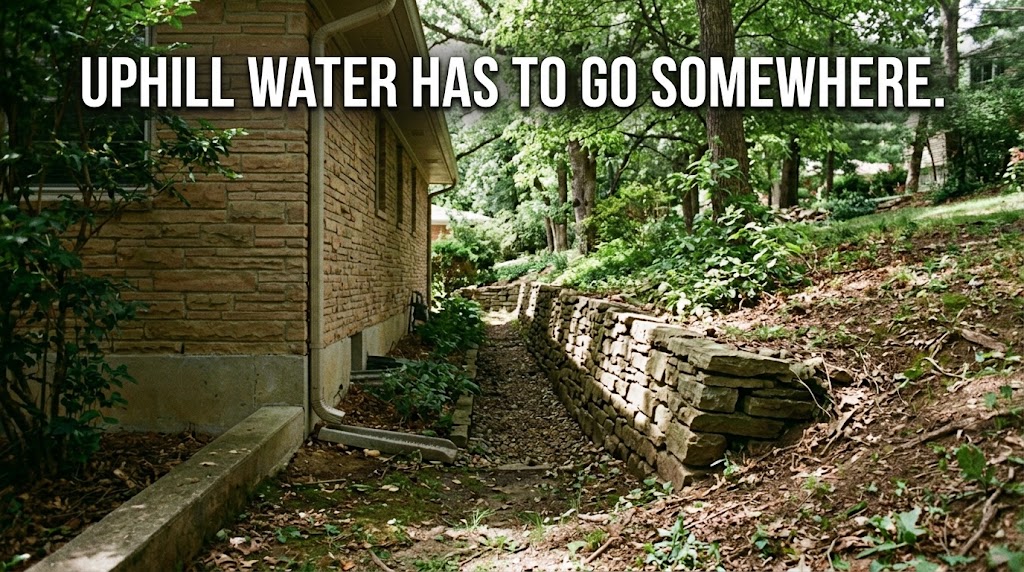
- On the uphill side, rainwater may flow toward the house, so grading, drainage paths, and downspout discharge matter.
- On the downhill side, more of the foundation may be exposed, making foundation-related conditions easier to observe.
- Along the slope, walkways, steps, and patios may show how the site has moved or drained over time.
So a home inspector may observe accessible grading, drainage, exterior wall systems, and foundation-related conditions within scope.
That doesn’t mean every Bluffview property has a drainage or foundation concern. It means the individual site deserves evaluation. For more, see slab foundation movement: settling vs. heave.
Retaining Walls and Site Structures
Sloped lots often rely on retaining walls to hold back soil near the house, driveway, or yard. When they’re near the home, an inspector may note visible conditions such as cracking, leaning, bulging, or drainage concerns.
However, determining whether a retaining wall is structurally adequate requires engineering evaluation beyond the scope of a home inspection. So if a visible condition raises a question, the report may recommend further evaluation by a qualified professional.
Inspector Hindsight: “A retaining wall holds back soil. It also holds back water, until it doesn’t. That’s why we look at both.”
Multi-Level Homes
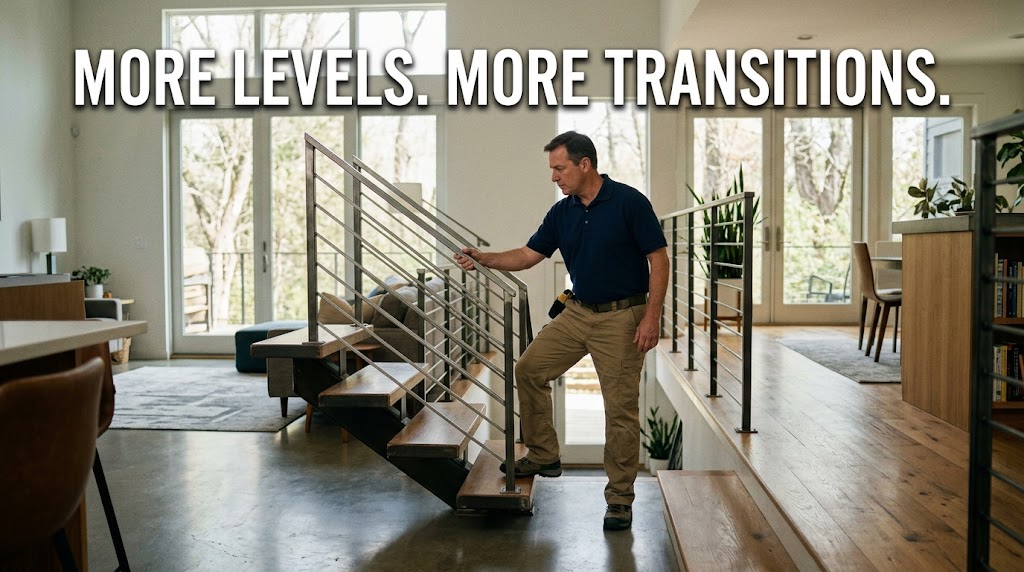
Homes built on changing grade often step down with the land, creating split levels, short stair runs, and floors at different elevations.
Each change in level is a transition worth noticing. For example, an inspector may observe stairs, handrails, and guards for visible safety concerns. They may also look at how floors, walls, and foundation areas relate where one level meets another.
So more levels simply mean more transitions to understand.
Large Windows and Exterior Interfaces
Architecturally individual homes often feature large window walls, glass doors, and unusual exterior transitions. These are places where glass, framing, cladding, and grade meet, so water management matters.
An inspector may observe accessible windows and doors for operation, visible damage, sealant condition, and water staining. On a sloped lot, the relationship between lower-level openings and the surrounding grade deserves attention, too.
Custom Architecture
Custom architecture can produce unusual rooflines, attic configurations, window systems, exterior interfaces, and additions.
So a Bluffview home inspector evaluates what’s actually present rather than following assumptions based on a standard floor plan. For more on complex rooflines and multiple attic spaces, see our Preston Hollow home inspector guide.
Mature Trees and Landscaping
Bluffview’s mature landscaping is part of its appeal. However, trees close to the house can affect roof debris, gutter performance, drainage, and the moisture conditions around the foundation.
So an inspector may note branches contacting the roof, debris in gutters or valleys, and vegetation close to the house. A nearby tree isn’t proof of damage, though. It’s context. For more, see what inspectors check on your roof.
What a Bluffview Home Inspection Can’t Do
A home inspection is visual and limited to accessible conditions within scope. It can’t see inside walls or underground, guarantee every concealed condition will be found, predict future performance, or certify retaining walls. It also doesn’t decide whether you should buy the house.
Instead, it gives you better information. For help prioritizing findings, see our guide to home inspection red flags.
Captain Obvious: “Beautiful hillside. Great view.”
Inspector Hindsight: “Great view. Now where does the rain go?”
Captain Obvious: “It was obvious.”
Inspector Hindsight: “Until it wasn’t.”
Bluffview Home Inspection FAQs
Do custom homes need home inspections?
Yes. Custom construction can create unique systems and configurations that deserve property-specific evaluation.
Does rolling terrain mean a home has foundation problems?
No. Topography is context, not proof of a defect.
Does a home inspection evaluate retaining walls?
An inspector may note visible conditions on retaining walls near the home. However, structural adequacy requires engineering evaluation beyond the home inspection scope.
Are multi-level homes harder to inspect?
Not necessarily harder, but they include more transitions, such as stairs, guards, and floor levels, that deserve attention.
Is Bluffview in Dallas?
Yes. Bluffview is a Dallas neighborhood in the DFW Metroplex.
Schedule a Bluffview Home Inspection
Looking for a Bluffview home inspector or a professional Dallas home inspection? Understand the house, and the lot it sits on, before it becomes yours.
Schedule your RedFish home inspection, or call (866) 218-6699 to confirm service in your area.
RedFish Inspections
Inspecting To A Higher Standard.

