

Luxury homes near White Rock Lake can combine distinctive architecture, larger lots, mature landscapes, and lake-oriented settings, including properties around the Lawther Drive area in Dallas.
For buyers searching for a White Rock Lake home inspector, the setting raises natural questions about water, drainage, and moisture. A good inspection answers those questions with evidence, not assumptions.
Why Hire a White Rock Lake Home Inspector?
A home inspection helps buyers understand visible and accessible conditions before ownership. It evaluates accessible roofing, attic areas, electrical, plumbing, heating and cooling, exterior and interior components, and structural elements within the inspection scope.
The core inspection is the same as anywhere else in Dallas. However, in a lake-area setting, site, drainage, and exterior observations can be especially useful. For a full breakdown, see what is checked during a home inspection.
Lake Proximity Is Context, Not a Diagnosis
Being near water doesn’t mean a property has a moisture or drainage problem. It does make exterior and site observations especially useful.
So a home inspector may evaluate accessible grading, drainage, downspout discharge, exterior cladding, roofing, and moisture-related evidence where present. The question isn’t “Is the lake nearby?” It’s “Where does the water on this property actually go?”
Near Water Isn’t the Same as Flood Risk
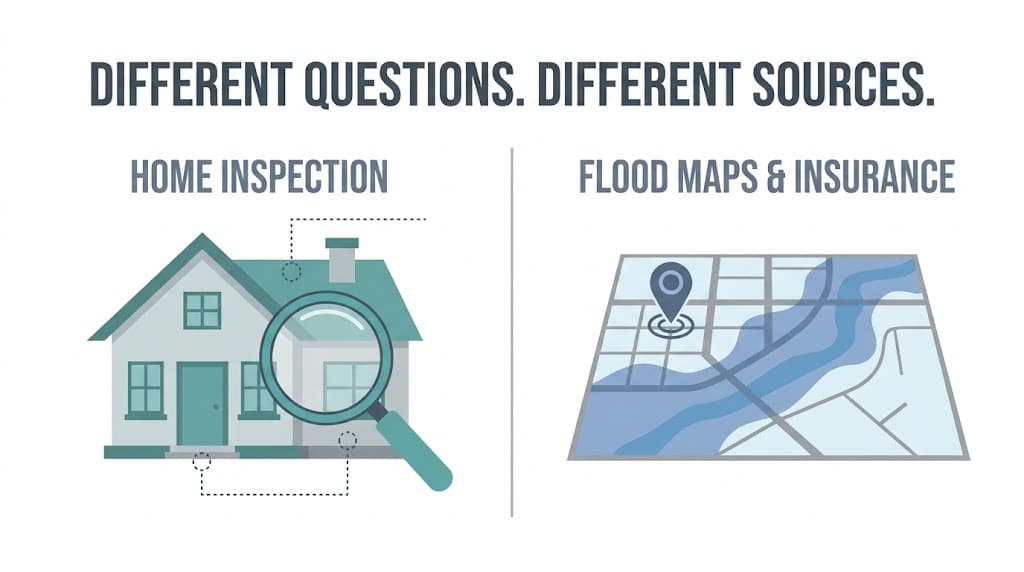
Buyers near any body of water often ask about flooding. That’s a reasonable question, but it isn’t one a home inspection answers.
A home inspection documents the visible condition of the property. It doesn’t determine whether a property sits in a flood zone, how likely it is to flood, or what flood insurance may be required. For those questions, check FEMA’s flood maps and talk with your insurance agent and real estate professional.
Inspector Hindsight: “The inspection tells you about the house. Flood maps tell you about the land. You need both answers.”
Following the Moisture Evidence
When moisture-related evidence is present, the inspector follows it. That may include:
- Staining on ceilings, walls, or lower-level finishes
- Conditions in an accessible crawl space
- Grading that slopes toward the house
- Downspouts discharging near the foundation
- Deterioration at exterior wall bases, doors, or windows
However, a stain doesn’t identify its source, and a damp area doesn’t prove the lake is involved. The source requires supporting evidence. For more, see crawl space moisture and what inspectors look for and what thermal imaging reveals in a home inspection.
Outdoor Living and Weather Exposure
Lake-area homes often feature decks, patios, terraces, and large windows facing open views. Those features get more sun, wind, and rain than sheltered parts of the house.
So an inspector may observe visible conditions at deck surfaces, railings, exterior doors, window frames, sealants, and where outdoor spaces meet the house. For more on large window walls and exterior interfaces, see our Bluffview home inspector guide.
Lot and Elevation Conditions
Some lake-area properties have elevation changes between the house and the street or the water. Properties like these deserve individual evaluation, so an inspector evaluates the actual property rather than making assumptions from the neighborhood.
For more on sloped lots and site conditions, see our Bluffview guide. For large estate lots and multiple systems, see our Preston Hollow guide.
Established Estates and Newer Builds
Lake-area neighborhoods can include established homes alongside newer construction. An older estate may contain systems from several periods, while a newer home can still have observable conditions worth documenting.
For more, see our Highland Park home inspector guide on historic homes and our guide to new construction home inspections.
What a White Rock Lake Home Inspection Can’t Do
A home inspection is visual and limited to accessible conditions within scope. It can’t see inside walls or underground, guarantee every concealed condition will be found, determine flood-zone status, or predict future performance. It also doesn’t decide whether you should buy the house.
Instead, it gives you better information. For help prioritizing findings, see our guide to home inspection red flags.
Captain Obvious: “Lake house. Must have water problems.”
Inspector Hindsight: “Must? Show me the evidence.”
Captain Obvious: “It was obvious.”
Inspector Hindsight: “Until it wasn’t.”
White Rock Lake Home Inspection FAQs
Do homes near White Rock Lake need special inspection?
The core inspection remains the same, but site, drainage, and exterior observations can be particularly useful.
Does lake proximity automatically mean moisture problems?
No. Conclusions must be based on observable evidence.
Can a home inspection tell me if a property is in a flood zone?
No. Flood-zone status comes from FEMA flood maps. Your insurance agent and real estate professional can help with flood insurance questions.
What does an inspector look for on a lake-area lot?
An inspector may look at visible grading, drainage, downspout discharge, exterior cladding, roofing, outdoor living areas, and moisture-related evidence where present.
Is White Rock Lake in Dallas?
Yes. White Rock Lake is in the city of Dallas, within the DFW Metroplex.
Schedule a White Rock Lake Home Inspection
Looking for a White Rock Lake home inspector or a professional Dallas home inspection? Understand the house, and how it handles water, before it becomes yours.
Schedule your RedFish home inspection, or call (866) 218-6699 to confirm service in your area.
RedFish Inspections
Inspecting To A Higher Standard.

