

This guide to VA septic inspection requirements separates what the VA actually publishes from what an individual lender or underwriter may ask for.
If you’re buying or selling a home with a septic system using VA financing, you may hear a surprisingly specific list of requirements.
What size is the septic tank?
Has the tank been pumped?
Are there cracks?
Was it hydrostatically tested?
Is groundwater entering the tank?
Those can all be legitimate questions about a septic system. But there is an important distinction that buyers, sellers, agents—and sometimes even people working inside the transaction—can miss:
A question being asked by a lender or underwriter does not necessarily mean that the VA Lenders Handbook independently requires that specific test or data point.
The current VA Lenders Handbook addresses individual water supply and sewage disposal systems in Chapter 12, §12.08, “Individual Water Supply/Sewage Disposal Requirements.” The current handbook table of contents places that section at page 12-14. (Source: Benefits)
And understanding what the VA actually requires starts there.
Does the VA Require a Septic Inspection for Every VA Loan?
The VA’s underlying concern is whether the property satisfies its Minimum Property Requirements; that should not automatically be translated into a universal checklist of specific septic tests.
VA guidance has long required an individual sewage disposal system to adequately dispose of domestic waste in a sanitary manner without creating a nuisance or endangering public health. The VA’s published Chapter 12 guidance also identifies circumstances in which health-authority approval is required, including certain proposed-construction cases and cases where the appraiser identifies a problem or the area is known to have soil-percolation problems. (Source: Benefits)
That’s different from saying:
“Every VA loan requires the septic tank to be pumped.”
Or:
“Every VA septic inspection requires a hydrostatic test.”
Or:
“VA requires the inspector to report the tank capacity on every property.”
Those are much more specific claims, and they need to be supported by an actual VA requirement before being presented as such.
Inspector Hindsight: “The question isn’t simply, ‘What did the underwriter ask for?’ The better question is, ‘What requirement is the underwriter trying to establish compliance with?’”
That distinction matters.
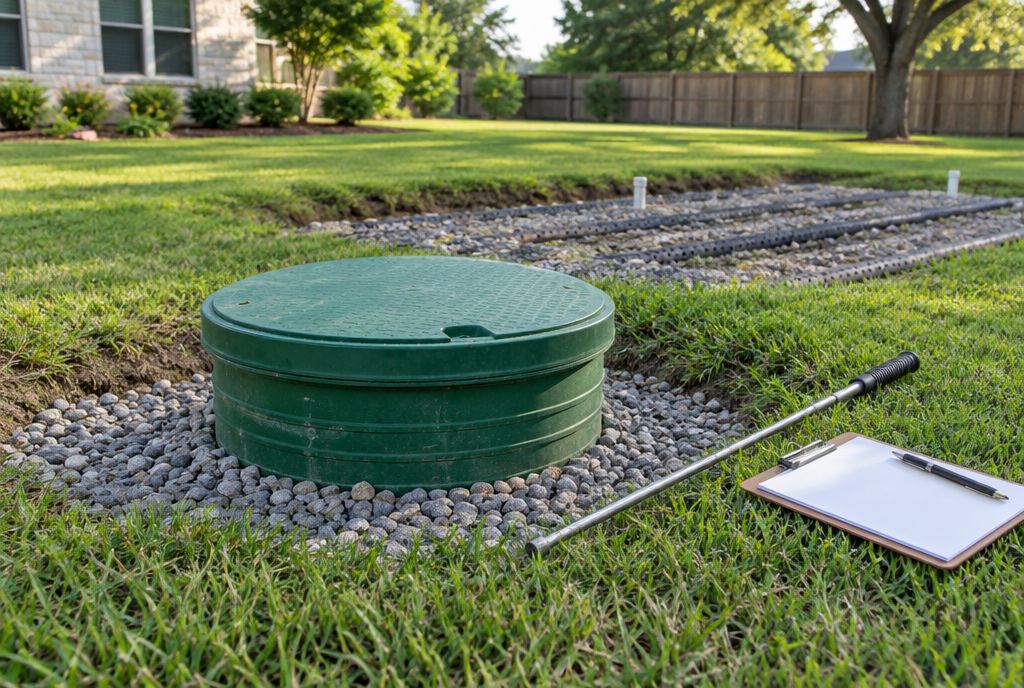
Why Might a VA Lender Ask for a Septic Evaluation?
A lender may need additional evidence to determine whether the sewage disposal system satisfies applicable VA property requirements.
This is where the practical side of the transaction can become confused with the regulatory side.
A lender or underwriter may receive information that creates additional questions about the system. They may then seek documentation sufficient to resolve those questions.
That could result in requests involving tank condition, signs of structural deterioration, sewage backups, apparent infiltration, system operation, or other conditions.
But the fact that an underwriter asks one of those questions does not, by itself, establish that the question appears in the VA Handbook as a mandatory test that must be performed on every septic system.
Captain Obvious: “So ‘the lender asked for it’ and ‘the VA requires this on every house’ aren’t necessarily the same sentence?”
Inspector Hindsight: “Exactly. And treating them as the same thing is where a lot of confusion starts.”
Does VA Require the Septic Tank to Be Pumped?
Based on the published VA material we reviewed, septic-tank pumping is not a universal VA requirement.
This is an especially important point because statements about mandatory pumping can spread quickly through real estate transactions.
If a septic evaluation identifies a deficiency, additional investigation, servicing, repair, approval, or documentation may be necessary depending on the condition and the lender’s determination of what is needed to establish compliance.
That is different from claiming that every VA septic inspection requires pumping or that a particular observed condition automatically triggers an identical pumping requirement in every transaction.
The applicable VA requirement, the actual system condition, local requirements, and lender documentation needs all matter.
Does VA Require a Hydrostatic Test of the Septic Tank?
We did not identify a universal VA Handbook requirement stating that every septic tank must undergo hydrostatic testing.
A lender may request information about leakage, groundwater intrusion, structural integrity, or other conditions. A qualified evaluator may also have an established inspection procedure for assessing particular components.
Those facts should not be converted into a blanket statement that “VA requires a hydrostatic test” unless the controlling VA guidance for that transaction actually requires it.
The same principle applies to questions such as:
What is the tank capacity? Is the tank cracked? Is groundwater entering the tank? What is the condition of the tank?
These may be useful or important inspection questions. But useful inspection information and an expressly mandated VA test are not automatically the same thing.
VA Requirement vs. Lender Requirement: Why the Difference Matters
Here’s the simplest way to understand the issue.
VA establishes eligibility and Minimum Property Requirements. The lender is responsible for making lending and underwriting decisions within the VA program and may need documentation to establish that those requirements have been satisfied.
That can create three separate layers:
Federal VA requirements → lender/underwriter documentation requirements → the septic professional’s inspection scope.
They overlap, but they are not interchangeable.
Suppose an underwriter asks:
“Is there evidence of groundwater intrusion into the tank?”
The answer may be important to that loan.
But saying, “The underwriter needs an answer to this question” is different from saying, “VA regulations require every septic inspector in every VA transaction to perform this exact procedure.”
That distinction isn’t semantics. It helps buyers, sellers, agents, inspectors, and lenders communicate accurately about what is actually needed.
What If the Septic System Has an Actual Problem?
An observed problem with an individual sewage disposal system can create an MPR issue and may require additional documentation or corrective action before the property can satisfy VA requirements.
The VA’s published guidance establishes the fundamental expectation that an individual sewage disposal system dispose of domestic waste in a sanitary manner without creating a nuisance or endangering public health. (Source: Benefits)
None of this means septic condition doesn’t matter.
It matters considerably.
The distinction is about how the requirement is described.
A system with evidence of failure or another significant deficiency is very different from an apparently functional system where someone has simply assumed that a particular testing procedure is mandatory because the financing is VA.
Why Are People Hearing Different Things About VA Septic Inspections?
Much of the confusion can come from combining VA requirements, lender overlays or documentation requests, local requirements, professional inspection practices, and older guidance into one supposed “VA checklist.”
There’s another complication: VA’s handbook itself has been reorganized and updated.
Older Chapter 12 material identified “Individual Sewage Disposal” as Topic 17 on page 12-24. The current VA Lenders Handbook table of contents instead identifies §12.08, “Individual Water Supply/Sewage Disposal Requirements,” at page 12-14. (Source: Benefits)
That means somebody searching the internet may encounter older VA material, current handbook references, lender instructions, inspector procedures, and secondary articles—all describing the subject differently.
Inspector Hindsight: “Before arguing over what ‘VA requires,’ make sure everybody is reading the same version of the rule—and talking about the same requirement.”
That’s a useful rule far beyond septic systems.
What About FHA Septic Inspections? Are Those Requirements Changing Too?
FHA guidance should be checked against the current HUD Handbook 4000.1 rather than assuming that a proposed, anticipated, older, or lender-specific requirement is current FHA policy.
This is particularly important right now.
HUD describes Single Family Housing Policy Handbook 4000.1 as its consolidated and comprehensive source of FHA Single Family Housing policy. HUD published an updated Handbook 4000.1 on August 12, 2026, and provides a redline version so stakeholders can identify revisions. (Source: HUD)
Therefore, we’re intentionally not stating that FHA has adopted a new universal septic-inspection requirement unless the applicable current HUD provision establishes it.
There may be discussions, interpretations, lender procedures, or anticipated changes circulating through the industry. Those should be identified as such—not presented as final FHA policy before HUD makes them final.
That’s especially important for real estate professionals communicating requirements to clients.
VA, FHA, and Lender Requirements Are Not Automatically Interchangeable
A VA transaction and an FHA transaction are governed by different federal programs and guidance.
VA publishes its Lenders Handbook for the VA Home Loan program. FHA identifies Handbook 4000.1 as the authoritative consolidated source for FHA Single Family Housing policy. (Source: Benefits)
A requirement associated with one should not automatically be attributed to the other.
And neither should automatically be confused with a lender’s own documentation request.
Captain Obvious: “So ‘government-backed loan’ isn’t one giant rulebook?”
Inspector Hindsight: “Correct. Which is why the name at the top of the handbook matters.”
What Should Buyers and Real Estate Agents Ask When a Septic Requirement Comes Up?
Ask what is actually being required, who is requiring it, and what documentation will satisfy that requirement.
If someone says, “VA requires this,” or “FHA requires this,” a useful follow-up is:
Where is that requirement found in the current guidance?
If the answer instead is, “Our underwriter requires this documentation,” that’s useful information too. It simply describes the requirement more accurately.
For a transaction already in underwriting, the lender should clarify what documentation it needs. Inspectors and septic professionals can then explain whether the requested information falls within their inspection scope and what procedures are appropriate to obtain it.
That keeps everyone focused on the same objective instead of debating a rule that may have been misunderstood.
Frequently Asked Questions
Does every VA loan require the septic tank to be pumped?
We did not identify a blanket VA requirement requiring every septic tank to be pumped simply because the property is being purchased with VA financing. An actual system condition, local requirement, or lender documentation request may lead to additional evaluation, servicing, repair, or documentation.
Does VA require hydrostatic testing of every septic tank?
We did not identify a universal VA Handbook requirement for hydrostatic testing of every septic tank. If a lender requests information about leakage or groundwater intrusion, clarify what evidence the lender requires and what evaluation method is appropriate.
If an underwriter asks for the septic tank size, does that mean VA requires tank size on every inspection?
Not necessarily. An underwriter’s request for information should not automatically be described as a universal VA Handbook inspection requirement.
Can a VA lender ask for more septic information?
A lender may require documentation it considers necessary to establish that applicable loan and property requirements have been satisfied. The important communication point is to distinguish that request from a claim that VA expressly mandates the same test in every transaction.
What does VA ultimately care about with an individual sewage disposal system?
The VA’s published guidance requires an individual sewage disposal system to adequately dispose of domestic waste in a sanitary manner without creating a nuisance or endangering public health. (Source: Benefits)
Has FHA changed its septic inspection requirements?
FHA requirements should be evaluated using the current version of HUD Handbook 4000.1 and its applicable effective dates. HUD published an updated handbook on August 12, 2026. We would not characterize an anticipated or industry-discussed change as an FHA requirement unless it appears in controlling current HUD guidance. (Source: HUD)
The Bottom Line: Ask What the Rule Actually Says
When septic systems and government-backed financing meet, terminology matters.
“VA requires an adequate sanitary sewage disposal system” is not automatically equivalent to “VA requires every inspector to perform this particular test.”
Likewise, “the underwriter needs this information” does not automatically mean “this exact question appears in the VA Handbook.”
The same caution should be used as FHA requirements evolve: verify the current HUD guidance, its effective date, and the exact requirement before turning an industry conversation into a supposed federal rule.
At RedFish Inspections, the goal is not to make the rules sound more complicated—or more absolute—than they are. It’s to provide useful inspection information, clearly explain the scope of the inspection, and help clients understand what the observed conditions may mean.
Schedule Your RedFish Inspection
Schedule your RedFish inspection online, or call (866) 218-6699 to confirm availability for your property and the inspection type you need.
RedFish Inspections
Inspecting To A Higher Standard.

