

What is checked during a home inspection? A home inspection evaluates the visible and accessible systems and components of a property within the inspection scope. Depending on the home, that may include:
- Roofing and exterior
- Structure and foundation
- Electrical
- Plumbing
- Heating and cooling
- Interior rooms, windows, and doors
- Attic, insulation, and ventilation
- Crawl space, when present and accessible
- Drainage
- Built-in or included components within scope
The inspector documents observable conditions, identifies important limitations, and recommends further evaluation when a condition needs expertise beyond the inspection scope. However, a home inspection doesn’t involve dismantling the house or guaranteeing that every concealed condition will be found.
Captain Obvious: “So we’re checking the house.”
Inspector Hindsight: “Yes.”
Captain Obvious: “All of it?”
Inspector Hindsight: “Visible and accessible systems within the inspection scope.”
Captain Obvious: “That answer had significantly more paperwork in it.”
Inspector Hindsight: “It also had accuracy.”
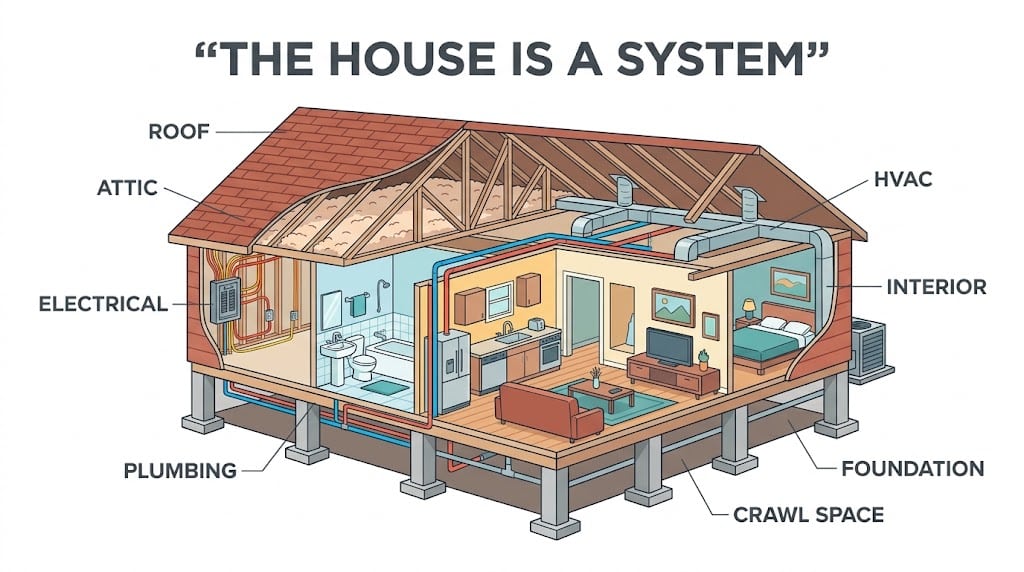
The House Is a Collection of Connected Systems
A home inspection can feel mysterious if you’ve never been through one. The inspector walks the exterior, looks at the roof, opens the electrical panel, runs water, checks rooms, looks in the attic, and may enter a crawl space. Along the way, they operate equipment, take photos, and make notes. Then you receive a report about a house you may be preparing to own.
So what’s actually being checked? The simplest answer is the house as a collection of connected systems.
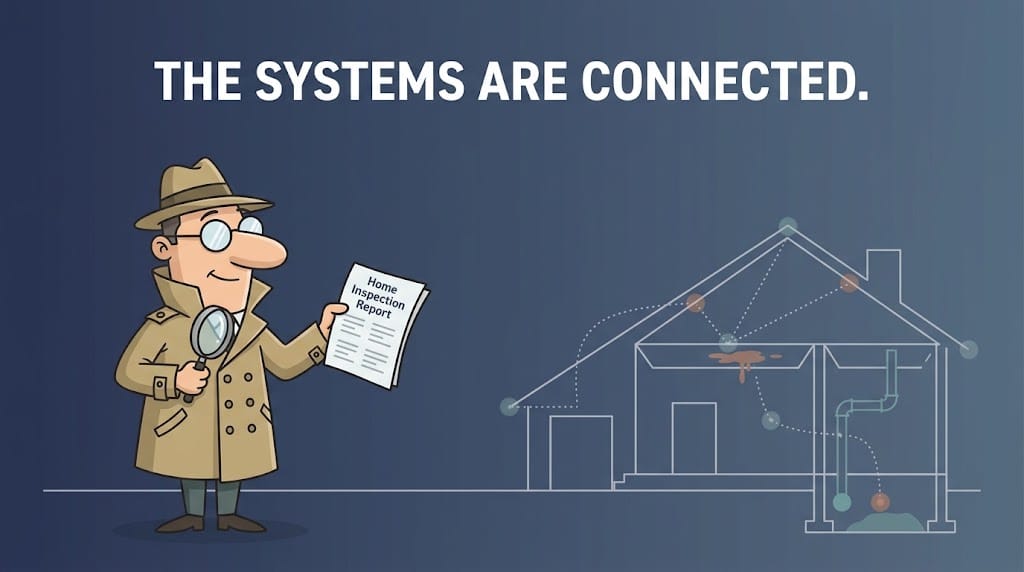
A good inspection doesn’t treat the roof, plumbing, electrical, foundation, attic, HVAC, and interior as unrelated boxes. Instead, the inspector looks at individual components and at how they relate. For example:
- A stain is inside, but the source may be above it.
- Moisture is in the crawl space, but the contributing condition may be outside.
- A door sticks, but the real question may involve the frame, floor, foundation, humidity, or installation.
The inspection begins with what can be observed. Then the inspector follows the evidence.
Does a Home Inspector Check the Roof?
Yes. Roofing is an important part of the inspection. Depending on the roof type, accessibility, safety, and scope, an inspector may evaluate visible roof coverings, flashing, penetrations, valleys, edges, drainage components, roof-mounted components, previous repairs, and deterioration.
The inspector may also look for related clues elsewhere, such as attic or ceiling staining. Still, the actual condition matters:
- A ceiling stain doesn’t automatically prove an active roof leak.
- A repaired area doesn’t automatically mean the repair failed.
- An older roof isn’t automatically defective.
For more, see what inspectors check on your roof.
Does the Inspector Always Walk on the Roof?
No. Roof access depends on safety and accessibility, including pitch, height, weather, surface condition, roofing material, moisture, fragility, and safe access.
The goal isn’t to put boots on every roof at any cost. Instead, it’s to observe the roof as effectively and safely as conditions allow. If an area can’t be adequately observed, that limitation matters.
What Is Checked on the Exterior of the House?
The exterior shows how the house manages weather, moisture, drainage, and structural relationships. Visible observations may involve:
- Wall surfaces, cladding, brick, or masonry
- Trim, soffits, and fascia
- Exterior windows, doors, sealants, and penetrations
- Exterior stairs, porches, decks, and railings
- Drainage relationships
The inspector looks for damage, deterioration, openings, displacement, moisture staining, previous repairs, and missing components.
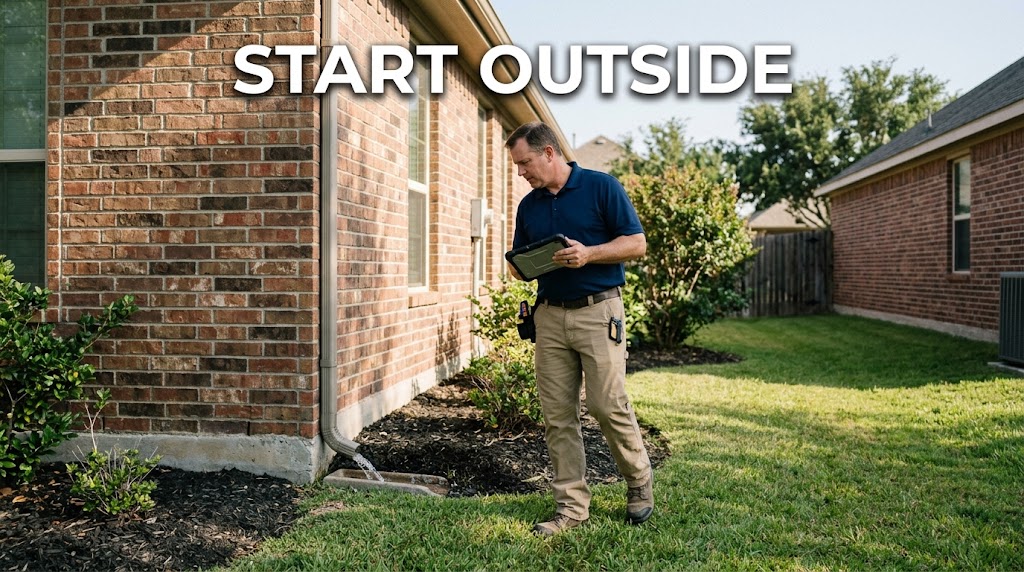
Why Does the Inspector Look at the Ground Around the House?
Because water outside can eventually matter inside. So an inspector may look at grade, drainage, downspout discharge, low areas, water collection, walkways, driveways, and vegetation.
The key question is often: where does water go?
Captain Obvious: “Downhill.”
Inspector Hindsight: “Usually.”
Captain Obvious: “I finally have one.”
Inspector Hindsight: “Now determine where downhill leads.”
Does a Home Inspector Check the Foundation?
Yes. Visible and accessible foundation components are part of the inspection scope. Observations may involve cracking, displacement, deterioration, previous repairs, moisture, and support conditions.
However, one foundation crack doesn’t automatically mean foundation failure. Instead, the inspector looks for context:
- Where is the crack, and which direction does it run?
- Is displacement visible?
- Are other cracks or related interior conditions present?
- Are doors or windows showing related changes?
- What do the floors and exterior show?
In short, patterns matter. For more, see slab foundation movement: settling vs. heave.
Does the Inspector Check for Structural Problems?
Yes. Visible and accessible structural components are part of the inspection. Depending on construction, these may include foundation components, floor framing, visible wall framing, roof framing, beams, columns, posts, piers, and connections.
The inspector may identify damage, deterioration, movement, displacement, alterations, unusual supports, or previous repairs. Some findings may need further evaluation by a qualified structural professional.
What Does the Inspector Check in the Electrical System?
Electrical inspection can involve accessible components such as:
- Service equipment and electrical panels
- Breakers or overcurrent devices
- Visible wiring
- Receptacles, switches, and lighting
- Visible grounding or bonding components, within scope
- Disconnects and other accessible equipment
The inspector looks for damage, improper-looking connections, overheating evidence, missing protective components, unsafe exposed wiring, moisture, and other safety concerns. These findings deserve clear communication, because some can have meaningful safety implications. For more, see electrical defects home inspectors flag.
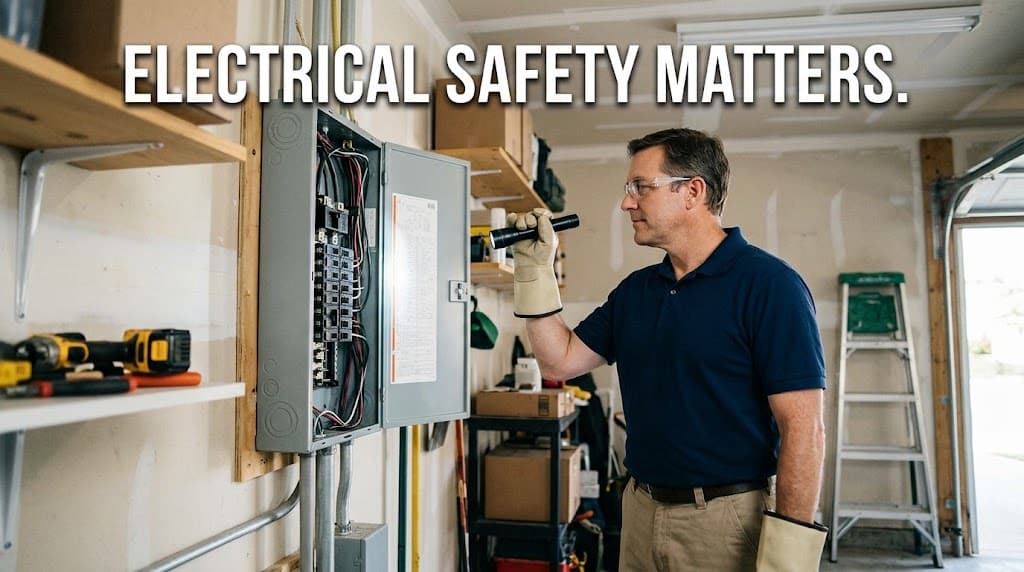
Does the Inspector Open the Electrical Panel?
Electrical equipment may be evaluated within the inspection scope when conditions allow safe access. However, buyers and homeowners shouldn’t try to duplicate a panel inspection themselves. So don’t:
- Remove energized electrical covers
- Touch exposed conductors
- Reach inside service equipment
- Move electrical components
Captain Obvious: “So we leave that part to the inspector.”
Inspector Hindsight: “And qualified electrical professionals when appropriate.”
What Does the Inspector Check With Plumbing?
The plumbing inspection covers visible and accessible conditions involving fixtures, faucets, sinks, toilets, showers, bathtubs, accessible supply and drain piping, water-heating equipment, drainage, and visible leaks.
The inspector may also operate fixtures to see how they perform at the time of inspection.
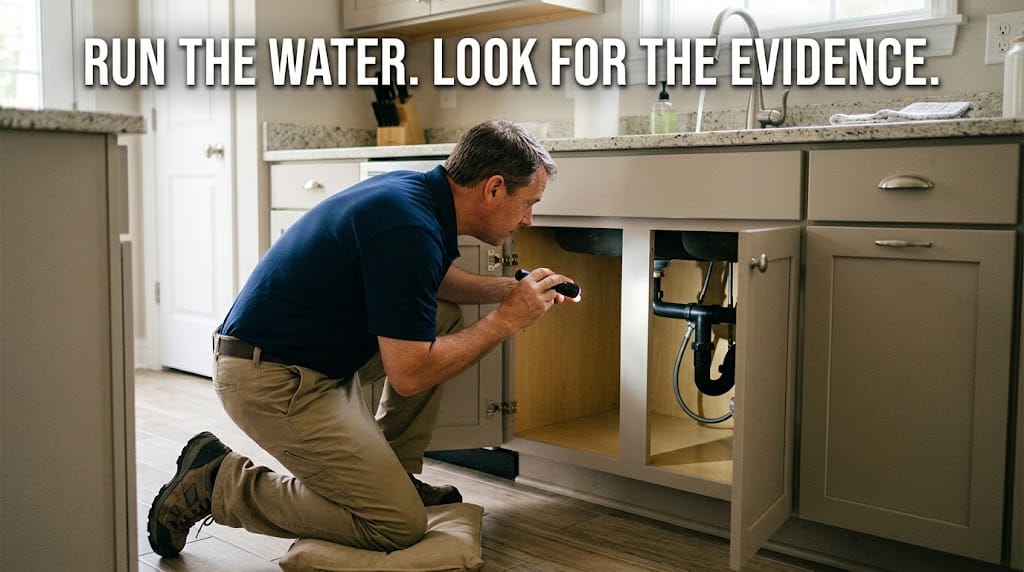
Does the Inspector Check for Leaks?
Yes. Visible evidence of leakage is an important observation. The inspector may look for active dripping, water staining, corrosion, damaged materials, moisture around plumbing, standing water, and swollen cabinetry.
However, a stain doesn’t prove a leak is currently active. And water visible in one spot doesn’t always show where it started.
Inspector Hindsight: “Water tells you where it became visible. Investigation helps determine where it came from.”
Does the Inspector Check the Water Heater?
Yes. Accessible water-heating equipment may be evaluated within scope. Observations may involve equipment condition, connections, visible leakage, temperature-related and safety components, energy-source components, and venting where applicable.
The exact system depends on the property, since not every home has the same equipment.
What Does the Inspector Check With HVAC?
Heating and cooling systems are an important part of the inspection. Depending on the equipment, weather, condition, and scope, the inspector may evaluate:
- Heating and cooling equipment
- Thermostats
- Supply and return areas
- Visible ductwork
- Condensate management
- Other accessible components
The inspection describes operation and visible condition at the time of inspection. It doesn’t guarantee future performance.
Does an Old HVAC System Automatically Fail Inspection?
No. Age provides context, and condition provides evidence. Older equipment may still operate, while newer equipment may still have problems.
So a useful report focuses on current operation, visible condition, observed deficiencies, reliably known age, limitations, and any recommended further evaluation.
Captain Obvious: “Old HVAC.”
Inspector Hindsight: “Yes.”
Captain Obvious: “Replace it?”
Inspector Hindsight: “You skipped the inspection.”
What Is Checked Inside the House?
Interior inspection may include visible and accessible walls, ceilings, floors, doors, windows, stairs, railings, cabinets, counters, and fixtures. The inspector looks for damage, cracking, staining, moisture clues, operational concerns, loose components, and safety concerns.
Interior finishes can also provide clues about other systems. For example, a ceiling stain may raise a roofing, plumbing, HVAC, or moisture question. Likewise, a floor change may raise a structural or moisture question, and a wall crack deserves context from the rest of the building.
Does the Inspector Check Windows?
Yes. Accessible windows may be evaluated for operation, visible damage, hardware, frames, glass, sealant, and water staining.
However, not every blocked, painted-shut, or unsafe window can necessarily be operated. So access and condition matter.
Does the Inspector Check Doors?
Yes. Accessible doors may be operated and evaluated for function, damage, hardware, alignment, closing, latching, and deterioration.
However, one sticking door isn’t a foundation diagnosis. Instead, the inspector considers the context.
Captain Obvious: “Door sticks.”
Inspector Hindsight: “Yes.”
Captain Obvious: “Foundation.”
Inspector Hindsight: “Door sticks.”
Captain Obvious: “I knew we were coming back to this.”
Does the Inspector Check Stairs and Railings?
Yes. Stair and guard components can have important safety implications. So the inspector may observe handrails, guards, steps, landings, loose components, damage, and openings.
Significant safety observations are communicated clearly and directly.
Does a Home Inspector Check the Attic?
Yes, when it’s safely accessible and within scope. The attic can provide valuable information about:
- Roof framing and decking
- Insulation and ventilation
- Electrical wiring
- HVAC equipment or ducts, where present
- Exhaust routing
- Moisture staining and evidence of leakage
The attic is especially useful because several building systems often meet there.
Captain Obvious: “Why does every investigation eventually end up in the attic?”
Inspector Hindsight: “Because houses keep putting useful clues there.”

Does the Inspector Check Attic Insulation?
Visible insulation may be evaluated for presence, distribution, missing areas, displacement, damage, and moisture-related conditions.
However, a visual inspection can’t confirm the insulation behind every finished surface.
Does the Inspector Check Ventilation?
Visible ventilation components may be evaluated where applicable, including those in attics, bathrooms, and exhaust systems.
Different houses can have different ventilation designs. So the right approach depends on how the building was designed.
Does a Home Inspector Enter the Crawl Space?
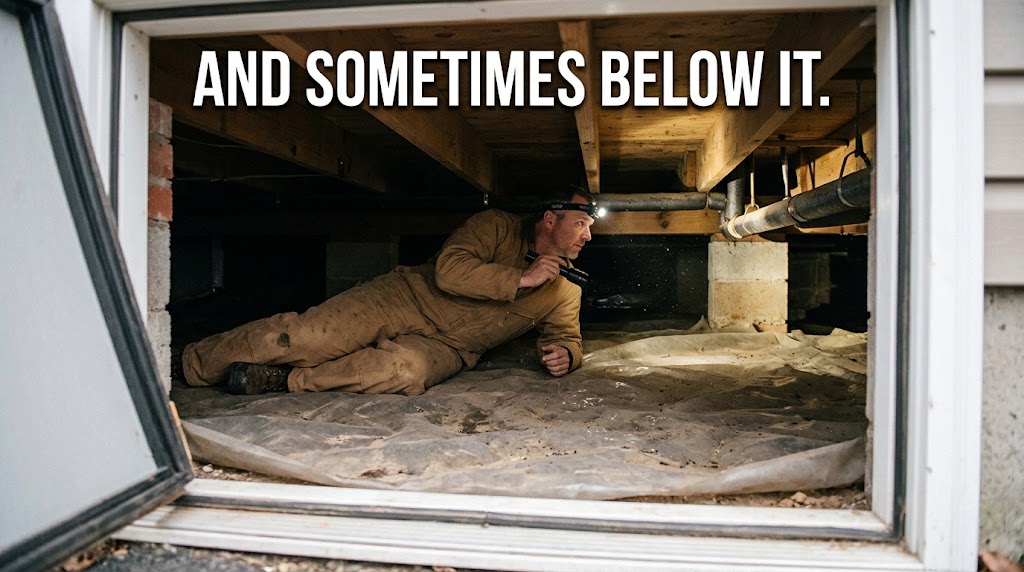
If the home has a crawl space, inspection depends on safe access and scope. A crawl space can show moisture, plumbing, framing, supports, foundation components, insulation, electrical and HVAC components, drainage evidence, and wood deterioration.
However, access may be limited by low clearance, water, debris, animals, unsafe conditions, equipment, or obstructions. For more, see crawl space moisture and what inspectors look for.
What if Only Part of the Crawl Space Can Be Seen?
Then only the observable portion can be evaluated. That distinction matters, because “not observed” doesn’t mean “confirmed good.” It means not observed.
Inspection limitations are part of the inspection, so they shouldn’t be hidden or minimized.
Does a Home Inspector Check for Mold?
A general home inspection may identify visible moisture-related conditions or growth-like material within scope. However, visual appearance alone isn’t definitive mold identification:
- A dark spot doesn’t automatically mean mold.
- Color doesn’t identify species.
- A musty odor doesn’t prove mold exists.
So the inspector documents the visible condition and recommends further evaluation when warranted.
Does the Inspector Check for Termites?
A general home inspection and a specialized wood-destroying insect (WDI) inspection can have different scopes. An inspector may notice visible wood damage or insect-related evidence.
However, WDI identification, activity determination, reporting, and treatment recommendations may require a specialized service and qualifications. So don’t assume every home inspection includes every pest-related service.
Does the Inspector Check the Sewer Line?
A standard visual home inspection doesn’t automatically evaluate the inside of an underground sewer line. A specialized sewer scope inspection uses camera equipment to view accessible sewer piping when that separate service is provided.
So the key question is: what service did you order?
Does the Inspector Check a Septic System?
Properties with onsite wastewater systems can raise specialized inspection questions. A general home inspection and a specialized septic evaluation may have different scopes.
So don’t assume that ordering a home inspection means every underground septic component was evaluated. Instead, confirm the services ordered for the property.
Does the Inspector Check a Private Well?
A private well involves both the well system and the water, and those aren’t necessarily the same evaluation.
A well inspection may evaluate accessible equipment and operation within its scope. Water-quality testing, however, answers different questions about a collected sample. So know what service you ordered. For more, see our guide to well inspections and water testing.
Does the Inspector Check Appliances?
Certain installed or built-in appliances may be included, depending on scope. The inspector may evaluate their operation at the time of inspection.
However, an appliance check isn’t a warranty, a remaining-life guarantee, an internal teardown, or a prediction that the appliance will never fail.
Does the Inspector Check the Garage?
Yes. Accessible garage areas can include walls, ceilings, doors, electrical components, garage vehicle doors where included, structural conditions, and water-heating or HVAC equipment where present.
Garages can also create important safety relationships with the home’s living areas.
Does the Inspector Check Fireplaces?
Visible and accessible fireplace and chimney components may be evaluated within scope. However, a general home inspection may not equal a specialized chimney inspection.
So specialized evaluation may be appropriate depending on the fireplace type, chimney configuration, visible conditions, or inspection limitations.
Does the Inspector Check for Water Damage?
Yes. Visible water-related evidence is an important part of many inspections. For example, observations may include stains, active dripping, damaged finishes, swollen materials, deteriorated wood, standing water, condensation, and moisture patterns.
However, visible water evidence isn’t the same as a confirmed source. The source requires supporting evidence.
Can Thermal Imaging Be Part of a Home Inspection?
Thermal imaging can be a useful tool when it’s included in the inspection process. It detects surface-temperature patterns. However, it doesn’t directly identify moisture, mold, leaks, missing insulation, or hidden damage.
So a thermal anomaly tells the inspector to look closer. It doesn’t replace inspection judgment. For more, see what thermal imaging reveals in a home inspection.
Does the Inspector Check Everything in the House?
No. No home inspection checks absolutely everything, because every inspection has a defined scope.
Some conditions may be concealed, inaccessible, underground, inside walls or equipment, under finishes, behind stored belongings, not operating, intermittent, or outside the scope. The inspector doesn’t dismantle the house to look for every possible condition.
The scope can also shift with the property type. For example, see how new construction home inspections work at different build phases.
What Is Not Checked During a Standard Home Inspection?
Exact exclusions depend on the inspection agreement. However, separately scoped items may include:
- Concealed conditions
- Invasive investigation
- Certain environmental testing
- Specialized pest services
- Specialized sewer, septic, or well and water testing
- Engineering analysis
- Code-compliance certification
- Other specialty services
So review your inspection agreement, and confirm which services were ordered.
Is a Home Inspection a Code Inspection?
Not automatically. A general home inspection and a municipal or code-compliance inspection can have different purposes and scopes.
The inspector may identify safety or installation concerns. However, don’t assume that because the house “passed” your inspection, it meets every code. That isn’t what a standard home inspection establishes.
Does a House Pass or Fail a Home Inspection?
A home inspection is more useful as information than as a pass-or-fail test. A report may contain maintenance items, repair items, safety concerns, system conditions, limitations, recommendations, and specialist referrals.
You use that information as part of your purchase decision. The inspector doesn’t make it for you.
Captain Obvious: “So no giant PASS stamp?”
Inspector Hindsight: “No.”
Captain Obvious: “I had one made.”
Inspector Hindsight: “I am increasingly concerned about your office-supply budget.”
Does the Inspector Tell You What to Fix?
The inspector may identify conditions that deserve correction or further evaluation. However, some repair questions need a contractor, electrician, plumber, HVAC professional, structural professional, roofer, or other qualified specialist.
In short, detailed repair design belongs to the qualified trade, not the inspection.
Does the Inspector Tell You Whether to Buy the House?
No. The inspector provides information, and you decide what it means for your transaction.
In fact, two buyers can receive the same report and make different decisions. One may be comfortable with planned maintenance, while another may not be. The inspection improves understanding. It doesn’t replace your judgment.
Selling instead? A pre-listing inspection gives sellers the same kind of information before they list.
What Should Buyers Ask During or After the Inspection?
Useful questions include:
- What did you observe?
- Which findings deserve the most attention?
- Are any conditions active?
- Are safety concerns present?
- What areas couldn’t be inspected?
- Which systems deserve further evaluation?
- What’s maintenance versus repair?
- What remains unknown?
- What should I understand about this property before moving forward?
Better questions lead to better use of the inspection.
What Should Buyers Look for in the Inspection Report?
Focus on what was observed, where, why it matters, what the limitations were, and whether further evaluation is recommended.
Don’t judge the property only by report length, photo count, or the number of comments. A 70-page report doesn’t automatically mean a bad house, and a 20-page report doesn’t mean a perfect one. Read the findings. For help prioritizing them, see our guide to home inspection red flags.
Can an Inspector Guarantee They Found Every Problem?
No. A visual inspection can’t guarantee discovery of every defect or future condition. Some problems may be concealed or intermittent. Others may develop later, be inactive during the inspection, or exist in inaccessible areas.
So a responsible inspection communicates both findings and limitations.
The Inspector’s Eye: The House Is Connected
Imagine an inspector sees a water stain on a bedroom ceiling. Captain Obvious sees a roof leak.
Meanwhile, Hindsight asks: What’s above this room: roof, attic, bathroom, HVAC, or plumbing? When did the stain appear? Has it rained recently? Is it wet now? What do the attic and roof show? Are repairs visible?
Now imagine the inspector finds moisture in the crawl space. Hindsight asks: What’s directly above it? What’s happening outside? Where do downspouts discharge? What does the framing show? Is the water isolated, and has it happened before?
That’s why a home inspection is more than a checklist. The systems are connected.
Captain Obvious: “So we check the roof.”
Inspector Hindsight: “Yes.”
Captain Obvious: “And the plumbing.”
Inspector Hindsight: “Yes.”
Captain Obvious: “And the electrical.”
Inspector Hindsight: “Yes.”
Captain Obvious: “But then we look at how all of those things relate.”
Inspector Hindsight: “Exactly.”
Captain Obvious: “It was obvious.”
Inspector Hindsight: “Until it wasn’t.”
What Is Checked During a Home Inspection? The Simple Answer
A home inspection evaluates visible and accessible systems and components within its defined scope. That may include roofing, exterior, structure, foundation, electrical, plumbing, HVAC, interior, windows, doors, stairs, attic, insulation, ventilation, crawl space, drainage, garage, and other included components.
However, remember:
- The inspector doesn’t see through walls.
- No inspection guarantees every defect will be found.
- An inaccessible area isn’t confirmed defect-free.
- One symptom doesn’t automatically identify the cause.
- Old doesn’t automatically mean failed, and new doesn’t automatically mean perfect.
- A home inspection isn’t automatically a code inspection.
- Specialty systems may require specialty services.
- The inspector doesn’t decide whether you buy the house.
The purpose is simple: understand the property, the evidence, and the limitations. Then make a better-informed decision.
Home Inspection FAQs
What is checked during a home inspection?
A home inspector evaluates visible and accessible systems and components within scope. That may include roofing, exterior, structure, foundation, electrical, plumbing, HVAC, interiors, windows, doors, attics, crawl spaces, drainage, and other included components.
Do home inspectors check the roof?
Yes. Visible roof conditions are commonly evaluated within scope, subject to accessibility and safety limitations.
Do home inspectors check the foundation?
Yes. Visible and accessible foundation conditions may be evaluated for cracking, displacement, deterioration, repair evidence, and other observable conditions.
Do home inspectors check electrical systems?
Yes. Accessible electrical components may be evaluated for visible condition, operation where appropriate, and safety concerns within scope.
Do home inspectors check plumbing?
Yes. Accessible fixtures, piping, water-heating equipment, drainage, leakage, and other included components may be evaluated.
Do home inspectors check HVAC?
Yes. Heating and cooling equipment may be evaluated for visible condition and operation, within scope and weather conditions.
Do home inspectors check the attic?
Yes, when safely accessible. Inspectors look at framing, roof decking, insulation, ventilation, electrical and HVAC components, and moisture evidence.
Do home inspectors check crawl spaces?
Yes, when present, safely accessible, and within scope. Inspectors look for moisture, plumbing, framing, supports, insulation, foundation conditions, and other visible components.
Do home inspectors check for mold?
A general inspection may identify visible moisture-related conditions or growth-like material. However, appearance alone doesn’t establish mold species or health effects.
Do home inspectors check for termites?
A specialized WDI inspection may be separate from the general home inspection. So confirm the specific services ordered.
Do home inspectors check sewer lines?
The inside of underground sewer piping generally requires a specialized sewer scope service rather than a standard visual inspection.
Do home inspectors check septic systems?
Specialized septic evaluation may require a separate service. So confirm the inspection scope for the property.
Do home inspectors check private wells?
Well system evaluation and water-quality testing can be different services. So confirm exactly what was ordered.
Do home inspectors check everything?
No. A home inspection has a defined scope and can’t guarantee discovery of concealed, inaccessible, intermittent, or out-of-scope conditions.
Does a home pass or fail an inspection?
No. A home inspection provides information about observed conditions rather than a pass-or-fail determination.
Schedule Your RedFish Inspection
A home inspection isn’t just someone walking through a house with a checklist. It’s an evaluation of the systems you may be preparing to own: the roof, structure, electrical, plumbing, heating and cooling, attic, crawl space, exterior, interior, and the relationships between them.
Understand the property before it becomes your property.
Schedule your RedFish inspection.
RedFish Inspections
Inspecting To A Higher Standard.
Call (866) 218-6699

