

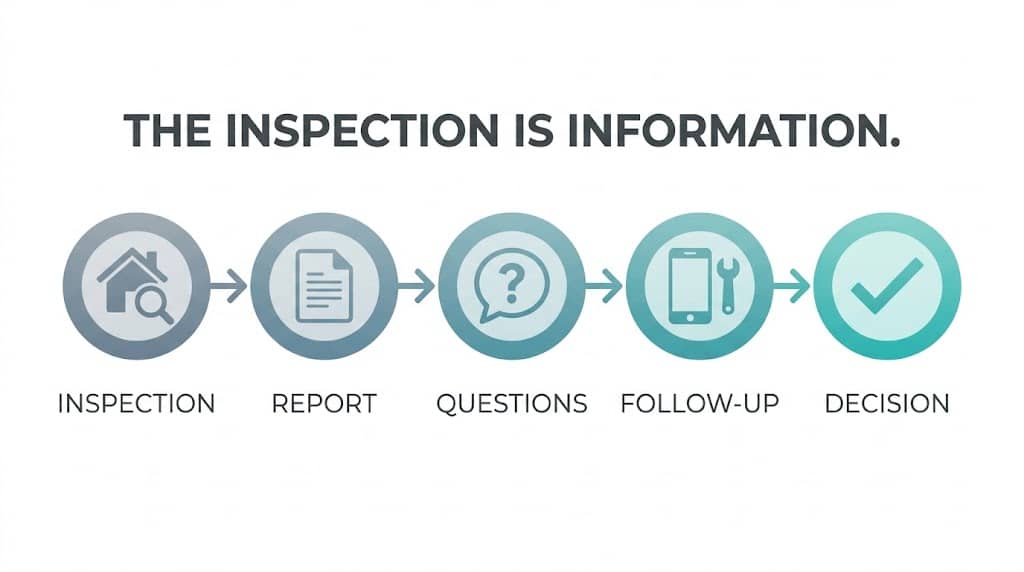
What happens after home inspection day? After a home inspection, the buyer receives and reviews the inspection report. Next, they identify findings that deserve closer attention and ask questions about anything they don’t understand. Then they decide whether additional evaluation by qualified professionals may be appropriate.
The buyer then uses that information, along with real estate, contractual, financial, and other professional guidance, to decide what happens next. The report provides information about the property. It doesn’t make the purchase decision for you.
The Inspection Is Over. Now What?
The inspector is finished. The ladder is back on the truck, the electrical panel is closed, the water has stopped running, and the attic access is back in place. Now you’re waiting for the report.
Captain Obvious: “So… are we done?”
Inspector Hindsight: “With the inspection.”
Captain Obvious: “There’s more?”
Inspector Hindsight: “Now you have to understand what we found.”
Captain Obvious: “I preferred the ladder part.”
For buyers, the inspection itself is only part of the process. What happens afterward can matter just as much.
After all, an inspection report isn’t supposed to be a giant list of reasons to panic. Instead, it’s supposed to help you understand the property. If you’re still preparing, see what is checked during a home inspection.
What Is the First Thing to Do After the Home Inspection?
Read the inspection report. All of it. That means not just the first page, the summary, the photos, the items that sound expensive, or the words in bold.
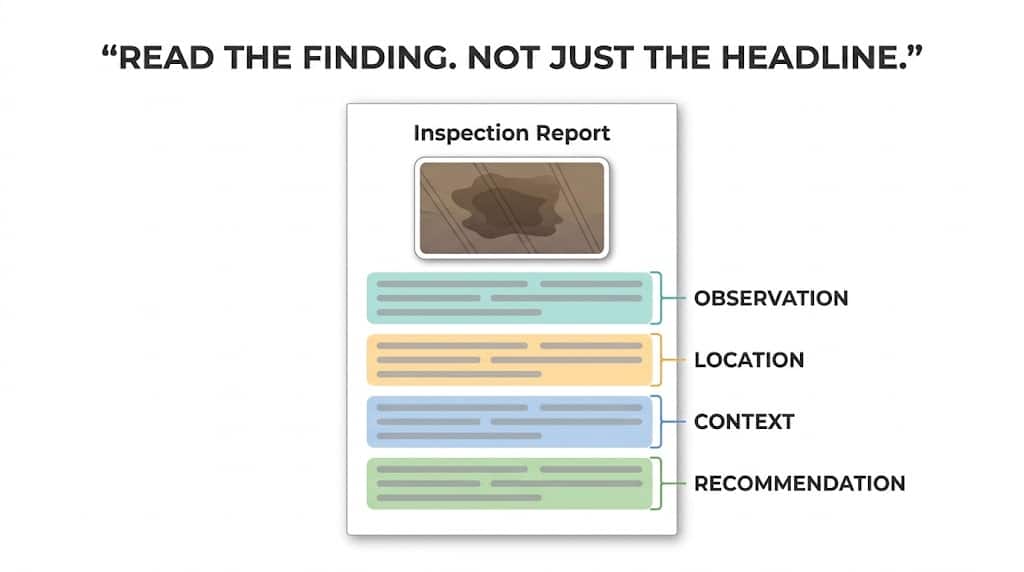
A complete report may contain observed conditions, photos, descriptions, recommendations, maintenance information, safety observations, inspection limitations, inaccessible areas, and system information. Those details provide context.
Should You Only Read the Inspection Summary?
No. A summary can help you get oriented. However, it shouldn’t replace the full report.
That’s because the full report may explain where a condition was found, what was observed, why it matters, what limitations existed, whether further evaluation was recommended, and which photos relate to the finding.
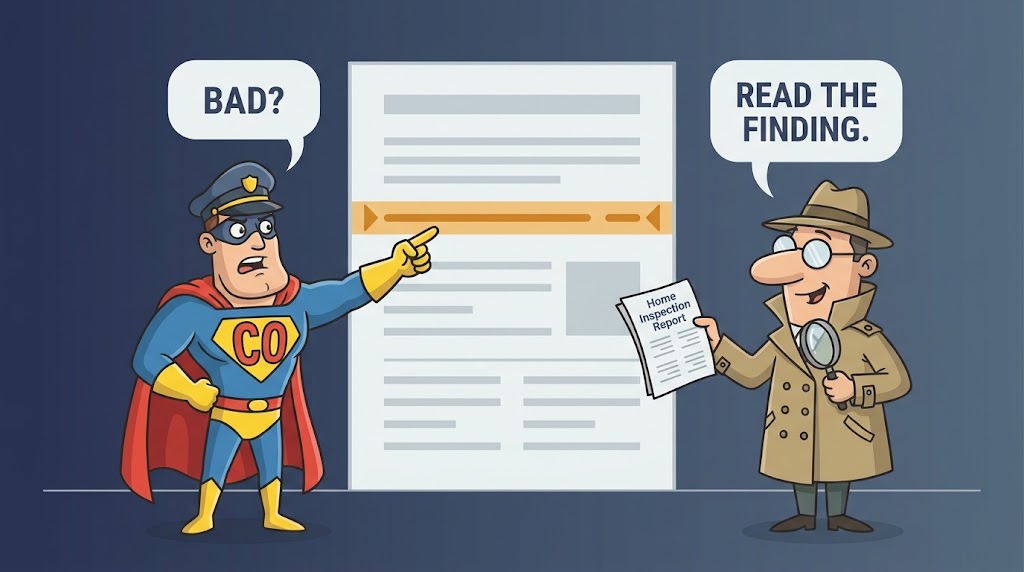
Captain Obvious: “So I can’t just read the red stuff?”
Inspector Hindsight: “You can.”
Captain Obvious: “Great.”
Inspector Hindsight: “If you also want to miss context.”
Captain Obvious: “There it is.”
How Should You Read a Home Inspection Report?
Start with understanding. For each important finding, ask:
- What was observed, and where?
- Is it active?
- Is safety involved?
- How extensive is the visible condition?
- Are other systems related?
- What couldn’t be determined?
- Is further evaluation recommended?
- What remains unknown?
These questions are much more useful than asking, “Is this house bad?”
Does a Long Inspection Report Mean the House Has Major Problems?
No. Report length alone tells you very little about the property’s condition. A longer report may simply include more photos, descriptions, maintenance information, system details, or limitations. It may also reflect a larger property or a more detailed reporting style.
In short, page count isn’t a property-condition rating.
Captain Obvious: “Seventy-two pages.”
Inspector Hindsight: “Yes.”
Captain Obvious: “Terrible house.”
Inspector Hindsight: “You haven’t read page two.”
What Inspection Findings Should You Pay Attention To First?
Findings that may deserve closer attention include:
- Safety concerns
- Active water intrusion
- Significant structural concerns
- Electrical hazards
- Major plumbing leakage
- Roofing concerns
- HVAC safety or operational issues
- Significant deterioration or moisture-related damage
- Important inspection limitations
- Recommendations for specialist evaluation
However, the category alone doesn’t determine severity, because context matters. For more, see our guide to home inspection red flags.
What if the Report Has a Lot of Small Items?
That’s common. Homes contain thousands of components, and they age, move, wear, and need maintenance. So an inspection may list relatively minor conditions alongside more important ones.
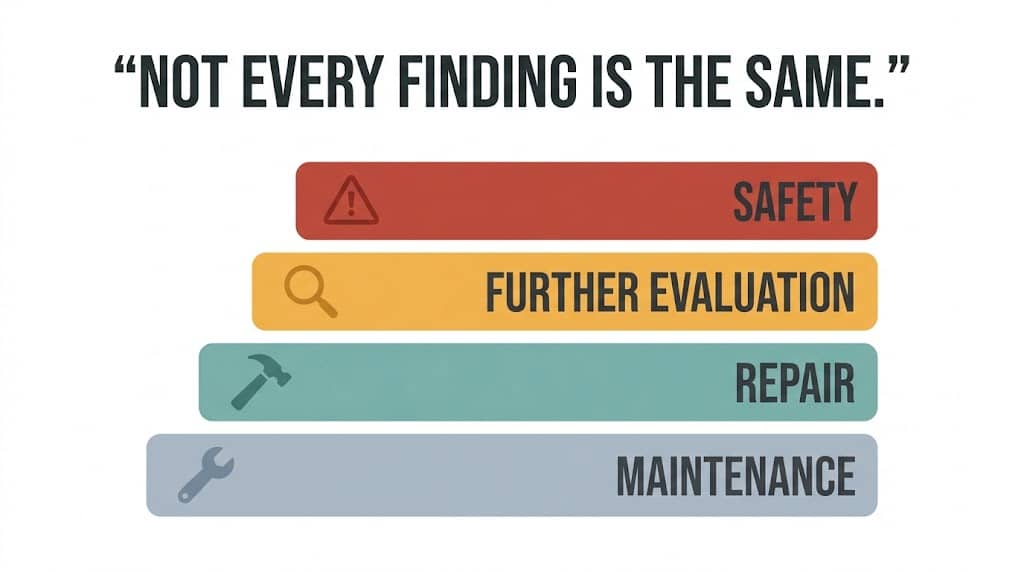
The goal isn’t to treat every observation the same way. After all, a loose cabinet handle and a significant electrical safety concern don’t deserve the same level of attention.
What if the Inspector Found Something Serious?
First, understand exactly what was observed. Then, understand what the inspector recommended.
A significant finding may need evaluation by a qualified professional, such as a structural professional, electrician, plumber, HVAC professional, roofer, or other specialist. That’s because some questions need expertise beyond the home inspection scope.
What Does “Further Evaluation” Mean?
It generally means another question needs an answer beyond what could reasonably be determined during the home inspection.
For example, an inspector may observe significant structural movement. The inspection documents the visible condition, and a structural professional may then evaluate the structural question. Similarly, the inspector may identify an electrical condition that deserves professional assessment, and an electrician may determine the right correction.
Inspector Hindsight: “The inspection identifies the question. Sometimes another professional provides the next answer.”
Does “Further Evaluation” Mean Something Is Definitely Wrong?
Not necessarily. A recommendation for further evaluation doesn’t automatically mean catastrophic damage exists, a system must be replaced, the transaction should be canceled, or the most expensive repair is required.
Rather, it means the evidence justifies additional expertise, testing, access, or investigation.
Should You Call the Inspector With Questions?
Yes. If you don’t understand a finding, asking the inspector for clarification can help. Good questions include:
- Can you explain what you observed, and where exactly?
- What made this condition noteworthy?
- Was it active during the inspection?
- Was the area fully accessible?
- Is this maintenance, repair, safety, or further evaluation?
- What remains unknown?
The goal isn’t to ask the inspector to predict the transaction. Instead, it’s to understand the inspection.
What Shouldn’t You Ask the Inspector to Decide?
Don’t expect the inspector to decide:
- Whether you should buy the house
- Whether you should cancel the transaction
- What the seller must repair or disclose
- What your contract requires
- How negotiations should be handled
- Whether a repair request will be accepted
These questions involve contractual, legal, financial, or negotiation issues outside the home inspection.
Does the Seller Have to Fix Everything in the Inspection Report?
An inspection report doesn’t create a universal requirement for the seller to repair every finding. What happens next depends on factors outside the inspection, including your contract and transaction process.
So questions about repair requests, seller obligations, negotiation, contract deadlines, credits, and concessions belong with your real estate or legal professionals. The inspector’s role is property condition.
Should You Get Repair Estimates After the Inspection?
For certain findings, you may decide that a qualified contractor or specialist should take a look. That professional can assess the condition, possible corrections, scope of work, and other trade-specific questions.
An inspection isn’t a repair estimate. Actual pricing depends on the specific condition, property, contractor, materials, access, location, and scope.
What if the Inspector Found a Foundation Crack?
Don’t jump straight from “foundation crack” to “foundation failure.” Instead, review the context:
- Where is the crack, and which direction does it run?
- Is displacement visible?
- Are there related cracks?
- Are doors, windows, or floors showing related changes?
- What does the exterior show?
- Was further evaluation recommended?
The finding matters, but the pattern matters more. For more, see slab foundation movement: settling vs. heave.
What if the Inspector Found a Ceiling Stain?
A ceiling stain is evidence, but it doesn’t identify the source. Possible sources include roof-related moisture, plumbing, HVAC condensate, condensation, previous water intrusion, or another condition.
So the useful questions are: Was the area wet? What’s above it? What related evidence was observed? Is the stain historical? Was a source identified? Is further evaluation appropriate?
Captain Obvious: “Brown stain. Roof.”
Inspector Hindsight: “Maybe.”
Captain Obvious: “You really enjoy that word.”
Inspector Hindsight: “I enjoy evidence.”
What if the Inspection Found Electrical Problems?
Electrical findings range from straightforward corrections to significant safety concerns. So read the actual finding and understand what equipment is involved, what was observed, whether safety is a concern, and whether further evaluation is recommended.
Serious electrical conditions deserve professional attention. However, don’t open energized equipment or try to reproduce the inspector’s testing yourself. For more, see electrical defects home inspectors flag.
What if the Roof Has Problems?
Read roof findings in context, too. The report may cover roof coverings, flashing, penetrations, previous repairs, drainage, deterioration, leakage evidence, attic observations, and limitations.
So don’t reduce the whole roof section to “How old is the roof?” Age is useful context, but current observable condition is the evidence. For more, see what inspectors check on your roof.
What if the HVAC System Is Old?
Older equipment isn’t automatically failed equipment. A home inspection may provide information about current operation, visible condition, observed deficiencies, accessible components, reliably known age, and limitations.
However, no inspection can guarantee how long a system will keep running. If further evaluation is recommended, make sure you understand why.
What if the Inspection Found Moisture?
Follow the evidence. Ask:
- Where is the moisture, and is it active?
- What material is affected, and how extensively?
- Is plumbing, the roof, or HVAC equipment nearby?
- What’s happening outside?
- Does the crawl space or attic show more evidence?
- Has it happened before?
Inspector Hindsight: “Wet is an observation. Why it’s wet is the question.”
For more, see crawl space moisture and what inspectors look for and what thermal imaging reveals in a home inspection.
What if the Report Mentions Mold?
Be precise. A dark spot isn’t automatically mold, color doesn’t identify species, and appearance alone can’t support health conclusions.
So if the inspection identifies visible growth-like material or moisture-related conditions, review exactly what was observed and what further evaluation was recommended. Mold and health-related questions may require qualified specialists.
What if Part of the House Wasn’t Inspected?
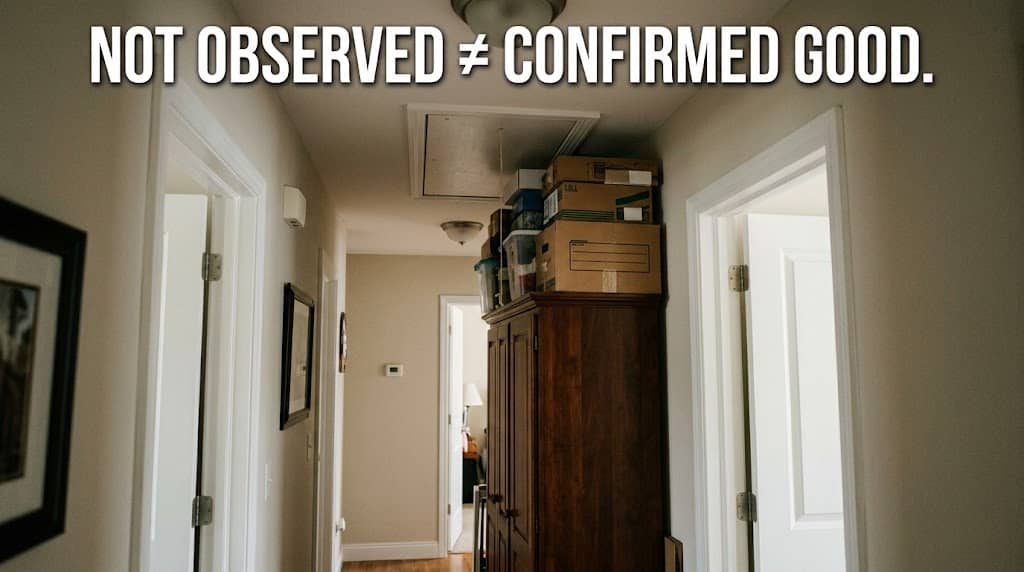
Pay attention to inspection limitations. An area may not have been inspected because of unsafe access, stored belongings, locked access, low clearance, standing water, roof conditions, equipment, furniture, finishes, or other obstructions.
The key distinction is that “not observed” doesn’t mean “no problem exists.” It means that area’s condition wasn’t fully determined.
Should You Be Worried About an Inaccessible Area?
Don’t assume the worst, but don’t ignore the limitation either. Instead, ask:
- Why was the area inaccessible?
- How important is it?
- Can access reasonably be provided?
- Would additional evaluation be useful?
- Does the report note related evidence nearby?
The limitation itself is information.
Can the House Be Reinspected After Repairs?
Some buyers arrange a follow-up evaluation after repairs or specialist work. If you’re considering one, make sure you understand its scope.
A later observation doesn’t automatically certify all the work. It also doesn’t guarantee code compliance or future performance.
Should You Ask for Receipts or Repair Documentation?
Property and repair documentation can provide useful history. Depending on the situation, that might include contractor invoices, roof or foundation repair records, HVAC service records, plumbing or electrical work, WDI treatment documentation, or other records.
Documentation doesn’t prove a condition is perfect today. However, it can help answer what happened, when, who did the work, and what was reported.
What if a Repair Was Already Made Before the Inspection?
Previous repairs are information. The inspector may observe the current visible condition.
So don’t assume a repair has failed. Likewise, don’t assume it’s guaranteed to be good forever. Instead, ask what the current evidence shows.
What if the Inspection Report and Seller Information Don’t Match?
Don’t immediately assume dishonesty. Differences may involve timing, terminology, previous repairs, property history, or what was visible, known, or accessible.
If information seems inconsistent, clarify the facts through the relevant parties and professionals. After all, the inspection report documents conditions, not intentions.
Can the Inspection Report Tell You How Much Everything Will Cost?
Not reliably. Repair cost depends on the actual defect, its extent, access, materials, contractor, location, design, additional damage, and repair approach.
That’s why actual pricing should come from a qualified repair professional.
Can the Inspector Tell You How Urgent a Finding Is?
The report should communicate significant safety or condition concerns clearly, because some findings deserve faster attention than others. For example, a routine maintenance recommendation and a serious electrical safety concern shouldn’t be treated the same.
So the report should help you understand why a finding matters, whether safety is involved, whether further evaluation is appropriate, and what limitations exist.
What Happens if the Inspection Finds Nothing Major?
Then the inspection still gave you useful information. A home doesn’t need a dramatic defect for the inspection to matter.
The report can still help you understand maintenance, system condition, property features, smaller repairs, safety improvements, areas to monitor, and limitations. After all, the goal isn’t to find something terrible. It’s to understand the property.
What if the Inspection Finds a Lot?
Don’t count the comments. Understand them. Ten small maintenance items may mean something very different from one significant safety or structural concern.
Captain Obvious: “Twenty-seven findings.”
Inspector Hindsight: “Okay.”
Captain Obvious: “Is that bad?”
Inspector Hindsight: “What are they?”
Captain Obvious: “Twenty-seven.”
Inspector Hindsight: “That’s a number.”
Captain Obvious: “You make panic surprisingly difficult.”
Inspector Hindsight: “That’s the idea.”
Do You Have to Make a Decision Immediately After the Inspection?
Transaction timelines depend on your contract and circumstances. Your inspector can’t interpret your contract deadlines.
So confirm your actual timeline with your real estate or legal professionals. That matters because additional evaluations can take time. Know your deadlines, and get them from the people responsible for the transaction rather than from assumptions online.
What Role Does Your Real Estate Professional Play After the Inspection?
The inspector and the real estate professional have different roles:
- The inspector explains property condition.
- Your real estate professional helps you understand the transaction process.
- A legal professional handles legal questions.
- Qualified contractors and specialists handle trade-specific evaluation and repair.
Keeping those roles clear helps you get better answers.
Should You Send the Report to Contractors?
If further evaluation is needed, relevant parts of the report can help a professional understand the inspector’s observation.
However, the contractor should evaluate the actual property and condition rather than price work from a single sentence or photo. In short, the report identifies the observed condition, and the specialist determines the trade-specific answer.
What if a Contractor Disagrees With the Inspector?
Different professionals may have different scopes, information, access, or expertise. So start with the facts:
- What did the inspector actually observe?
- What did the specialist actually evaluate?
- Did conditions change?
- Was additional access available?
- Was specialized testing performed?
Avoid turning a professional disagreement into a contest. The goal is to understand the property.
Should You Google Every Finding in the Report?
You can research unfamiliar terms, but be careful. Searching “foundation crack” can quickly turn into “my house is collapsing.” Similarly, “ceiling stain” can become “complete roof failure,” and “old HVAC” can become “replace everything tomorrow.”
Search results don’t know the condition of the house you just inspected. Your inspection report does.
Captain Obvious: “But the internet said—”
Inspector Hindsight: “The internet hasn’t been inside this house.”
What Should First-Time Buyers Remember?
Almost every existing home has something to report. So findings don’t automatically mean the property is a bad purchase.
Instead, focus on severity, safety, active conditions, system significance, patterns, limitations, further evaluation, property history, and what you personally need to understand before deciding.
The Inspector’s Eye: From Finding to Next Step
Imagine the report says: Water staining observed at bedroom ceiling.
Captain reads: Roof replacement. Hindsight reads: Water staining observed at bedroom ceiling.
Captain Obvious: “Those are not the same sentence.”
Inspector Hindsight: “Exactly.”
Now the questions begin. Was the stain wet? What’s above the room? What did the attic and roof show? Is plumbing or HVAC equipment nearby? Is there a repair history? Was further evaluation recommended?
The finding tells us what was observed. The supporting evidence helps us understand what it may mean. And the recommendation helps answer what happens next. That’s how an inspection report should be used.
Captain Obvious: “It was obvious.”
Inspector Hindsight: “Until it wasn’t.”
What Happens After Home Inspection Day: The Simple Process
- Read the complete report.
- Identify important findings.
- Understand the context.
- Review inspection limitations.
- Ask the inspector questions.
- Identify findings that need specialist evaluation.
- Get professional information when needed.
- Discuss transaction questions with your transaction professionals.
- Make your own informed decision.
What Not to Do After a Home Inspection
Don’t:
- Panic because the report is long
- Treat every comment as equally serious
- Assume every crack means structural failure
- Assume every stain is an active roof leak
- Assume every dark spot is mold
- Assume every old system has failed
- Ignore inaccessible areas or recommendations for further evaluation
- Ask the inspector to predict negotiations or give legal advice
- Expect repair pricing from the report
- Assume the inspection found every possible defect
Instead: read, ask, understand, and follow the evidence.
After the Home Inspection FAQs
What happens after a home inspection?
The buyer reviews the report, understands significant findings and limitations, asks questions, and gets further professional evaluation when appropriate. Then they use that information, along with transaction guidance, to decide what happens next.
What should I do first after the home inspection?
Read the complete report, and identify any findings, limitations, and recommendations you don’t fully understand.
Should I only read the inspection summary?
No. A summary helps, but the full report provides important context, descriptions, photos, limitations, and recommendations.
Does a long inspection report mean a bad house?
No. Report length alone doesn’t determine property condition.
Does the seller have to fix everything?
No. An inspection report doesn’t create a universal requirement to repair every finding. Transaction and contract questions belong with the appropriate professionals.
What does further evaluation mean?
It means an observed condition or limitation may need additional expertise, testing, access, or investigation beyond the home inspection scope.
Should I call the inspector if I don’t understand something?
Yes. Clarifying a finding with your inspector can help you understand what was observed, why it matters, and what further evaluation may be appropriate.
Can the inspector tell me whether to buy the house?
No. The inspector provides property-condition information, and you make the purchase decision.
Can the inspector tell me what the seller must repair?
No. The inspector identifies property conditions. Repair obligations and negotiation questions belong with your transaction or legal professionals.
Should I get specialists involved after the inspection?
When the report recommends further evaluation, a qualified specialist may be needed to answer questions beyond the inspection scope.
Can a home inspection find every problem?
No. Concealed, inaccessible, intermittent, future, or out-of-scope conditions may not be found during a visual inspection.
What if part of the house was not inspected?
Review why the area was inaccessible, and decide whether additional access or evaluation is appropriate. Not observed doesn’t mean confirmed defect-free.
Schedule Your RedFish Inspection
The inspection isn’t finished just because the inspector left the house. The next part is understanding what the evidence means.
Read the report, understand the findings and limitations, and ask questions. Then bring in the right professionals when another level of evaluation is needed, and use that information to make your decision. That’s what the inspection is for.
Schedule your RedFish inspection.
RedFish Inspections
Inspecting To A Higher Standard.
Call (866) 218-6699

