

Crawl space moisture can reveal a lot about a home. In fact, some of the most useful information about a house may be in the place nobody wants to visit: underneath it.
Crawl spaces can contain plumbing, electrical components, structural framing, supports, insulation, and foundation components. Some homes also have mechanical equipment down there. Together, they hold plenty of clues about how moisture is, or isn’t, being managed.
Captain Obvious: “So we’re going under the house.”
Inspector Hindsight: “If it’s safely accessible.”
Captain Obvious: “I was hoping you’d forget that part.”
Inspector Hindsight: “The house didn’t.”
A crawl space inspection isn’t simply a hunt for standing water. Instead, the real job is understanding visible conditions and how they relate to the rest of the property.
What Do Home Inspectors Look For in a Crawl Space?
When a crawl space is safely accessible and within scope, an inspector may look for visible conditions involving:
- Moisture and standing water
- Drainage evidence
- Plumbing leakage
- Wood framing and supports
- Insulation
- Ventilation or conditioning features, where applicable
- Electrical components
- Foundation conditions
- Wood deterioration or wood-destroying insect evidence
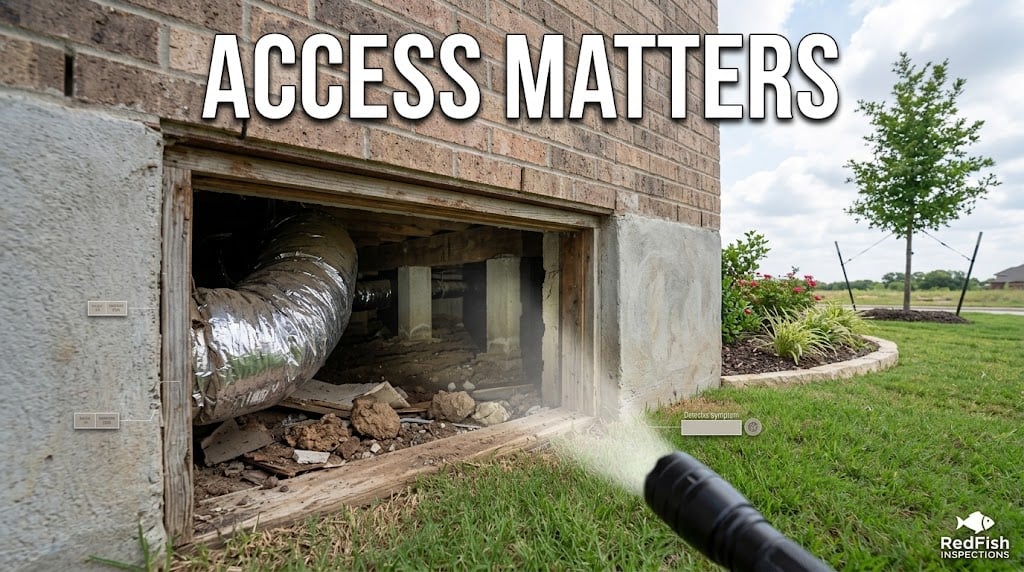
However, access matters. An inspector can’t report inaccessible or concealed areas as though they were fully observed.
Is Moisture in a Crawl Space Always a Problem?
Moisture deserves attention. However, “moisture” can describe several different conditions, such as:
- Standing water or damp soil
- Condensation
- A plumbing leak
- Staining on framing
- Damp insulation
- Evidence of previous water entry
- Elevated moisture in a material, when appropriately measured
In other words, moisture starts the investigation. It doesn’t finish it.
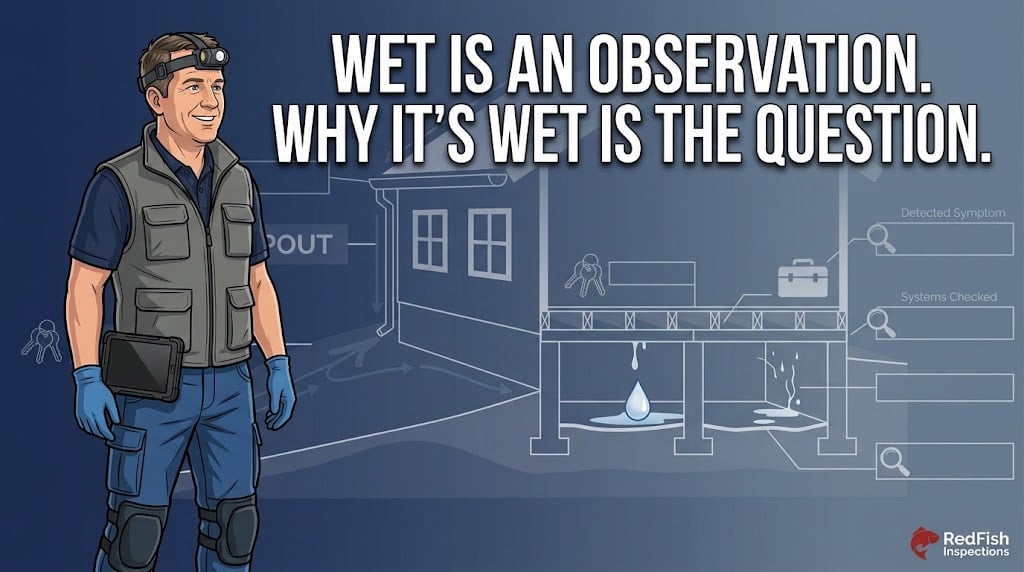
Inspector Hindsight: “Wet is an observation. Why it’s wet is the question.”
Where Can Crawl Space Moisture Come From?
There’s no single source of crawl space moisture. Potential contributors include:
- Plumbing leakage
- Exterior drainage
- Roof runoff discharged near the structure
- Surface water or ground moisture
- Condensation
- HVAC condensate issues, where equipment is present
- Water entering through or around foundation components
- Previous water events
So an inspector shouldn’t pick one explanation just because it’s common. Instead, the pattern matters.
What Does Standing Water in a Crawl Space Mean?
Standing water is an important observation. However, it doesn’t identify its own source. So an inspector may ask:
- Where is the water concentrated?
- Is it near plumbing or near the perimeter?
- Is the soil wet throughout the crawl space?
- Are drainage patterns visible?
- Has it rained recently?
- Are downspouts discharging nearby?
- Do stains show a previous water level?
- Are framing or insulation materials wet?
- Has the condition happened repeatedly?
Captain Obvious: “Water under the house.”
Inspector Hindsight: “Yes.”
Captain Obvious: “Bad drainage.”
Inspector Hindsight: “Maybe.”
Captain Obvious: “Plumbing leak?”
Inspector Hindsight: “Maybe.”
Captain Obvious: “Groundwater?”
Inspector Hindsight: “Maybe.”
Captain Obvious: “You really like that word.”
Inspector Hindsight: “It keeps us from making things up.”
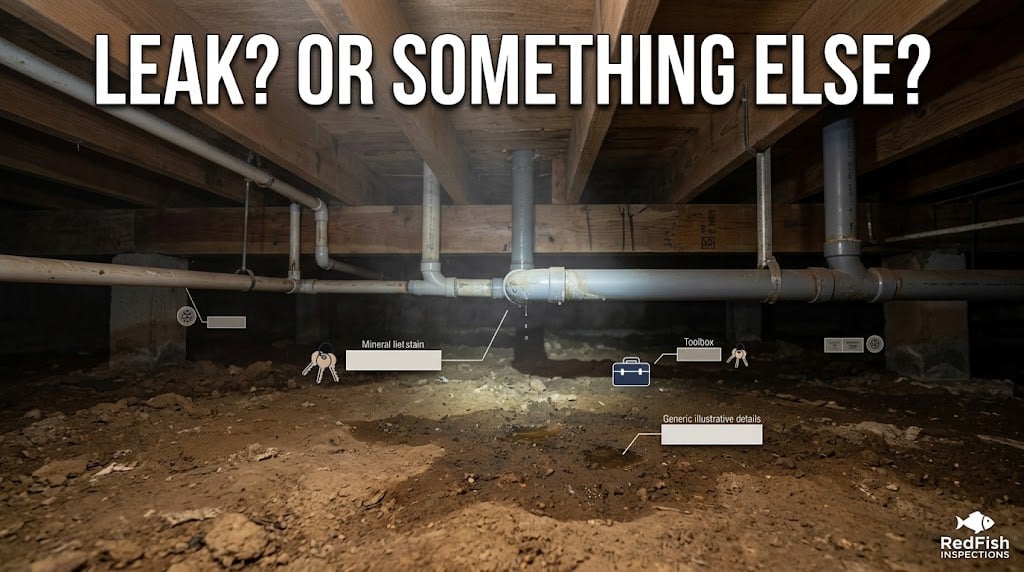
Can a Plumbing Leak Cause Crawl Space Moisture?
Yes. Accessible plumbing below a home is one possible moisture source. For example, an inspector may observe:
- Active dripping or water staining
- Corrosion
- Damp materials or standing water below plumbing
- Damaged piping
- Loose or problematic connections, where visible
However, water below a pipe doesn’t prove that pipe is the source. So the inspector looks for supporting evidence.
Can Rainwater End Up in a Crawl Space?
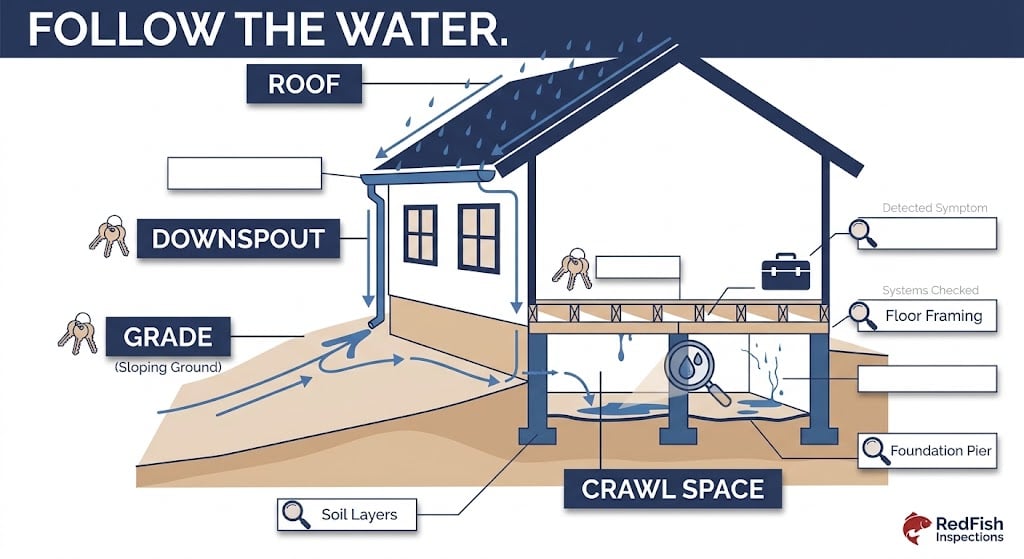
Yes. Exterior water management affects conditions around and below a home. So an inspector may consider:
- Roof runoff, gutters, and downspouts
- Grade and low areas near the foundation
- Surface drainage
- Foundation openings
- Porches and decks
In short, the useful question is: where does the water go?
Inspector Hindsight: “Don’t start under the house and forget to look outside.”
Why Do Gutters and Downspouts Matter?
Where present, gutters and downspouts help control roof runoff. So if water concentrates near the foundation, that becomes part of the crawl space moisture investigation.
However, missing gutters don’t automatically mean a crawl space problem. Likewise, a wet crawl space doesn’t automatically mean the gutters failed. Rather, roof drainage is one relationship worth evaluating.
Why Does the Grade Around the House Matter?
Surface drainage affects where rainwater travels around a property. Therefore, inspectors look at whether visible site conditions appear to direct water toward or away from the structure.
A visual inspection documents observable drainage conditions. However, it isn’t an engineering analysis, so more specialized evaluation may be appropriate when the situation calls for it.
Can Condensation Cause Crawl Space Moisture?
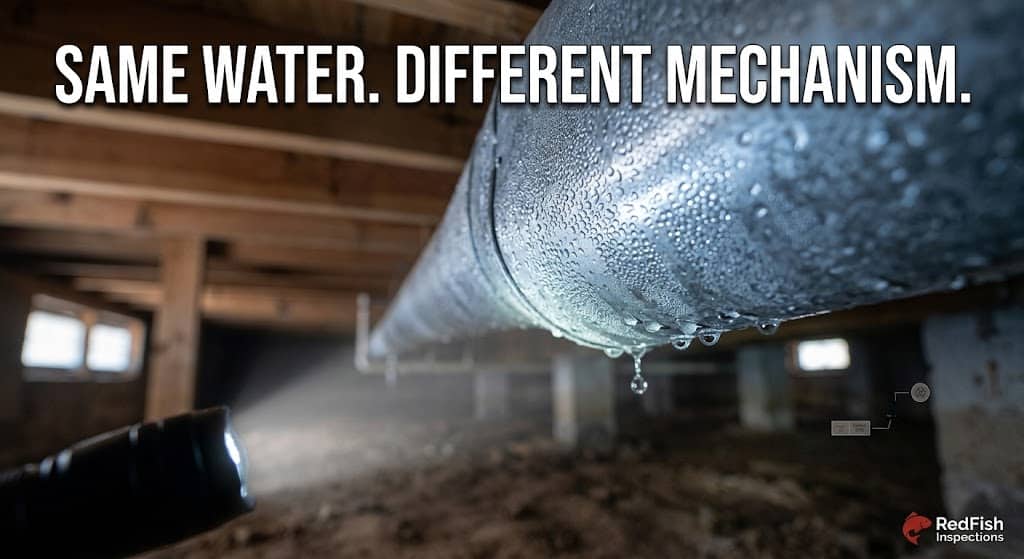
Yes. Condensation forms when a surface is cool enough for water vapor in the surrounding air to condense on it. For example, it can appear on ductwork, piping, mechanical equipment, and other cool surfaces.
Still, visible water on a pipe or duct should be evaluated in context. For more on moisture in the home, see our guide on humidity and moisture control in Texas homes.
Captain Obvious: “Wet pipe. Leak.”
Inspector Hindsight: “Or condensation.”
Captain Obvious: “Right.”
Inspector Hindsight: “Same visible symptom. Different moisture mechanism.”
What Do Inspectors Look For on Wood Framing?
Accessible wood framing reveals information about moisture history and current condition. For example, an inspector may observe:
- Staining or discoloration
- Visible deterioration or damaged wood
- Previous repairs
- Sagging or displacement
- Insect-related evidence
- Wet or damp-looking areas
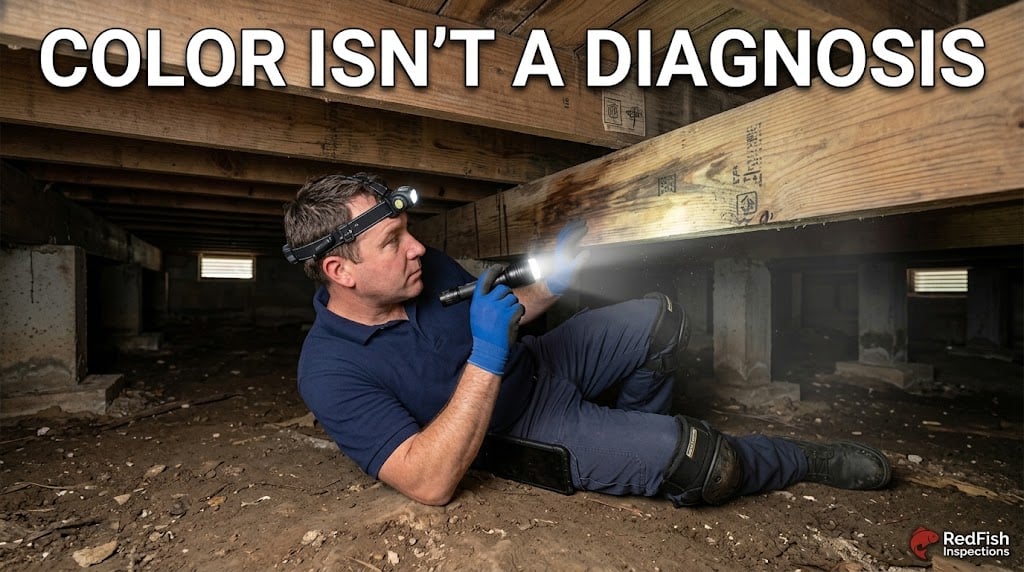
However, appearance alone doesn’t establish the cause or the concealed extent of deterioration. A dark joist isn’t automatically rotten, and a stain isn’t automatically active.
Does Dark Wood in a Crawl Space Mean Mold?
No. Color alone doesn’t identify mold, and dark material on framing can have several explanations.
If growth-like material is visible, the inspector can document the observable condition within scope. However, appearance alone can’t identify a mold species or predict health effects.
Captain Obvious: “Dark spot.”
Inspector Hindsight: “Dark spot.”
Captain Obvious: “We’ve had this conversation.”
Inspector Hindsight: “And somehow color still isn’t a laboratory.”
What About Wood-Destroying Insects?
Crawl spaces contain accessible wood where insect-related evidence may be visible. For example, observations can include damaged wood, tubes, holes, frass-like material, or previous treatment evidence.
However, insect identification and activity determinations belong within the appropriate professional scope. After all, a home inspection and a specialized WDI inspection may answer different questions. For more, see our guide to termite and WDI inspections for Texas buyers.
Can Crawl Space Moisture Damage Wood?
Yes. Persistent moisture can contribute to deterioration of wood and other materials. Still, the inspector should report the condition actually observed.
For example, “visible wood deterioration” is supportable when deterioration is visible. In contrast, “the entire floor system is rotten” isn’t supportable unless the evidence establishes it. In short, inspection language matters.
The same wood-and-moisture principles apply to other wood-intensive homes, as our guide to buying a log home in Texas explains.
What Do Inspectors Look For at Supports?
Accessible supports may include beams, joists, posts, piers, foundation components, and connections. So an inspector may look for:
- Damage or deterioration
- Movement
- Improvised alterations
- Missing or problematic connections
- Moisture effects
Serious structural concerns may warrant evaluation by a qualified professional. However, one crawl space observation shouldn’t become a structural diagnosis without supporting evidence. For related reading, see our guide on foundation cracks and what they mean in Texas, plus slab foundation movement: settling vs. heave.
What About Floor Insulation?
Where insulation is present and visible, an inspector may observe missing, displaced, wet, stained, or damaged insulation.
In fact, wet insulation can be a clue that moisture is occurring nearby. However, the insulation itself may not identify the source.
Should a Crawl Space Be Vented or Sealed?
There’s no responsible one-sentence answer for every crawl space. Designs vary. For example, some use exterior ventilation, while others are enclosed or conditioned. Some also use vapor-control strategies.
The right configuration depends on the building design, applicable requirements, climate, and equipment. So don’t call a crawl space “wrong” just because it doesn’t match another house. Instead, first identify which system you’re looking at.
What Is a Crawl Space Vapor Retarder?
Some crawl spaces use material over exposed soil as part of a moisture-control strategy. During a visual inspection, observable conditions may include:
- Coverage and displacement
- Damage
- Standing water above the material
- Exposed soil
However, material and installation requirements depend on the design and applicable standards. So there’s no single universal specification.
Does a Vapor Retarder Guarantee a Dry Crawl Space?
No. One moisture-control component can’t guarantee the performance of the entire space. After all, water can still come from plumbing, drainage, bulk water entry, condensation, mechanical conditions, or installation details.
Captain Obvious: “Plastic on the ground. Problem solved?”
Inspector Hindsight: “Component present. Now inspect the system.”
What About Crawl Space Vents?
Where vents are part of the design, an inspector can evaluate their visible condition. However, more ventilation isn’t always better. Likewise, closing every vent isn’t always better.
Instead, moisture behavior depends on the actual crawl space design and environmental conditions. This is another place where generic internet advice can sound more confident than the evidence.
Can HVAC Ducts Affect Crawl Space Moisture?
Yes. Where ducts or equipment are in the crawl space, an inspector may observe condensation, damaged insulation, disconnected ducts, or condensate-related conditions.
Again, water on or near HVAC components is evidence. However, its exact source still needs support.
Can a Crawl Space Cause a Musty Smell in the House?
A damp crawl space can be relevant when investigating musty odors. However, odor alone doesn’t prove the crawl space is the source.
So the inspector considers where the odor is strongest, visible crawl space conditions, air pathways, moisture evidence, HVAC relationships, and other sources in the home. In short, the smell is a clue, not a diagnosis. For more, see our guide on why your house smells musty.
Can Crawl Space Moisture Lead to Mold?
Moisture is an important condition for indoor mold growth. So if suspected growth is observed, it should be handled with technical care.
However, moisture doesn’t automatically mean mold is present. Also, dark material doesn’t identify a mold species. Therefore, the inspection distinguishes between a moisture observation, visible growth-like material, material deterioration, laboratory identification, and health assessment. Those aren’t interchangeable.
Can Thermal Imaging Find Crawl Space Moisture?
Thermal imaging detects surface temperature patterns. Under the right conditions, a temperature anomaly may point to an area worth investigating.
However, thermal imaging doesn’t see through floors or walls, directly identify moisture, identify mold, or guarantee hidden defects will be found. Rather, a temperature pattern is one more piece of evidence.
What About Moisture Meters?
A moisture meter can provide additional information about certain accessible materials when used appropriately. However, a reading still needs context.
After all, the material, location, instrument, and surrounding conditions all matter. Also, one reading doesn’t establish the condition of every concealed component.
What If the Crawl Space Is Too Small to Enter?
Access is a critical limitation. For example, a crawl space may be restricted by:
- Low clearance
- Standing water
- Unsafe conditions or other hazards
- Debris or obstructions
- Animals
- Mechanical equipment
- Locked or damaged access
If an area can’t be safely entered or fully observed, the inspector shouldn’t pretend it was inspected.
Captain Obvious: “So you’re not squeezing through an eight-inch opening?”
Inspector Hindsight: “Inspection does not require becoming two-dimensional.”
What If Only Part of the Crawl Space Is Accessible?
Then the limitation matters. The inspector reports what was visible and accessible, and identifies areas that couldn’t be observed.
This is one of the most important principles in inspection: “not observed” doesn’t mean “no problem exists.” It simply means the area wasn’t observed.
Can an Inspector Guarantee There’s No Hidden Crawl Space Moisture?
No. A visual inspection can’t guarantee the absence of concealed moisture. For example, conditions can exist inside walls, below flooring, behind insulation, under stored materials, or beyond inaccessible areas.
Instead, the inspection describes visible and accessible conditions at the time of inspection. It isn’t a guarantee of concealed or future conditions.
What Should Buyers Ask About a Crawl Space?
Useful questions include:
- Was the crawl space fully accessible?
- Was standing water observed?
- Were plumbing leaks visible?
- Was moisture-related staining present?
- What condition was the framing in?
- Were supports visibly altered or damaged?
- Was insulation wet or displaced?
- Were insect-related conditions observed?
- Were any areas inaccessible?
- Was further evaluation recommended?
- Is there a known history of water or repairs?
After all, these questions reveal much more than “Was it dry?”
What Records Should Buyers Ask For?
If crawl space work has been done, records provide useful context. For example, ask about drainage, plumbing, foundation, or structural repairs. Also ask about pest or WDI treatment, moisture-control work, insulation, HVAC work, and previous inspection reports.
However, a repair doesn’t automatically mean it failed. Likewise, missing documentation doesn’t prove a defect. Records simply provide context.
What Should Sellers Do Before an Inspection?
Sellers can help by making the crawl space accessible when it’s safe. For example, that may include:
- Making sure the access opening is reachable
- Removing stored items blocking access
- Providing keys for secured access
- Sharing relevant repair records
- Disclosing known conditions according to applicable requirements
Also, avoid last-minute cosmetic work meant only to change what’s visible. After all, the goal is access and information.
When Should Further Evaluation Be Considered?
Further evaluation may be appropriate when conditions exceed the scope of a visual inspection. For example:
- Significant standing water
- Active leakage
- Extensive wood deterioration
- Structural concerns
- Suspected WDI activity
- Significant electrical concerns
- Persistent unexplained moisture
- Inaccessible areas tied to significant concerns
In short, the right next professional depends on the actual condition.
The Inspector’s Eye: Follow the Crawl Space Moisture
Imagine an inspector enters a crawl space and sees a wet area. Captain Obvious sees water, which is correct.
Next, Inspector Hindsight asks more questions:
- Where is it, and is it isolated?
- What’s directly above it?
- Is plumbing present?
- What does the soil look like?
- Is there staining on the foundation?
- Are the framing and insulation wet?
- What’s happening outside this wall?
- Where do the downspouts discharge?
- Has it rained recently?
- Has the water been here before?
- Is the condition active right now?
That is inspection thinking. The water matters. However, the relationships tell the story.
Captain Obvious: “Wet crawl space.”
Inspector Hindsight: “Yes.”
Captain Obvious: “Find the water source.”
Inspector Hindsight: “Now you’re getting it.”
Captain Obvious: “It was obvious.”
Inspector Hindsight: “Until it wasn’t.”
Crawl Space Moisture: The Simple Answer
Crawl space moisture deserves attention because it can relate to plumbing, drainage, ground moisture, condensation, wood framing, insulation, foundation components, HVAC, and wood-destroying insects.
However, remember:
- Water doesn’t identify its own source.
- Dark wood doesn’t automatically mean mold or rot.
- A stain doesn’t automatically mean the condition is active.
- A vapor retarder doesn’t guarantee a dry crawl space.
- One dry area doesn’t guarantee the entire space is dry.
- An inaccessible area can’t be reported as fully observed.
In the end, the best question is: what does the evidence actually support?
Crawl Space Moisture & Inspection FAQs
What do home inspectors look for in a crawl space?
Inspectors may evaluate visible conditions involving moisture, standing water, plumbing, framing, supports, foundation components, insulation, electrical and HVAC components, and drainage evidence.
Is water in a crawl space always a serious problem?
It deserves attention. However, its significance depends on the source, extent, duration, affected materials, and related conditions.
What causes crawl space moisture?
Possible contributors include plumbing leaks, exterior drainage, roof runoff, ground moisture, condensation, and mechanical conditions.
Can a plumbing leak make a crawl space wet?
Yes. However, water below plumbing doesn’t by itself prove the plumbing caused it.
Does dark wood in a crawl space mean mold?
No. Color alone doesn’t identify mold or establish the cause of discoloration.
Can crawl space moisture damage wood?
Yes, persistent moisture can contribute to deterioration. Still, the inspector reports what’s observable rather than assuming hidden extent.
Can a crawl space cause a musty smell?
It may be relevant. However, odor alone doesn’t establish the source.
Can thermal imaging detect crawl space moisture?
It detects surface temperature patterns. It doesn’t directly identify moisture or mold, and it can’t see through walls.
What if the crawl space isn’t accessible?
The inspector can only evaluate areas that can be safely observed. So inaccessible areas become an inspection limitation.
Does a vapor retarder guarantee a dry crawl space?
No. It’s one part of a moisture-control strategy and doesn’t guarantee the whole space stays dry.
Should every crawl space be vented?
Not necessarily. Designs differ, so ventilation or conditioning should be evaluated in the context of the actual building.
Should I buy a house with crawl space moisture?
That decision is yours. The inspection documents the condition, its context, and its limits, and identifies when further evaluation may help.
Schedule Your RedFish Inspection
Some of the most important clues about a home may be underneath it. If the crawl space is safely accessible, it can reveal useful information about moisture, plumbing, framing, supports, drainage, and insulation.
So don’t just ask, “Was it wet?” Instead, ask, “Why?”
Schedule your RedFish inspection.
RedFish Inspections
Inspecting To A Higher Standard.
Call (866) 218-6699
