

Log home maintenance starts with understanding what you’re looking at. After all, a log home can make a strong first impression.
Visible wood, exposed structure, big rooflines, and wide porches all add character. In fact, many buyers start arranging furniture before the inspection even begins. Captain Obvious approves.
However, an inspection has a different job. A log home is still a house. So it still has a roof, foundation, electrical, plumbing, and heating and cooling. It also has windows, doors, drainage, site conditions, and an attic or crawl space.
Log construction simply adds another layer of questions, because the wall material itself deserves careful attention. The goal isn’t to make you afraid of log homes. Rather, it’s to help you understand the one you’re considering.
What Should You Inspect When Buying a Log Home?
Inspect the entire property, with particular attention to visible and accessible log-wall conditions. For example, that includes:
- Moisture exposure and deterioration
- Joints and penetrations
- Windows and doors
- Roof drainage
- Foundation or crawl-space conditions
- Signs of previous maintenance or repair
However, a crack, stain, gap, or weathered area is only an observation. Its significance depends on location, pattern, moisture, extent, nearby conditions, construction, and maintenance history.
Captain Obvious: “It’s a house made of logs.”
Inspector Hindsight: “Excellent start.”
Captain Obvious: “So we inspect the logs.”
Inspector Hindsight: “And the roof, foundation, electrical, plumbing, HVAC—”
Captain Obvious: “Right. Still a house.”
Inspector Hindsight: “Exactly.”
What Is Different About a Log Home Inspection?
A log home inspection still covers the whole property. However, log construction adds visible conditions worth understanding. So an inspector may pay particular attention to:
- Log surfaces and log ends
- Joints between logs
- Openings around doors and windows
- Penetrations
- Areas exposed to roof runoff
- Areas near decks and porches
- Wood close to grade
- Visible deterioration or moisture staining
- Previous repairs and coating condition
- Foundation or crawl-space relationships
The goal isn’t to treat every unusual-looking log as a defect. Instead, it’s to recognize patterns that deserve attention.
Why Does Water Matter So Much Around Log Walls?
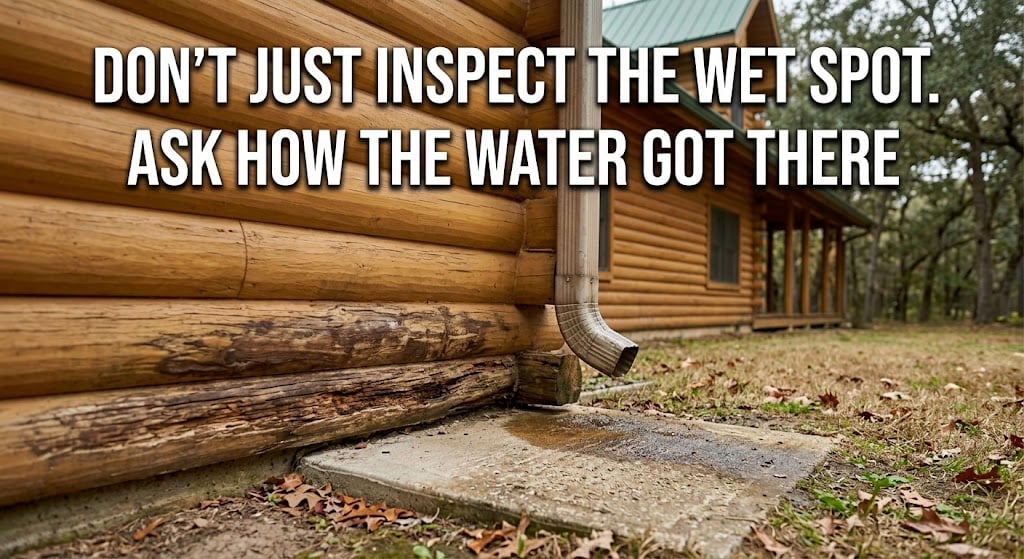
Repeated moisture exposure can affect wood and the materials around it. So the useful question isn’t just “Is this wood?” Rather, it’s “How is water being managed around this wood?”
That means looking at relationships: the roof, gutters, downspouts, splashback, decks, porches, windows, doors, and penetrations. Ground clearance, drainage, vegetation, and joints matter too.
In fact, a condition on the wall may begin with something happening somewhere else.
Inspector Hindsight: “Don’t just inspect the wet spot. Ask how the water got there.”
Captain Obvious: “Water. Again.”
What Are Common Log Home Problems?
Common concerns in log homes may involve:
- Moisture exposure and wood deterioration
- Open joints or gaps
- Weathered coatings
- Damaged log surfaces
- Problematic penetrations
- Conditions around windows and doors
- Roof-drainage issues
- Wood close to the ground
- Insect-related evidence
- Previous repairs
- Foundation or crawl-space moisture
However, “common” doesn’t mean “present in every log home.” A good inspection reports the actual property, not a stereotype of the property type.
Are Cracks in Logs Always a Problem?
No. A visible crack doesn’t automatically mean structural failure or significant deterioration. In fact, some cracks in wood are commonly called checks.
Still, seeing a check only starts the question. So the inspector may consider:
- Where is it, and how large is it?
- Which direction does it face?
- Can it collect water?
- Does it intersect another opening?
- What does the surrounding wood look like?
- Is staining or deterioration visible?
- Are multiple logs affected?
- Is there evidence of previous repair?
Captain Obvious: “Crack in log.”
Inspector Hindsight: “Yes.”
Captain Obvious: “Bad?”
Inspector Hindsight: “You skipped six questions.”
Captain Obvious: “I was being efficient.”
What Is Checking in a Log?
Checking is a common term for cracks or separations that develop in wood as it changes with moisture and drying. Therefore, checking alone doesn’t mean the log has failed.
A useful distinction is this: a check being present is an observation. In contrast, a check causing a particular problem requires evidence.
Why Does the Direction of a Log Check Matter?
The orientation and location of an opening affect how it interacts with water. For example, an upward-facing check may deserve attention if it can collect water.
Even so, the inspector should evaluate surrounding conditions rather than apply a universal diagnosis. So ask:
- Is the opening exposed to weather, or protected by a roof or porch?
- Does water drain away?
- Is staining or deterioration visible?
- Has the opening been maintained or sealed?
- What is happening nearby?
Inspector Hindsight: “The crack matters. The water path may matter more.”

Do All Log Cracks Need to Be Sealed?
Not necessarily. The right treatment depends on the log construction, opening configuration, location, exposure, existing materials, and condition. Manufacturer or builder guidance also matters, where available.
So repair approaches are best recommended by a qualified log-home professional. Meanwhile, the inspector’s role is to document the condition and explain why it deserves attention.
What Does Wood Deterioration Look Like?
Visible wood deterioration can present in different ways. For example, an inspector may notice:
- Soft-looking or damaged areas
- Surface loss or discoloration
- Open or deteriorated wood fibers
- Areas linked to repeated moisture exposure
- Damaged log ends
- Previous repair material
However, appearance alone may not reveal the full depth or extent of concealed deterioration. That limitation matters.
Can a Log Look Fine on the Surface and Have a Hidden Problem?
Yes. Concealed conditions can exist in any building, including log homes. A visual inspection evaluates visible and accessible conditions within scope.
So it can’t see through solid wood, inside every log, behind every finish, or inside every concealed joint. Nor can it guarantee the absence of hidden deterioration.
In other words, what wasn’t seen isn’t proven absent. Instead, the inspection reports what was visible and accessible, along with relevant limitations.
Can You Tell How Deep Wood Deterioration Goes by Looking at It?
Not always. A visibly affected surface may justify further evaluation. However, the full extent of deterioration can be concealed.
So an inspector shouldn’t claim visual evidence shows dimensions that weren’t actually measured or observed.
Captain Obvious: “So it looks damaged.”
Inspector Hindsight: “Yes.”
Captain Obvious: “How far does it go?”
Inspector Hindsight: “That’s exactly the question.”
Why Do Log Ends Deserve Attention?
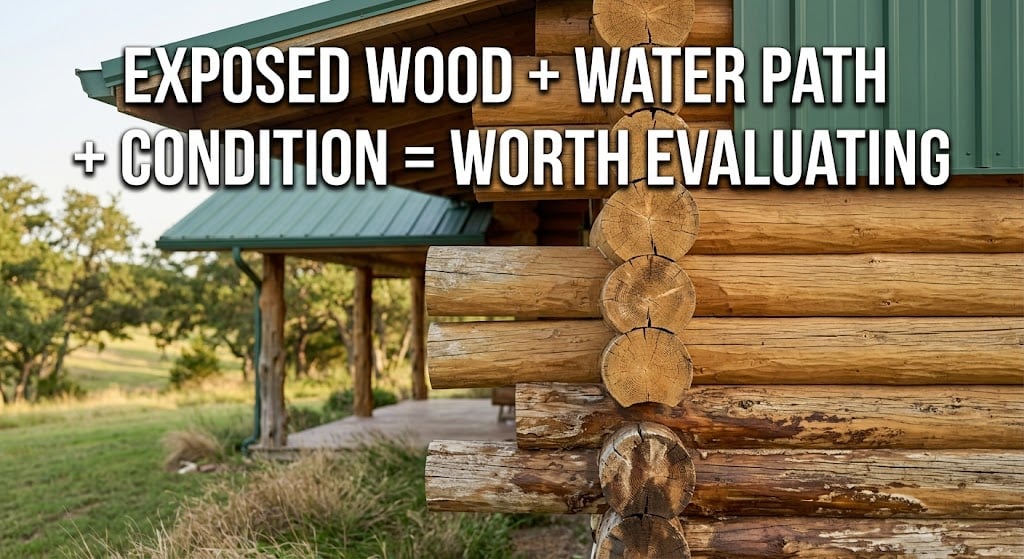
Log ends are exposed parts of the wall system. As a result, they may show weathering, cracking, moisture effects, or deterioration.
For example, inspectors may look closely at log ends near corners, roof edges, porches, and decks.
However, a log end isn’t automatically a problem. Instead, exposed wood, a water path, and visible condition together make it worth evaluating.
Why Do Windows and Doors Matter in a Log Home?
Every window and door interrupts the wall. Therefore, the surrounding area deserves attention. An inspector may look at:
- Trim, joints, and sealant
- Flashing details, where visible
- Staining or moisture evidence
- Openings or deterioration
- Window or door operation
- Previous repairs
However, the opening may not be the source of every nearby condition. After all, water travels, so the pattern matters.
Does a Stain Below a Window Mean the Window Leaks?
Not automatically. A stain below a window is evidence of a condition. However, it doesn’t pinpoint where water entered.
So an inspector may consider the window, trim, joints, and wall openings. Roof conditions above, deck or porch connections, and penetrations may also be involved.
Inspector Hindsight: “The stain tells you where water became visible. Not necessarily where it entered.”
Why Do Roof Overhangs Matter on a Log Home?
Roof geometry affects how much weather reaches the walls. So an inspector observes how the roof, overhangs, gutters, and drainage relate to the walls below.
However, no single overhang dimension applies to every log home. That depends on the specific design. Instead, the inspection question is simpler: how is the building managing water?
Why Do Gutters and Downspouts Matter?
Where gutters and downspouts are present, their condition and discharge affect how roof water is managed. So an inspector may look for:
- Overflow evidence or leakage
- Improper discharge
- Water concentrating near walls
- Splashback
- Drainage toward the foundation
Captain Obvious: “Roof water goes down.”
Inspector Hindsight: “Preferably where the building intends.”
Captain Obvious: “Water has opinions.”
Inspector Hindsight: “Water has gravity.”
What Is Splashback?
Splashback happens when water hits a lower surface and splashes onto nearby building materials. On a log home, repeated wetting of lower wall areas deserves attention.
For example, contributors may include roof runoff, short or missing downspout extensions, hard surfaces, decks, and ground conditions.
So when lower-wall staining appears, the next step is to investigate the water path.
Why Does Wood-to-Ground Distance Matter?
Wood close to soil or other moisture-retaining conditions can deserve extra attention. However, required clearances depend on the property and applicable standards.
So instead of applying one measurement, inspect the relationship:
- Where is the wood, and where is the soil?
- Where does water go?
- Is deterioration visible?
- Is insect-related evidence present?
- Is vegetation touching the structure?
Can Landscaping Create Problems Around Log Walls?
Yes. Vegetation close to walls can affect access, visibility, drying, and moisture. In addition, dense landscaping may block the inspector’s view of parts of the wall.
That creates two separate concerns: the property condition and an inspection limitation. So if vegetation blocks the wall, the report should say so rather than call the hidden area defect-free.
What Should You Look For Around Decks and Porches?
Decks and porches create important connections with log walls. Therefore, inspectors may consider:
- Attachment areas and wall penetrations
- Water drainage and roof drainage
- Clearances
- Visible wood condition
- Areas where debris collects
- Support conditions and accessible structure
- Previous repairs
In other words, a beautiful porch can still raise questions where it meets the house.
Captain Obvious: “But the rocking chairs are excellent.”
Inspector Hindsight: “We’re inspecting the connection.”
Captain Obvious: “We can appreciate both.”
Can Decks Hide Part of a Log Wall?
Yes. Decks, trim, finishes, and other attachments can conceal portions of exterior walls. So a visual inspection can’t report on hidden surfaces as though they were exposed.
This is a recurring principle: concealed is not the same as confirmed good.
What Should an Inspector Look For at Log Joints?
Joints between logs reveal information about weather exposure, movement, maintenance, and joint materials. For example, an inspector may observe:
- Open areas or unusual gaps
- Deteriorated or missing material
- Staining
- Previous repairs
However, not every log home uses the same joint construction. So repair recommendations should reflect the actual log system and specialist guidance.
What About Chinking or Sealant?
Some log homes use joint materials such as chinking, sealants, or gaskets. So the inspector may evaluate their visible condition where accessible, asking:
- Is the material intact?
- Are gaps visible, or has it separated?
- Is deterioration present?
- Is there evidence of water entry?
- Does it appear to have been repaired?
Also, don’t assume every material between logs is the same product or serves the same purpose.
Can Fresh Stain or Coating Hide a Problem?
A fresh coating changes how the surface looks. However, it doesn’t prove someone was hiding a defect. Nor does it prove the wood underneath is problem-free.
So the inspector evaluates what is visible without assigning motive.
Captain Obvious: “Fresh stain.”
Inspector Hindsight: “Yes.”
Captain Obvious: “Cover-up?”
Inspector Hindsight: “We don’t inspect motives.”
Captain Obvious: “Right. We inspect houses.”
What Does Log Home Maintenance Involve?
Log home maintenance centers on understanding and caring for the actual building system. Depending on the home, owners may need to watch:
- Exterior coatings, joints, and sealants
- Weather exposure
- Roof drainage, gutters, and downspouts
- Windows and doors
- Vegetation near the walls
- Wood condition and moisture
- Deck and porch connections
- Insect-related evidence
- Foundation or crawl-space conditions
However, the right schedule and products depend on the construction and materials. So one-size-fits-all maintenance intervals rarely fit.
How Often Does Log Home Maintenance Call for Staining?
There’s no responsible universal answer. Instead, timing depends on the product, exposure, orientation, and weather. Previous preparation, wood condition, manufacturer guidance, and building design matter too.
So rather than following a fixed schedule, inspect the condition, know the product when possible, and follow appropriate manufacturer and log-home guidance.
Does Darker Wood Mean Rot?
No. Color alone doesn’t establish decay. For example, wood appearance varies with species, finish, age, weathering, moisture, staining, dirt, and previous coatings.
So discoloration can justify a closer look. However, it shouldn’t become an automatic diagnosis.
Captain Obvious: “Dark spot.”
Inspector Hindsight: “Yes.”
Captain Obvious: “Rot?”
Inspector Hindsight: “Color.”
Captain Obvious: “I walked into that one.”
What About Insects in a Log Home?
Wood structures naturally make buyers think about wood-destroying insects. Visible evidence may warrant specialized evaluation. For example, observations can include:
- Damaged wood or holes
- Tubes or other insect-related material
- Frass-like material
- Previous treatment evidence
However, insect identification belongs within the appropriate professional scope. Also, a log home isn’t automatically a termite problem.
Does a Log Home Need a Termite or WDI Inspection?
A specialized wood-destroying insect (WDI) evaluation can answer questions beyond a general visual inspection. So ask whether one is available and appropriate for your property.
Also, keep in mind that a home inspection and a specialized WDI inspection may have different scopes.
Why Does the Foundation Still Matter?
Because a log home is still a house, and its foundation supports everything above it. So an inspector may evaluate visible conditions involving:
- Foundation components and cracking
- Movement indicators
- Drainage
- Wood-to-foundation relationships
- Floor conditions
In short, don’t focus so hard on the logs that the rest of the building disappears. For more on foundation evidence, see slab foundation movement: settling vs. heave.
Captain Obvious: “Inspect the logs.”
Inspector Hindsight: “And the house.”
Captain Obvious: “You keep adding the house.”
Inspector Hindsight: “It’s an important component.”
What About Crawl Spaces Under Log Homes?
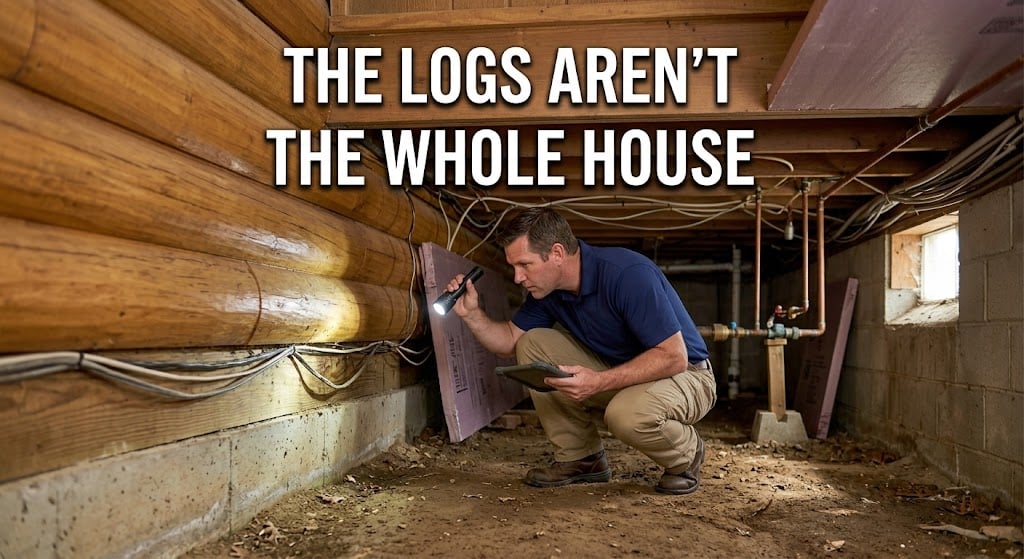
An accessible crawl space can reveal valuable information about conditions below the house. For example, an inspector may evaluate:
- Moisture and drainage evidence
- Wood framing and supports
- Plumbing and electrical components
- Insulation and ventilation, where applicable
- Insect-related evidence
However, crawl spaces also create limitations when access is restricted or unsafe.
Can Crawl-Space Moisture Affect a Log Home?
Yes. Moisture below a building can affect materials in the crawl space. So the key task is to determine what is actually observed, such as:
- Standing water or damp materials
- Staining or condensation
- Drainage evidence
- Plumbing leakage
Still, the source shouldn’t be diagnosed without evidence.
What About the Roof?
The roof deserves the same attention as on any home. In addition, its relationship with the log walls can be especially revealing. So inspectors may consider:
- Roof covering condition
- Flashings and penetrations, where visible
- Drainage, gutters, and downspouts
- Roof-to-wall relationships
- Evidence of leakage
- Attic conditions, where accessible
After all, a wall condition may begin with roof water. That’s why systems shouldn’t be inspected as isolated boxes.
What About Chimneys and Fireplaces?
Chimneys and fireplaces intersect with roof and wall assemblies. So an inspection may consider roof penetrations, flashing, clearances, exterior connections, interior components, and moisture evidence.
Depending on the property and conditions, specialized chimney evaluation may also be appropriate.
Do Log Homes Settle Differently?
Log construction can involve building-specific movement and detailing. However, construction methods vary, so no single rule applies to every log system.
If unusual movement, gaps, displacement, or door and window problems appear, the actual system should be evaluated. In other words, don’t blame the cause on logs just because the building is made of them.
Do Sticking Doors Mean the Log Walls Have Moved?
Not automatically. A sticking door has several possible causes, so it’s an observation.
Therefore, the inspector looks for supporting evidence, such as other door or window problems, visible wall movement, or foundation observations. Moisture, installation issues, and damage also count.
In short, one sticky door shouldn’t become a whole structural theory.
What About Electrical Systems in Log Walls?
Electrical systems still need inspection within the home-inspection scope. However, log construction can affect where wiring is visible or concealed.
So the inspector evaluates accessible components but can’t see wiring inside solid construction. The limitation is simple: visible and accessible.
What About Plumbing in a Log Home?
Plumbing is evaluated as part of the property, although some piping may be concealed. For example, inspectors may evaluate accessible fixtures, supply and drain piping, water heaters, connections, and leakage evidence.
After all, log walls don’t eliminate ordinary plumbing concerns.
Captain Obvious: “Rustic sink.”
Inspector Hindsight: “Still plumbing.”
Captain Obvious: “Rustic leak?”
Inspector Hindsight: “Still a leak.”
What About HVAC?
Heating and cooling equipment still needs evaluation. Depending on the home, the inspector may observe accessible equipment, distribution components, controls, and condensate management.
Again, a specialty home doesn’t mean the ordinary systems stop mattering.
What Should Buyers Ask About Log Home Maintenance?
Ask the seller about log home maintenance history, including exterior coatings, log repairs, and joint or sealant work. Also ask about moisture repairs, roof work, window, door, deck, and porch work, insect treatment, and foundation or crawl-space work.
Useful questions include:
- When was the exterior last maintained, and with what products?
- Who performed the work, and are invoices available?
- Were damaged logs repaired or replaced?
- Has the home experienced water intrusion?
- Are previous inspection reports available?
After all, documentation explains what a single inspection can’t recreate.
Why Does Log Home Maintenance History Matter?
A log home shows its condition today. However, records help explain yesterday. For example, a repaired area raises useful questions:
- What happened, and when?
- How was it repaired?
- Was the source corrected?
- Has the condition returned?
- Is documentation available?
Inspector Hindsight: “A repair is part of the story. The question is whether you have the rest of the story.”
What If the Log Home Was Recently Restored?
Restoration can improve a home’s condition and appearance. However, it also changes what is visible.
So don’t assume restored means perfect. Likewise, don’t assume restored means something was hidden. Both conclusions lack evidence.
Instead, ask for records, inspect the current work, and understand the limitations.
Can a Home Inspection Tell You Everything About a Log Home?
No. A home inspection is not destructive, so it doesn’t dismantle the building to expose hidden conditions. Depending on scope and access, limitations may include:
- The inside of logs
- Areas behind finishes
- Concealed fasteners and structural connections
- Inaccessible crawl spaces
- Concealed roof or underground components
- Areas blocked by belongings or vegetation
In short, a strong inspection tells you what was observed and what couldn’t be.
When Might a Log-Home Specialist Be Appropriate?
Specialized evaluation may help when a condition needs expertise beyond the general inspection. For example:
- Significant visible wood deterioration
- Unusual structural movement
- Extensive log repairs
- Unclear construction details
- Major moisture-related conditions
- Specialized restoration questions
The inspector’s job isn’t to be every trade. Rather, it’s to recognize when the next question needs the right professional.
What Should Buyers Ask During a Log Home Inspection?
Ask:
- What condition are the visible logs in?
- Where is moisture exposure most apparent?
- Are any areas deteriorated, or are joints open?
- What do the log ends look like?
- What is happening around windows and doors?
- How is roof water managed, and does it drain away?
- What is visible around decks and porches?
- What does the crawl space show?
- Are previous repairs visible?
- What couldn’t be inspected?
- Is specialist evaluation recommended?
What Should Buyers Avoid?
Don’t reduce the whole inspection to “Are the logs good?” That question is too broad.
Instead, ask what was observed, where, and how extensive it is. Also ask what conditions are related, what couldn’t be observed, what needs more evaluation, and what maintenance history exists.
In the end, better questions create better decisions.
Should You Buy a Log Home With Some Cracks or Weathering?
The inspector shouldn’t make that decision for you. Instead, cracks, weathering, repairs, and maintenance needs should be understood in context.
So you need information about condition, extent, location, patterns, moisture, previous repairs, limitations, and specialist recommendations.
The goal isn’t finding an imperfection and rejecting the house. Rather, it’s understanding the property you’re considering.
Inspector Hindsight: “An inspection doesn’t make the decision for you. It gives you better information to make it.”
The Inspector’s Eye: Don’t Just Look at the Log
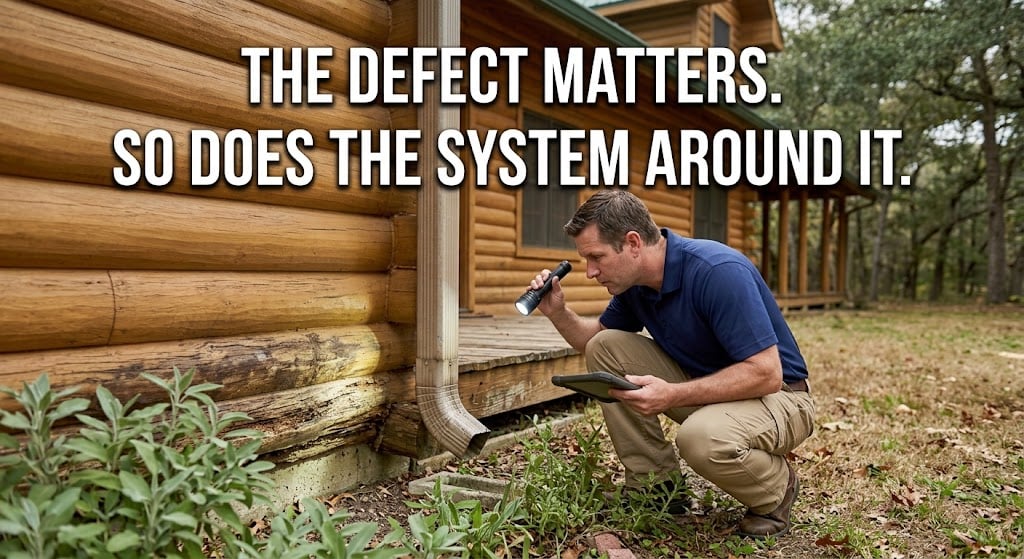
Imagine an inspector sees deterioration near the bottom of an exterior log wall. Captain Obvious sees damaged wood, which is correct.
Next, Inspector Hindsight asks more questions:
- Where exactly is it, and how close to grade?
- What is above it?
- Is roof water reaching this area?
- Is there splashback or a nearby downspout?
- Does a deck intersect the wall?
- Is vegetation holding moisture against it?
- Is the damage isolated, or are nearby logs affected?
- Is there a repair history?
- Does the crawl space show related conditions?
That is the Inspector’s Eye. The defect matters. However, so does the system around it.
Captain Obvious: “Damaged log.”
Inspector Hindsight: “Yes.”
Captain Obvious: “Replace log?”
Inspector Hindsight: “First understand why it’s damaged.”
Captain Obvious: “Because replacing it without fixing the cause—”
Inspector Hindsight: “May leave the cause in place.”
Captain Obvious: “Look at me anticipating consequences.”
Log Home Maintenance & Inspection: The Simple Answer
A log home inspection still evaluates the whole property. However, log construction deserves extra attention to log surfaces, log ends, and joints. Windows, doors, penetrations, moisture, and roof drainage matter too.
So do decks and porches, wood-to-ground relationships, crawl spaces, visible deterioration, previous repairs, and log home maintenance history.
Above all, remember:
- A crack isn’t automatically a structural failure.
- A dark spot isn’t automatically rot.
- A stain doesn’t identify its own water source.
- A fresh coating doesn’t automatically mean a cover-up.
- Old doesn’t mean failed, and restored doesn’t mean perfect.
In the end, the useful question is: what does the evidence show about this house?
Captain Obvious: “So it’s a log home.”
Inspector Hindsight: “Yes.”
Captain Obvious: “We inspect the logs.”
Inspector Hindsight: “Yes.”
Captain Obvious: “And everything around the logs.”
Inspector Hindsight: “Yes.”
Captain Obvious: “And the rest of the house.”
Inspector Hindsight: “Especially that.”
Captain Obvious: “It was obvious.”
Inspector Hindsight: “Until it wasn’t.”
Log Home Maintenance & Inspection FAQs
What should you inspect when buying a log home?
Inspect the whole property, with attention to log surfaces, log ends, joints, windows and doors, moisture, drainage, decks, porches, and crawl spaces. Also note visible deterioration and previous repairs.
What does log home maintenance involve?
It typically involves coatings, joints, sealants, roof drainage, vegetation, wood condition, and moisture management. The right schedule depends on the home’s construction and materials.
What are common log home problems?
Concerns can include moisture exposure, deteriorated wood, open joints, weathered coatings, penetrations, drainage issues, insect evidence, and deferred maintenance.
Are cracks in logs always bad?
No. Cracks or checks need context, including location, orientation, moisture exposure, surrounding condition, and pattern.
What is checking in a log home?
It’s a common term for cracks or separations that develop in wood. Checking alone doesn’t mean structural failure.
Does dark wood mean a log is rotten?
No. Color alone doesn’t establish decay. It may justify a closer look, but diagnosis needs evidence.
Can a log home have hidden wood deterioration?
Yes. A visual inspection can’t evaluate every concealed part of a log or wall.
Why is moisture important in a log home?
Repeated moisture exposure can affect wood and nearby materials. So inspectors pay close attention to how water is managed.
Why do gutters matter on a log home?
They help manage roof runoff. When they fail, water can concentrate near walls or the foundation.
Should a log home have a crawl-space inspection?
If the crawl space is accessible and within scope, it can reveal moisture, framing, plumbing, and support conditions.
How often should a log home be stained?
There’s no single interval for every log home. Timing depends on the product, exposure, construction, wood condition, and specialist guidance.
Does a newly restored log home still need an inspection?
Yes. Restoration doesn’t guarantee every component is defect-free, nor does it prove anything was hidden.
Can a home inspector see inside the logs?
No. A visual inspection can’t see through solid wood or other concealed construction.
Should I buy a log home with weathering or cracks?
That decision is yours. The inspection helps establish condition, patterns, limitations, maintenance history, and whether more evaluation is needed.
Schedule Your RedFish Inspection
A log home can have plenty of character. Still, your inspection should be about evidence.
So understand the logs, the moisture paths, and the log home maintenance history. And understand the rest of the house, not just the part that makes the listing photos memorable.
Schedule your RedFish inspection.
RedFish Inspections
Inspecting To A Higher Standard.
Call (866) 218-6699
