

A well water bacteria test and a well inspection sound similar. However, they answer very different questions.
In a house on municipal water, most buyers know roughly where the water comes from. With a private well, the property has its own water-supply equipment. That raises new questions:
- Where is the well, and what equipment is visible?
- How does water reach the house?
- What does the pressure tank do?
- Can the pump be inspected?
- Has the water been tested, for what, and when?
One question matters most: if the water looks fine, does that mean it is fine? Not necessarily. That is why understanding a private well starts by separating two related but different subjects: the well system and the water.
What Is a Well Water Bacteria Test?
A well water bacteria test analyzes a collected water sample for the specific bacterial indicators included in that test. In other words, it answers a different question than a well inspection.
A well inspection evaluates the system within its defined scope. In contrast, a bacteria test evaluates a water sample using the method involved.
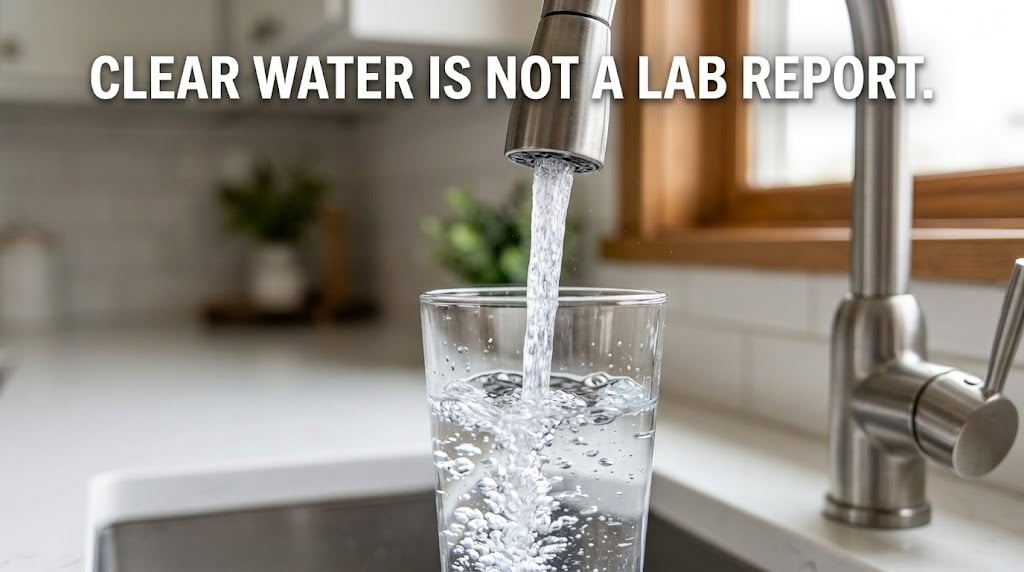
Importantly, you can’t reliably tell whether bacteria are present just because the water:
- Looks clear
- Smells normal
- Tastes normal
- Flows with good pressure
Captain Obvious: “Clear water.”
Inspector Hindsight: “Yes.”
Captain Obvious: “So the bacteria report says—”
Inspector Hindsight: “You haven’t tested it.”
Captain Obvious: “But it’s very clear.”
Inspector Hindsight: “That’s an appearance.”
Captain Obvious: “I can already tell this episode is going to ruin several shortcuts.”
What Is a Private Well?
A private well is an onsite water source that serves a property instead of relying only on a public water connection. The system varies by property.
For example, visible or associated components may include:
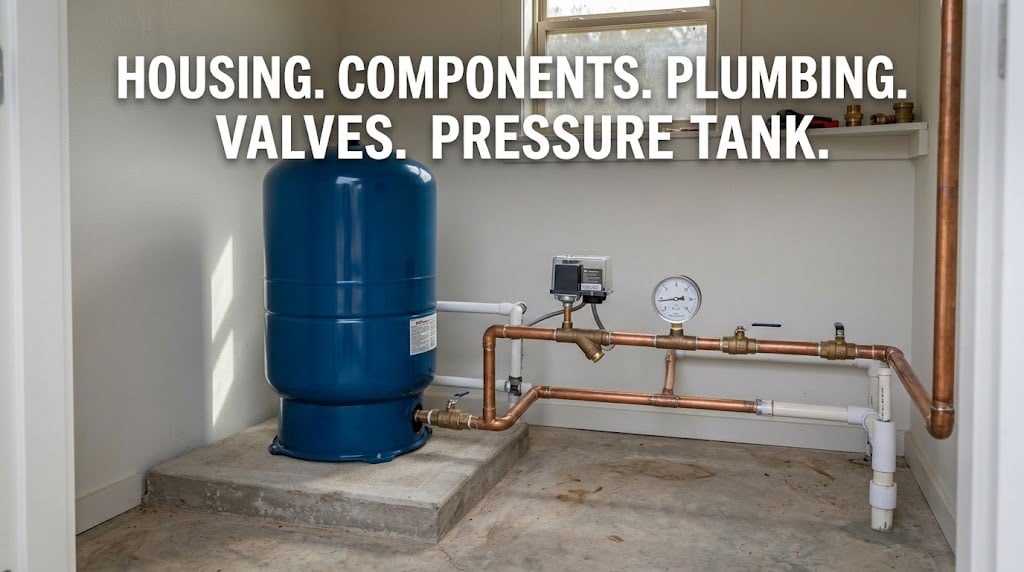
- Well housing or exterior well components
- Plumbing and valves
- A pressure tank
- Electrical or control components
- Pump-related equipment
However, some of the most important components may not be visible. In many installations, that includes the well pump.
What Does a RedFish Well Inspection Include?
A RedFish well inspection includes evaluation of:
- The well housing structure
- Visible components of the well
- Plumbing
- Valves
- The pressure tank
- A limited series of water-pressure tests
The well pump, however, is usually not accessible or visible. Therefore, it generally can’t be visually inspected, except through operational testing.
That distinction matters. So as a buyer, understand what was observed, what was evaluated through operation, and what wasn’t visible. Also know what falls outside the inspection scope.
Does a Well Inspection Include a Well Water Bacteria Test?
No. A RedFish well inspection evaluates well components and includes limited water-pressure testing. However, that is not the same as laboratory water-quality testing.
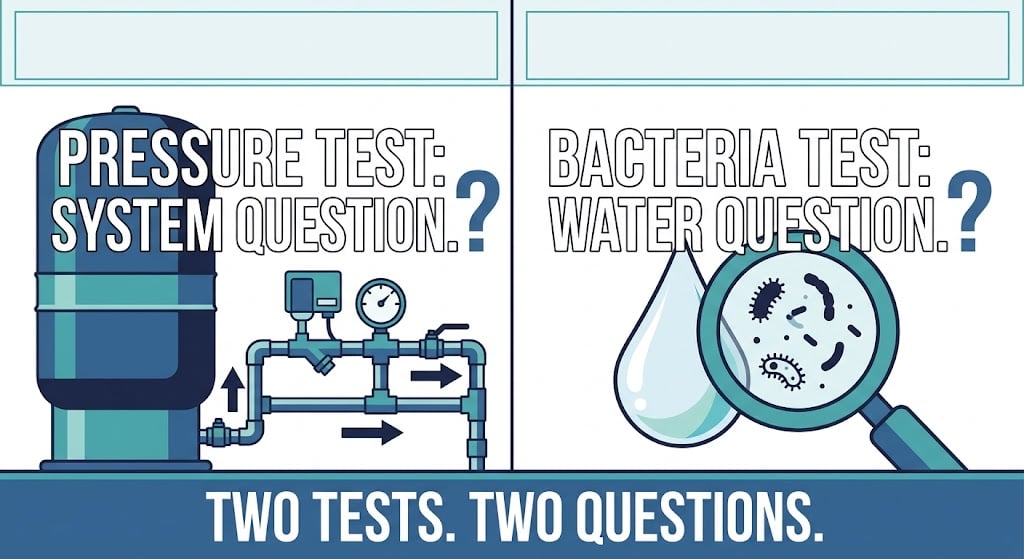
Pressure testing asks questions about how the system operates. Meanwhile, water-quality testing asks questions about the water sample itself. The two should never be confused.
Captain Obvious: “Water came out.”
Inspector Hindsight: “Yes.”
Captain Obvious: “Therefore water-quality laboratory complete.”
Inspector Hindsight: “No.”
Captain Obvious: “Worth a try.”
What Does a Well Water Bacteria Test Check For?
It depends on the specific test. The organisms or indicators covered vary by the test ordered and the laboratory or protocol involved.
So before relying on any result, confirm exactly what the test includes. In short, looking at water is not the same as testing water.
Can You See Bacteria in Well Water Without a Test?
No. Ordinary appearance doesn’t tell you whether a lab test would detect a bacterial indicator.
For example, water can look clear, clean, and normal and still need testing to answer a microbiological question. Likewise, cloudy or discolored water doesn’t automatically prove bacterial contamination.
In other words, appearance provides one kind of information, while lab analysis provides another.
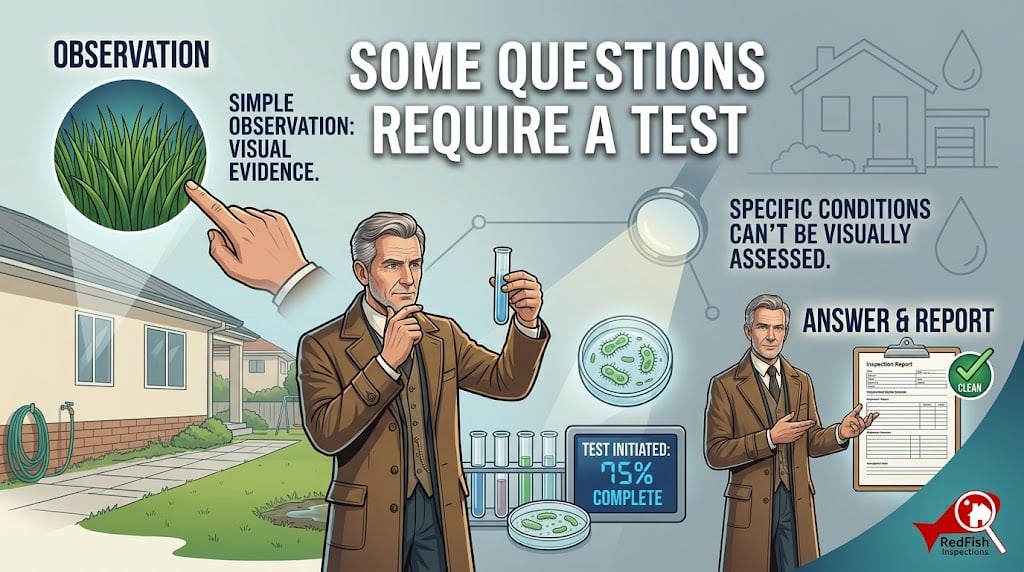
Inspector Hindsight: “Some questions require a test. This is one of them.”
Does Clear Well Water Mean It Is Safe to Drink?
Clear appearance alone can’t establish that well water is safe to drink. After all, our senses are useful but limited.
You can observe color, clarity, odor, and taste. However, those observations don’t add up to a water-quality analysis. So no professional should declare water safe based on appearance alone.
Captain Obvious: “So crystal clear isn’t a laboratory result?”
Inspector Hindsight: “No.”
Captain Obvious: “Marketing departments everywhere are devastated.”
Does Bad-Smelling Well Water Mean Bacteria?
Not automatically. Odor is useful information. However, smell alone doesn’t identify a specific contaminant or organism.
If the water smells unusual, appropriate evaluation may be warranted. Still, don’t jump from “this water smells strange” to “this bacterium is present.” That conclusion requires evidence.
In short, observe first. Then identify only when the evidence supports it.
What Does the Well Housing Tell an Inspector?
The well housing and other visible exterior components show the condition of the accessible part of the system. So the inspector evaluates the well housing structure within the inspection scope.
The goal isn’t to guess what is happening underground. Instead, it is to accurately document what can be observed.
Inspector Hindsight: “Visible condition tells you about the visible condition.”
Captain Obvious: “That’s dangerously close to my territory.”
What Does the Pressure Tank Do?
The pressure tank helps manage water delivery and pressure. During a RedFish well inspection, it is among the visible components evaluated.
An inspector may observe its accessible condition and consider system operation. However, a visual look at the pressure tank doesn’t reveal the condition of every concealed component.
Does RedFish Test Well Water Pressure?
Yes. A RedFish well inspection includes a limited series of water-pressure tests. They help determine whether adequate water pressure is being maintained.
However, it helps to be precise about what that means. Limited pressure testing does not:
- Simulate every possible flow condition
- Guarantee future pressure
- Establish the well’s production capacity
- Test every concealed component
- Determine the pump’s remaining life
Is Water Pressure the Same as Water Quality?
No. They answer completely different questions.
Good pressure tells you how water is being delivered during the test. However, it doesn’t tell you whether a bacteria test would come back negative.
Likewise, a good lab result doesn’t prove every mechanical well component is defect-free.
Captain Obvious: “Pressure test.”
Inspector Hindsight: “System question.”
Captain Obvious: “Bacteria test.”
Inspector Hindsight: “Water-quality question.”
Captain Obvious: “Two tests. Two questions.”
Inspector Hindsight: “Exactly.”
Captain Obvious: “This is suspiciously organized.”
Can a Home Inspector See the Well Pump?
Often, no. The well pump is usually not accessible or visible. As a result, it generally can’t get the same visual inspection as an exposed component.
Operational observations still provide information. However, operation is not the same as full visual access, and buyers should understand that limitation.
If the Well Pump Works, Is It in Good Condition?
Operation is useful information. However, it doesn’t guarantee the condition or future performance of an inaccessible pump.
If water is delivered during the inspection, that shows operation at that time. It doesn’t guarantee that:
- The pump has no defect
- The pump will keep operating indefinitely
- The pump has a particular remaining life
- Every component is properly installed
- No concealed condition exists
Inspector Hindsight: “Working today is useful information. It isn’t a warranty for tomorrow.”
Can an Inspector Tell How Long a Well Pump Will Last?
No. A home inspection can’t promise an exact remaining life for a well pump. After all, future performance depends on many variables.
So statements like “this pump has five years left” aren’t supportable. Instead, the inspector communicates current observable and operational information within scope.
What If the Water Pressure Is Low?
Low or unusual pressure can justify further investigation. However, the observation alone may not reveal the exact cause, since several components can be involved.
So the right response is to document the observation, consider the accessible system, and communicate limitations. Then recommend further evaluation when appropriate.
In other words, one pressure reading shouldn’t be used to diagnose an inaccessible pump unless the evidence supports it.
What If the Water Pressure Changes?
Changing pressure can also be meaningful, depending on how and when it happens. Useful questions include:
- When does the pressure change?
- Which fixtures are running?
- Is the condition repeatable?
- What does the visible equipment show?
- What happened during the limited pressure tests?
- Are there other symptoms?
Again, pattern and context are more useful than a single number.
Can a Well Inspection Tell How Much Water the Well Will Always Produce?
No. A standard well inspection isn’t a guarantee of well yield or future water availability. The RedFish well inspection includes limited pressure testing, not long-duration yield testing.
So if you need specific answers about well yield, aquifer conditions, well depth, or groundwater availability, additional specialized evaluation may be required.
Can an Inspector Tell How Deep the Well Is?
Not from a visual home inspection. However, well depth may be documented in well records or other reliable property information.
So don’t guess based on location, appearance, pressure, or neighboring properties. Instead, rely on verified records when the answer matters.
Why Do Well Records Matter?
Well records provide history that one inspection can’t recreate. For example, they may cover:
- Installation, depth, and construction
- Previous service and repairs
- Pump replacement
- Water testing
- Treatment equipment
Inspector Hindsight: “The inspection tells you about today. Records can help explain how the system got here.”
What Should Buyers Ask the Seller About a Private Well?
Useful questions include:
- When was the well installed, and are records available?
- Have the pump or pressure tank been replaced?
- Has the system needed repairs?
- When was the water last tested, and for what?
- Are lab reports available?
- Is treatment equipment present, and why was it installed?
- Has the well had performance problems or supply interruptions?
In short, property history adds context to current inspection findings.
What If the Seller Says the Water Was Tested?
Ask for the report. After all, “the water was tested” doesn’t tell you when, by whom, what was tested, or what the results were.
It also doesn’t tell you whether treatment equipment was running or whether anything changed afterward. So the actual report is far more useful than a general statement.
Captain Obvious: “They said it passed.”
Inspector Hindsight: “Passed what?”
Captain Obvious: “The test.”
Inspector Hindsight: “Which test?”
Captain Obvious: “I see where this is going.”
Does a Water Test Check for Everything?
No. A water test only covers the parameters included in that specific analysis. In other words, there’s no single universal “water test.”
So before interpreting any result, ask:
- What was tested, and what wasn’t?
- When was the sample collected?
- What method or laboratory was used?
- What do the results actually say?
What Does a Negative Well Water Bacteria Test Mean?
A negative result should be read according to the specific sample, test, method, and report. However, one lab result isn’t an unlimited guarantee about future water quality.
A test reflects the sample and the moment it was collected. Since conditions can change, no single test can guarantee water will stay safe forever.
What Does a Positive Well Water Bacteria Test Mean?
A positive result means the sample produced a result under the specific lab method and parameter reported. The right response depends on:
- What was detected
- How the sample was collected
- The testing protocol
- The well system
- Applicable public-health or regulatory guidance
- Any recommended confirmation or corrective steps
Because this is a health-related topic, rely on qualified water-quality and public-health guidance for next steps.
Should You Drink Water After a Positive Bacteria Result?
Follow the instructions of the qualified laboratory, public-health authority, or other professional interpreting the result.
This article is general education. It is not a substitute for property-specific health guidance.
Can Well Water Bacteria Test Results Change Over Time?
Yes. A water-quality result reflects a sample collected at a particular time. However, conditions around a private well can change.
That is why buyers should note the test date, sampling circumstances, system history, repairs, and maintenance. In short, an old test report isn’t a permanent description of current water quality.
Does a Water Filter Mean the Well Water Has a Problem?
Not automatically. Treatment equipment can be installed for many reasons. Instead, its presence should prompt questions such as:
- What does it treat, and why was it installed?
- Who maintains it, and when was it last serviced?
- Are records available?
- Was water tested before or after treatment?
- Is the equipment currently operating?
So don’t infer a specific contamination problem just because treatment equipment exists.
Does a Water Softener Disinfect Well Water?
Don’t assume so. Different treatment systems are designed for different purposes. Therefore, identify the equipment and understand what it is meant to do.
Captain Obvious: “Water equipment.”
Inspector Hindsight: “Yes.”
Captain Obvious: “Therefore it fixes all water.”
Inspector Hindsight: “No.”
Captain Obvious: “Another shortcut gone.”
What About UV, Filtration, or Other Treatment Equipment?
Private-well properties can have different treatment systems. However, the equipment alone doesn’t tell you:
- Why it was installed
- Whether it is correctly configured and maintained
- Whether it is working effectively
- What the untreated or treated water contains
Instead, treatment performance depends on the equipment, its maintenance history, and appropriate testing.
Can Well Water Look or Taste Different From City Water?
Yes, water characteristics vary between sources and properties. However, taste, odor, or appearance shouldn’t replace testing when a specific water-quality question needs an answer.
In other words, your senses can tell you there is an odor or discoloration. They can’t identify every cause.
What If There Is Rust or Corrosion on Well Equipment?
Visible corrosion on accessible well components can be documented. For example, the inspector may consider:
- Location and extent
- Associated moisture
- Condition of nearby plumbing
- Whether leakage is visible
- Whether operation appears affected
- Whether further evaluation is appropriate
However, a cause shouldn’t be assigned without supporting evidence.
What If the Well Equipment Is Leaking?
Visible leakage at accessible components should be documented. So the inspector may note where water appears, which component is affected, and whether deterioration is present.
The inspector may also note whether it occurs during operation and what limitations exist. Still, water alone doesn’t justify guessing at a concealed failure.
Inspector Hindsight: “Find the water. Then find the evidence for where it came from.”
What If the Well Equipment Is Inside a Well House?
A well house can affect access to visible components. For example, stored items, locked doors, construction, or unsafe conditions can limit the inspection.
If equipment can’t be accessed, that should be communicated. After all, “not observed” and “observed with no defects” are very different statements.
Can a Well Be Contaminated by Something on the Property?
Water-quality concerns depend on site conditions, well construction, the environment, and other factors.
So a septic system, barn, drainage area, or chemical container nearby doesn’t prove it contaminated the well. A potential source creates a question. However, testing and qualified evaluation provide the evidence.
The same evidence-first thinking applies to slab foundation movement: settling vs. heave.
What About a Well and Septic System on the Same Property?
Many properties have both a private well and an onsite septic system. In that case, the property manages both its water supply and its wastewater onsite.
These systems have different purposes and raise different inspection questions. Also, required separation distances vary by property and jurisdiction.
So understand where each system is, what records exist, and when specialized evaluation is appropriate.
Does Heavy Rain Affect Well Water?
Weather and surface conditions can be relevant to private-well questions. However, rain alone doesn’t prove contamination.
If you’re concerned about water quality after a weather event, use qualified water-quality guidance and appropriate testing.
Does a New Well Need an Inspection?
Yes, it can still benefit from one. New doesn’t mean defect-free.
For example, a newer well system can still have issues with visible components, plumbing, valves, or pressure equipment. Installation, operation, and documentation can also have problems.
Inspector Hindsight: “New construction is still construction.”
Captain Obvious: “I knew you were going to say that.”
Does an Old Well Automatically Need Replacement?
No. Age provides context, but it doesn’t establish current condition. So for an older well, buyers may want to understand:
- Installation, pump, and pressure-tank history
- Repairs and water-test history
- Current operation and visible component condition
- Available records and inspection limitations
In short, “old” is not a diagnosis.
Can a Well Inspection Guarantee the Well Will Keep Working?
No. A well inspection provides information about observable and operational conditions at the time of inspection. It can’t guarantee:
- Future pump operation or water pressure
- Future water availability or quality
- No concealed defects
- No future repairs
- No changing environmental conditions
Rather, the value is information, not a warranty on the future.
Does a Well Inspection Guarantee the Water Is Safe?
No. A well-system inspection and a water-quality test are different evaluations. A RedFish well inspection covers visible components and limited pressure testing. Therefore, it isn’t a statement about water quality.
If you want information about bacteria or other water-quality parameters, appropriate testing is what answers those questions.
What Should Buyers Ask Before a Well Inspection?
Before the inspection, ask:
- Where is the well, and what equipment is present?
- Is the property supplied entirely by the well?
- Are well records and repairs documented?
- Have the pump or pressure tank been replaced?
- Has the water been tested, when, and for what?
- Are lab reports available?
- Is treatment equipment installed?
- What does the well inspection include?
- Does water testing require a separate service?
In short, good questions define the scope before assumptions begin.
What Should Buyers Ask After a Well Inspection?
Afterward, ask:
- Which components were visible, and which were inaccessible?
- What was observed at the well housing and pressure tank?
- Were visible leaks present?
- What happened during the pressure testing?
- Were operational concerns observed?
- Could the pump be visually inspected?
- Is additional evaluation recommended?
- Was water quality tested separately?
- What remains unknown?
That final question matters. After all, a good inspection communicates limitations as clearly as findings.
What If a Well Inspection Finds a Problem?
If a condition needs specialized expertise, a qualified professional may be recommended. For example, that could be a well, plumbing, water-system, or laboratory specialist.
The right professional depends on the question. A mechanical well-system concern follows one path, while a water-quality concern may follow another.
Inspector Hindsight: “Different questions can require different experts.”
Should You Buy a House With a Private Well?
That is your decision, not the inspector’s. Instead, think of a private well as a property system to understand. Useful information includes:
- Current visible condition and operational observations
- Pressure-test information
- Maintenance and repair history
- Water-testing history and current results, when testing is done
- Inspection limitations
- Recommended additional evaluation
Inspector Hindsight: “You don’t need a perfect house. You need to understand the house you’re buying.”
The Inspector’s Eye: Clear Water Is Not a Lab Report
Imagine a faucet is running, and the water looks perfectly clear. Captain Obvious sees clear water, which is correct.
Next, Inspector Hindsight asks more questions:
- What is the pressure doing?
- What does the visible well equipment show?
- What does the pressure tank look like?
- Are leaks visible?
- What is the system history?
- Has the water been tested, when, and for what?
- What do the actual results say?
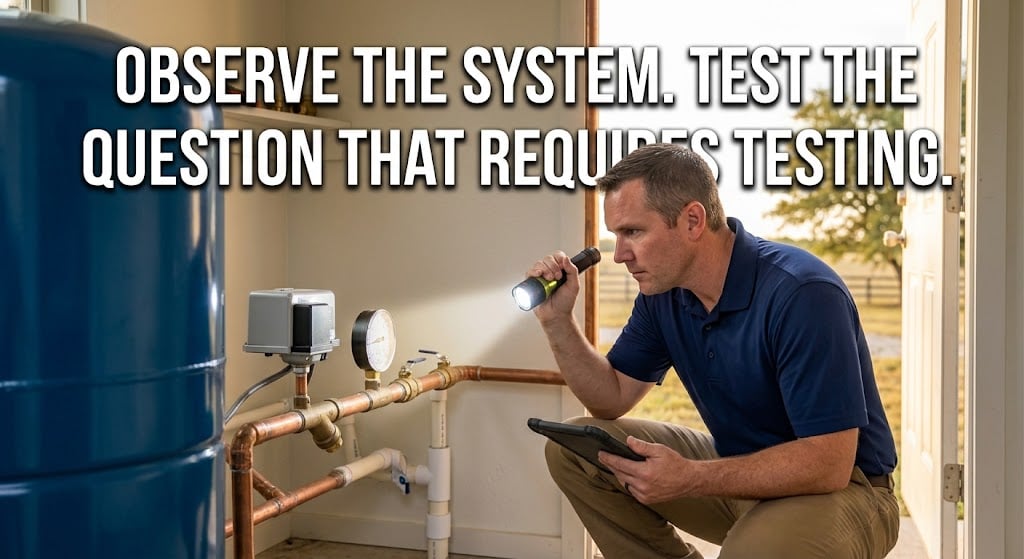
That is the Inspector’s Eye. It isn’t seeing clear water and declaring everything perfect. Instead, it means observing the system, understanding the scope, and testing the question that requires testing. Then it means reading the evidence and communicating limitations.
Captain Obvious: “So the water looks clear.”
Inspector Hindsight: “Yes.”
Captain Obvious: “And that tells us—”
Inspector Hindsight: “That it looks clear.”
Captain Obvious: “You’ve been waiting the entire article to say that.”
Inspector Hindsight: “A little.”
Well Inspections and Well Water Bacteria Tests: The Simple Answer
A private well inspection and a water-quality test answer different questions.
A RedFish well inspection includes evaluation of the well housing structure, visible well components, plumbing, valves, and the pressure tank, along with limited water-pressure testing. However, the well pump is usually inaccessible, so its visual evaluation is limited.
Meanwhile, a well water bacteria test evaluates a collected sample for the parameters included in that specific test. Remember:
- Clear water is not a lab result.
- Good pressure is not good water quality.
- A negative water test doesn’t prove every well component is perfect.
- A working pump doesn’t guarantee future performance.
- No single test checks for everything.
In the end, understand the system, the water, the history, the test, and the limitations.
Captain Obvious: “Inspect the well.”
Inspector Hindsight: “Yes.”
Captain Obvious: “Test the water when the question requires testing.”
Inspector Hindsight: “Yes.”
Captain Obvious: “Don’t confuse the two.”
Inspector Hindsight: “Exactly.”
Captain Obvious: “It was obvious.”
Inspector Hindsight: “Until it wasn’t.”
Well Water Bacteria Test & Well Inspection FAQs
What is a well inspection?
It evaluates the well system within a defined scope. A RedFish well inspection covers the well housing structure, visible components such as plumbing, valves, and the pressure tank, and limited water-pressure testing.
What is a well water bacteria test?
It analyzes a collected water sample for the bacterial indicators included in that specific test.
Is water testing the same as a well inspection?
No. A well inspection evaluates the system. Water testing evaluates a water sample according to the test performed.
Does a RedFish well inspection include bacteria testing?
No. The well inspection covers the well housing, visible components, and limited pressure testing. Water-quality testing is a separate question, so ask about testing options before your inspection.
Can you tell if well water has bacteria by looking at it?
No. Appearance alone can’t show whether a test would detect bacterial indicators.
Does clear well water mean it is safe?
No. Clear appearance can’t establish that water is safe to drink or free of contaminants.
Does bad-smelling well water mean it has bacteria?
Not necessarily. Odor is an observation, but it doesn’t identify a specific organism or contaminant.
Does RedFish inspect the well pump?
The well pump is usually inaccessible or not visible. So it generally can’t be visually inspected except through operational testing.
Does good water pressure mean the water quality is good?
No. Pressure and water quality answer different questions.
Can a well inspection tell how long the pump will last?
No. No inspection can guarantee an exact remaining life for a well pump.
Does a water test check for everything?
No. It only covers the parameters included in that specific analysis.
Does a well inspection guarantee future performance?
No. It describes conditions and operation within scope at the time of inspection.
What should buyers ask about a private well?
Ask about well records, installation, pump and pressure-tank history, repairs, water-testing history, treatment equipment, current findings, and limitations.
Schedule Your RedFish Inspection
The water coming from the faucet is only part of the story. So understand the well, the visible equipment, and how the system operates.
And when water quality is the question, understand what was actually tested.
Schedule your RedFish inspection.
RedFish Inspections
Inspecting To A Higher Standard.
Call (866) 218-6699
