

Septic tank failure signs aren’t always obvious, especially if you’ve never owned a septic system before. However, understanding the basics makes a big difference when buying a home.
Instead of sending wastewater to a municipal sewer, a septic property has an onsite system that collects and manages it. For many buyers, that raises a long list of questions:
- How does it work?
- Where is the tank, and where does the wastewater go?
- How old is the system?
- Has it been maintained?
- What does an inspection actually check?
- What happens if something is wrong?
Perhaps the biggest question is simply: how would I know? That is where inspection, property history, and specialized evaluation matter. After all, a septic system is mostly out of sight, but it shouldn’t be out of mind.
Septic Tank Failure Signs: The Quick Answer
Several conditions may justify a closer look at a septic system. For example:
- Slow drainage or recurring backups
- Unusual sewage-related odors
- Standing water or persistently wet ground
- Unusual conditions around the drainfield area
- Visible damage to accessible components
- Previous repair history
However, one symptom doesn’t prove a septic system has failed. Instead, finding the cause may require evaluating the system itself.
Captain Obvious: “Yard smells like sewage.”
Inspector Hindsight: “That deserves attention.”
Captain Obvious: “Septic failure?”
Inspector Hindsight: “That requires evidence.”
Captain Obvious: “You really don’t let symptoms skip the investigation.”
Inspector Hindsight: “Correct.”
How Does a Septic System Work?
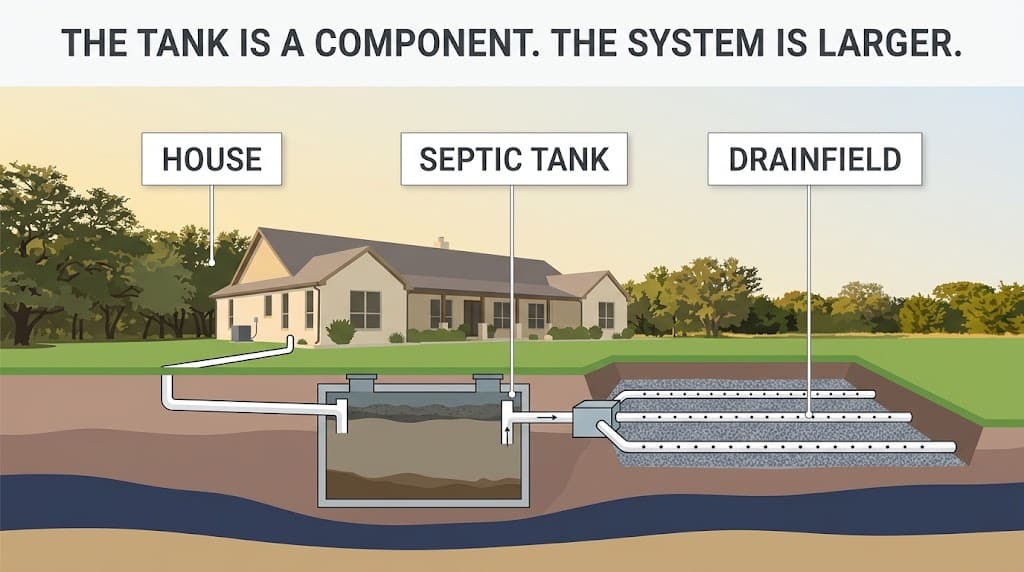
At a basic level, a conventional septic system receives wastewater from the house. Then it treats and disperses that wastewater onsite instead of sending it to a municipal sewer.
The exact design varies. For example, a system may include:
- Building sewer piping
- A septic tank with inlet and outlet components
- Distribution components
- A drainfield or soil absorption area
- Access points
- Other treatment or dispersal equipment, depending on design
Because systems vary, don’t assume every property uses the same configuration.
Captain Obvious: “Wastewater leaves the house.”
Inspector Hindsight: “Yes.”
Captain Obvious: “And doesn’t go to the city sewer.”
Inspector Hindsight: “If it’s on septic, correct.”
Captain Obvious: “Then the property has to deal with it.”
Inspector Hindsight: “Now we’re getting somewhere.”
What Does the Septic Tank Do?
The septic tank is one component of the system. Wastewater enters the tank, where separation and treatment occur. Then liquid moves to the next part of the system.
However, the tank isn’t a hole where everything disappears forever. Material accumulates, so systems need appropriate maintenance.
Also, people often use “septic tank” and “septic system” interchangeably. In reality, the tank is a component, while the system is larger.
What Is a Drainfield?
A drainfield is the area where treated wastewater disperses into the soil. Depending on the system and location, it may go by other names.
Its configuration depends on the system. So don’t assume every drainfield looks the same or every system uses identical components.
Likewise, not every septic property can be evaluated the same way. In short, the actual system matters.
What Is a Septic Inspection?
A septic inspection is a specialized evaluation of the onsite wastewater system within a defined scope. The exact procedure can vary based on:
- System type and access
- Property configuration
- Local requirements
- Inspection purpose
- Available records and system condition
- Professional qualifications
For that reason, no single checklist describes every septic inspection. Instead, the right question is: what does this specific inspection include?
Is a Septic Inspection Part of a Home Inspection?
Not necessarily. A general home inspection and a specialized septic evaluation can have different scopes.
A home inspector may observe visible conditions related to plumbing, drainage, the site, or accessible components. However, that doesn’t mean a complete septic inspection was performed.
Therefore, confirm exactly what you are ordering.
What Can a Home Inspector Notice Around a Septic Property?
During a general home inspection, visible conditions may raise questions about the wastewater system. For example:
- Unusual odors
- Standing water or persistently wet areas
- Visible damage or accessible system components
- Drainage concerns or plumbing symptoms
- Unusual vegetation patterns
- Evidence of previous work
However, these observations don’t automatically mean the septic system has failed. Rather, they are evidence that may justify further investigation.
What Are Common Septic Tank Failure Signs?
Common septic tank failure signs, or at least signs worth investigating, include:
- Slow drainage or recurring backups
- Sewage-related odors
- Standing water or persistently wet ground
- Unusual conditions around the treatment or dispersal area
- Visible component damage
- Recurring plumbing symptoms
- Previous system problems
Still, context matters. For example, a slow sink doesn’t diagnose a septic system. Similarly, an odor doesn’t identify its source, and a wet area doesn’t prove septic discharge.
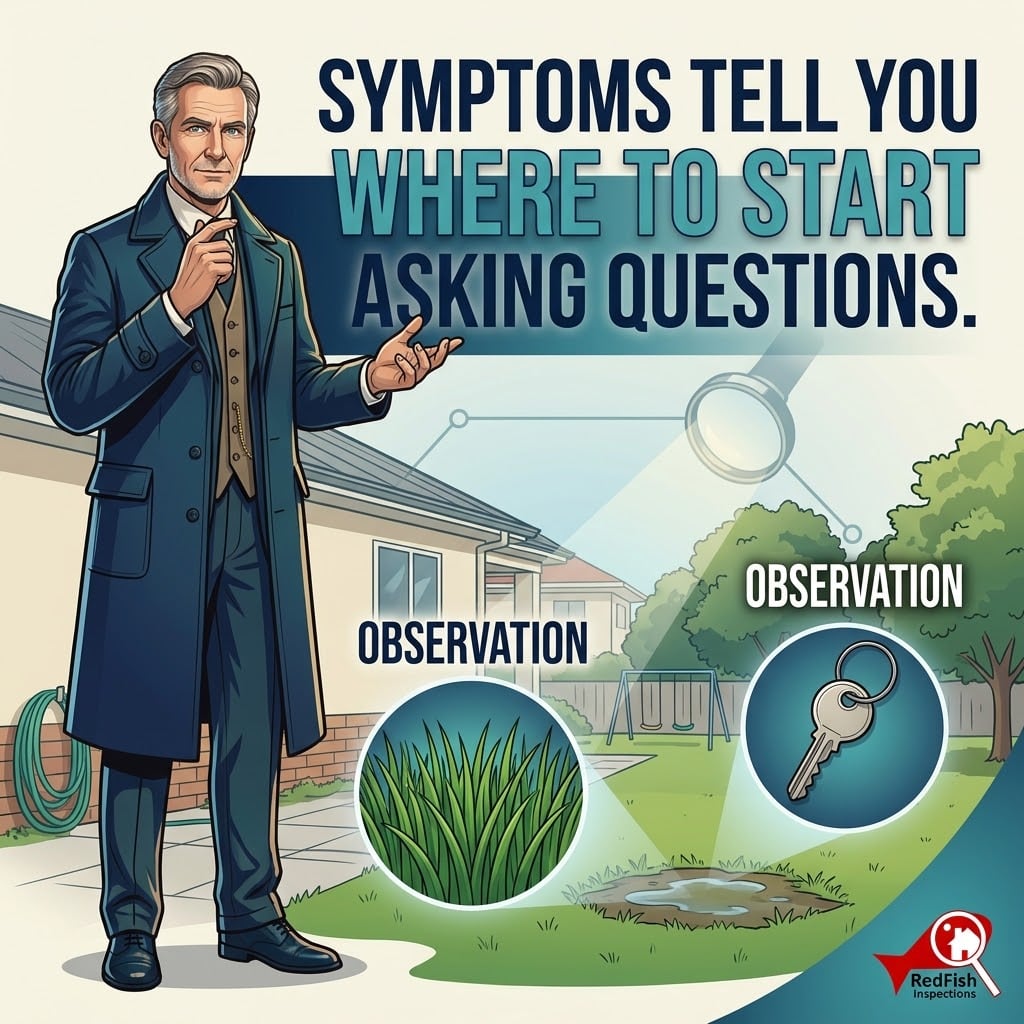
Inspector Hindsight: “Symptoms tell you where to start asking questions.”
Do Slow Drains Mean the Septic System Is Failing?
Not automatically. Slow drainage has several possible causes, such as:
- A fixture or local drain
- A branch line
- The building sewer
- An obstruction
- The septic system
- Another plumbing condition
So a slow drain shouldn’t instantly become a failed septic system.
Captain Obvious: “Sink drains slowly.”
Inspector Hindsight: “Yes.”
Captain Obvious: “Replace the septic system?”
Inspector Hindsight: “That escalated quickly.”
What About Multiple Slow Drains?
When several fixtures drain slowly, that gives different context than one isolated fixture. In that case, an evaluator may ask:
- Which fixtures are affected?
- Did the problem start at the same time?
- Are the fixtures in the same area?
- Is there a history of backups?
- What does the accessible plumbing show?
- What is known about the septic system?
In short, patterns matter. One symptom can be local, while multiple related symptoms may justify broader investigation.
Does a Sewage Smell Mean the Septic Tank Is Full?
Not necessarily. A sewage odor deserves attention. However, smell alone doesn’t identify the source, the component, or the tank’s condition.
After all, odors travel. Plumbing and ventilation conditions can create them, and so can the wastewater system.
So the right response is to locate the evidence rather than diagnose by smell alone.
Captain Obvious: “Smells bad.”
Inspector Hindsight: “Useful observation.”
Captain Obvious: “Nose inspection complete.”
Inspector Hindsight: “Absolutely not.”
Why Is There Standing Water Near the Septic Area?
Standing water or persistently wet soil can deserve closer attention. However, the source needs to be established first.
For example, wet ground can come from:
- Rainfall or surface drainage
- Irrigation
- Plumbing leakage
- Groundwater conditions
- Septic-related conditions
Seeing water doesn’t tell you where it came from. The same evidence-first approach applies to slab foundation movement: settling vs. heave.
Inspector Hindsight: “Water is evidence. Its source is the question.”
Does Green Grass Over a Septic System Mean It Is Failing?
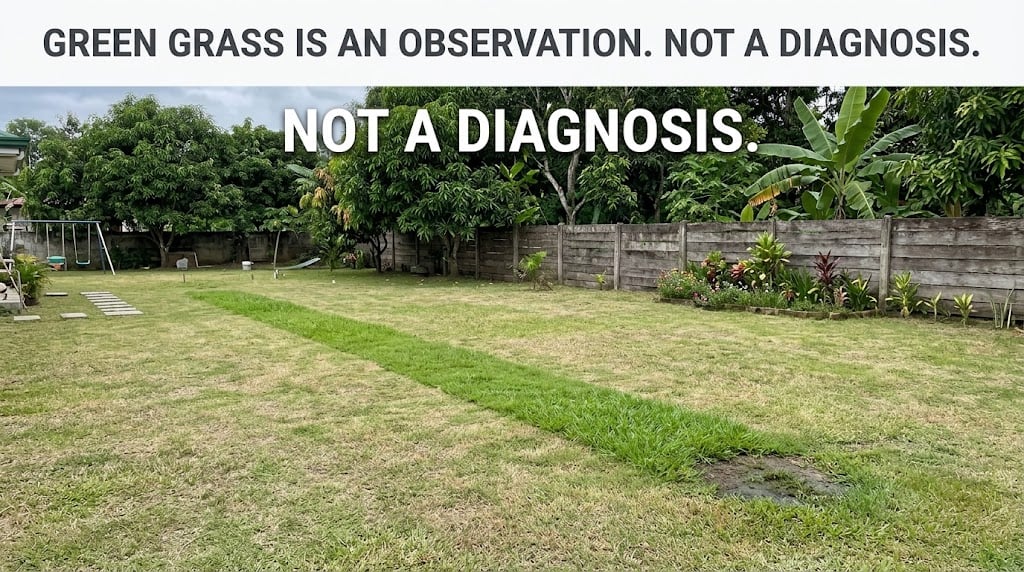
Not automatically. Vegetation differences happen for many reasons. An unusually green area may be worth noticing, especially alongside other observations. Still, grass color alone is not a diagnosis.
For instance, consider irrigation, shade, soil conditions, drainage, landscape treatment, moisture, and system location.
Captain Obvious: “Green grass.”
Inspector Hindsight: “Yes.”
Captain Obvious: “Septic?”
Inspector Hindsight: “Grass.”
Captain Obvious: “You’re impossible.”
Can a Septic System Fail Without Obvious Signs?
Some conditions may not create surface symptoms a homeowner immediately recognizes. That is one reason property history and appropriate inspection matter.
So don’t assume that no smell plus no puddle equals a perfect septic system. After all, the absence of a symptom isn’t the same as a full evaluation.
Can You See the Entire Septic System?
Usually not during a standard visual inspection. Much of a septic system may be underground, covered, inaccessible, or hidden by landscaping.
Even specialized septic evaluations have defined procedures and limitations. Therefore, no responsible inspection can promise to see everything underground.
Does a Septic Inspector Open the Tank?
It depends. The specialized procedure, system configuration, access, safety conditions, and applicable requirements all play a role.
So don’t assume every inspection opens every tank, uncovers every lid, or accesses every chamber. Instead, ask the provider exactly which components will be accessed.
Does a Septic Inspection Include Pumping?
Don’t assume so. Inspection, pumping, maintenance, and repair can be separate services with different purposes.
Therefore, buyers should ask:
- Is pumping included or recommended?
- Who performs it?
- What information does pumping provide?
- Are maintenance records available?
The answer depends on the service being ordered.
How Often Should a Septic Tank Be Pumped?
It depends on the system, tank size, household use, accumulated material, and design. As a result, no single pumping schedule applies to every system.
Instead, a better approach is to obtain:
- System information
- Maintenance and pumping records
- Previous inspection records
- Professional recommendations for that specific system
In short, property-specific information beats a generic schedule.
Why Do Septic Records Matter?
Records explain what one site visit can’t. For example, useful documentation may include:
- System design and installation records
- Permits, where applicable
- Maintenance and pumping history
- Repair and alteration records
- Previous inspection reports
Inspector Hindsight: “The property shows you today. Records can help explain yesterday.”

What If the Seller Doesn’t Know Where the Septic Tank Is?
That is useful information in itself. So don’t assume the system’s location.
Instead, records, site information, or qualified professionals may help identify system components.
Captain Obvious: “Tank is somewhere underground.”
Inspector Hindsight: “That narrows it down very little.”
Captain Obvious: “I contributed.”
Can a Home Inspector Locate a Septic Tank?
Don’t assume a standard home inspection includes locating septic components. Locating underground components may require:
- Records
- Specialized equipment
- Physical access
- System knowledge and other procedures
So if locating matters to you, ask whether the service you’re ordering includes it.
What If the Septic System Has Been Repaired?
Previous repairs provide important history. Therefore, buyers may want to ask:
- What was repaired, when, and why?
- Who performed the work?
- Are records available?
- Were permits or approvals involved, where applicable?
- Was only one component repaired?
- What is the current condition?
A repair tells you work occurred. However, it doesn’t tell you the condition of the whole system today.
What If the Septic System Is New?
New doesn’t mean you should skip the inspection. After all, “new” describes age.
It doesn’t guarantee correct installation, correct operation, or complete work. Similarly, it doesn’t rule out damage, documentation issues, or site concerns.
Captain Obvious: “Brand new.”
Inspector Hindsight: “Yes.”
Captain Obvious: “Perfect?”
Inspector Hindsight: “You’ve asked this question in three different systems now.”
Captain Obvious: “Consistency.”
What If the Septic System Is Old?
Older systems deserve context. However, old doesn’t automatically mean failed.
Instead, understand the system type, records, maintenance and repair history, current observations, and inspection limitations. Also note any recommended further evaluation.
In short, age, condition, and history are all information. However, they aren’t interchangeable.
Can a Septic Inspection Tell You How Long the System Will Last?
No inspection can guarantee a septic system’s remaining life. An evaluation describes current observable conditions within its scope.
However, it can’t reliably promise a system has a specific number of years left. After all, future performance depends on many variables.
Can a Septic Inspection Guarantee No Future Problems?
No. An inspection is a snapshot of conditions at a particular time, within a defined scope. So it cannot guarantee:
- No future blockage or component failure
- No concealed condition
- No future maintenance or repair
- No change in usage or environment
Rather, the value of inspection is better information, not certainty about the future.
What About Septic Alarms?
Some systems include electrical or mechanical components such as alarms, pumps, or controls. In other words, not every septic system is purely gravity-based.
That matters because the inspection approach can vary widely by design. So if specialized equipment is present, the appropriate professional should evaluate it.
Are All Septic Systems the Same?
No. This may be the most important idea in this article. Different properties use different wastewater system designs.
As a result, systems can have different components, maintenance needs, and inspection procedures. Access, limitations, and the right questions to ask can differ too.
That is why no universal septic checklist fits every home. Instead, the property determines the system, and the system helps determine the inspection.
Can You Build or Drive Over a Septic System?
Understand the location and design of septic components before changing the property. For example, structures, vehicles, landscaping, and drainage changes can affect buried components.
However, setback and load requirements vary by system design, location, and applicable rules. So get property-specific guidance before making site changes.
What About Trees Near a Septic System?
Vegetation can matter for buried components. However, a nearby tree doesn’t prove damage.
In other words, location creates a question, while evidence supports a conclusion. If root damage is suspected, a system-specific evaluation may be needed.
Can Heavy Rain Affect What You See Around a Septic System?
Yes. Recent weather and site moisture can change surface conditions. That matters because standing water or wet soil needs context.
So an inspector may consider:
- Recent rainfall and irrigation
- Drainage and topography
- Known system location
- Other moisture sources
- Visible wastewater-related evidence
After all, not every puddle is a septic problem.
Can a Septic Problem Affect the House?
Sometimes. Septic problems can show up as plumbing symptoms at the house, such as slow drainage, backups, or odors.
However, those symptoms can also have other plumbing causes. That is why the process moves from symptom, to evidence, to appropriate evaluation.
What Should Buyers Ask About a Septic System?
Before buying a septic property, useful questions include:
- What type of system is installed, and where are its major components?
- When was it installed?
- Are permits or design records available?
- When was it last inspected, maintained, or pumped?
- Have repairs been performed, and are records available?
- Have there been backups or other problems?
- What does the current inspection include?
- Were any components inaccessible?
- Is further evaluation recommended?
In short, good questions reduce assumptions.
What Should Buyers Ask After a Septic Inspection?
Afterward, ask:
- What was actually evaluated, and what system type was identified?
- Which components were accessible, and what couldn’t be evaluated?
- Were abnormal conditions, standing water, or odors observed?
- Were plumbing symptoms or repairs visible?
- Is documentation missing?
- Is maintenance or further evaluation recommended?
- What remains unknown?
That final question belongs in nearly every inspection conversation.
What If the Septic Inspection Finds a Problem?
If a significant condition is found, the next step depends on the finding. For example, it may involve a qualified septic, wastewater, plumbing, or engineering professional.
However, the inspector shouldn’t invent a repair design. Instead, the inspection communicates what was observed, why it matters, what limitations exist, and what next step is appropriate.
What Does a Septic Inspection Include?
It depends on the provider, the system, the property, and the inspection’s purpose. So before you order one, ask exactly what the service covers.
For example, find out which components will be accessed, whether the tank will be opened, and whether pumping or locating is included. Also ask what limitations may apply and what the report will contain.
In short, knowing the scope up front prevents surprises later.
Should You Buy a House With a Septic System?
A septic system alone isn’t a reason for an inspector to tell you to buy or walk away. In fact, many properties use onsite wastewater systems.
Instead, the useful question is: what system are you buying, and what do you know about it? So understand:
- The system type and current observations
- Inspection findings and limitations
- Maintenance and repair history
- Available documentation
- Any recommended further evaluation
Then make the decision with the right professionals involved in your transaction.
Inspector Hindsight: “The inspection doesn’t decide whether you buy the house. It helps you understand the house you’re deciding about.”
The Inspector’s Eye: A Wet Spot Is a Clue, Not a Diagnosis
Imagine an inspector sees a persistently wet area in the yard. Captain Obvious sees wet grass, which is correct.
Next, Inspector Hindsight asks more questions:
- Did it rain recently?
- Is irrigation present?
- Where does water drain?
- Is the septic system located here?
- Is there an odor or any plumbing symptom?
- Are there other wet areas?
- What system information is available?
- Does the condition need specialized evaluation?
That is the Inspector’s Eye. It isn’t seeing wet grass and declaring septic failure. Instead, it means observing, comparing, understanding context, and noting limitations. Then the right professional gets involved when needed.
Captain Obvious: “So the grass is wet.”
Inspector Hindsight: “Yes.”
Captain Obvious: “And we don’t know why yet.”
Inspector Hindsight: “Exactly.”
Captain Obvious: “I am becoming dangerously reasonable.”

Septic Tank Failure Signs & Inspections: The Simple Answer
A septic system manages household wastewater onsite instead of sending it to a municipal sewer. Meanwhile, a specialized septic inspection provides information about that system within a defined scope.
Septic tank failure signs worth investigating include slow drains, backups, odors, standing water, unusual wet areas, and visible component damage.
However, remember these points:
- A slow drain isn’t automatically septic failure.
- An odor doesn’t identify its own source.
- Wet grass doesn’t prove a septic problem.
- An old system isn’t automatically failed, and a new one isn’t automatically perfect.
- No inspection can guarantee future performance.
In the end, the best information comes from understanding the property, the system, its history, the evidence, and the inspection’s limitations.
Captain Obvious: “So if the house has septic—”
Inspector Hindsight: “Understand the system.”
Captain Obvious: “And if something looks wrong—”
Inspector Hindsight: “Follow the evidence.”
Captain Obvious: “And if we don’t know—”
Inspector Hindsight: “Don’t guess.”
Captain Obvious: “It was obvious.”
Inspector Hindsight: “Until it wasn’t.”
Septic Tank Failure Signs & Inspection FAQs
What is a septic inspection?
It is a specialized evaluation of an onsite wastewater system within a defined scope. Procedures vary by system type, access, property conditions, and requirements.
How does a septic system work?
It receives household wastewater and treats and disperses it onsite instead of sending it to a municipal sewer. Designs vary.
What are common septic tank failure signs?
Possible signs include slow drains, backups, sewage odors, standing water, persistently wet ground, and visible component damage.
Do slow drains mean the septic system is failing?
No. Slow drainage can come from fixtures, drains, piping, obstructions, or the septic system.
Does a sewage smell mean the septic tank is full?
Not necessarily. Odor alone doesn’t identify the source or the tank’s condition.
Does wet grass mean the septic system is failing?
No. Wet ground has many possible sources, so the surrounding evidence needs evaluation.
Is a septic inspection included with a home inspection?
Not necessarily. The two can have different scopes, so confirm exactly what you’re ordering.
Can an inspector see the entire septic system?
Usually not. Much of the system is underground, and even specialized inspections have limitations.
Are all septic systems the same?
No. Systems use different designs, components, and treatment or dispersal methods.
Does an old septic system automatically need replacement?
No. Age is context, but condition, maintenance history, design, and current evaluation matter.
Can a new septic system have problems?
Yes. New doesn’t guarantee defect-free installation or operation.
Can a septic inspection tell how long the system will last?
No. It describes current conditions within scope but can’t guarantee remaining service life.
Can a septic inspection guarantee no future problems?
No. An inspection is a snapshot and can’t guarantee future performance.
What should a buyer ask about a septic system?
Ask about system type, installation, maintenance, pumping, repairs, records, current findings, limitations, and recommended evaluations.
Should I buy a house with a septic system?
That decision is yours. Inspection information helps you understand the system, its history, its limitations, and any next steps.
Schedule Your RedFish Home Inspection
A septic system may be underground. However, your questions shouldn’t be.
Understand the property, understand the evidence, and understand what still needs evaluation.
Schedule your RedFish home inspection.
RedFish Inspections
Inspecting To A Higher Standard.
Call (866) 218-6699
