

What is a sewer scope inspection, and why do buyers ask about it? In short, it looks at a part of the plumbing that most inspections can’t see.
Most of a home inspection happens where an inspector can see the property. That includes the roof, attic, electrical panel, plumbing fixtures, HVAC equipment, foundation, and exterior.
However, one important part of the plumbing disappears underground almost immediately: the sewer line. After all, you can’t judge an underground pipe by looking at the grass above it.
That is where a sewer scope can add information. A specialized camera enters through an access point and travels through accessible piping. As a result, it shows conditions that would otherwise stay concealed.
Still, one principle applies from the start. A camera view is information, not a guarantee.
What Is a Sewer Scope Inspection?
A sewer scope inspection uses a specialized camera to view accessible portions of a property’s drain or sewer piping.
Depending on the system, access, and equipment, the camera may reveal visible conditions such as:
- Obstructions
- Root intrusion
- Damage, cracks, or separations
- Pipe deterioration
- Standing water
- Offsets
- Other visible conditions inside the pipe
In other words, a sewer scope adds information about a component that is usually hidden during a standard home inspection. However, it doesn’t guarantee that every section can be viewed or every defect found.
Captain Obvious: “So it’s a camera in a sewer pipe.”
Inspector Hindsight: “That’s the basic idea.”
Captain Obvious: “Finally. A job description I understand.”
Inspector Hindsight: “Wait until we get to the limitations.”
How Does a Sewer Scope Inspection Work?
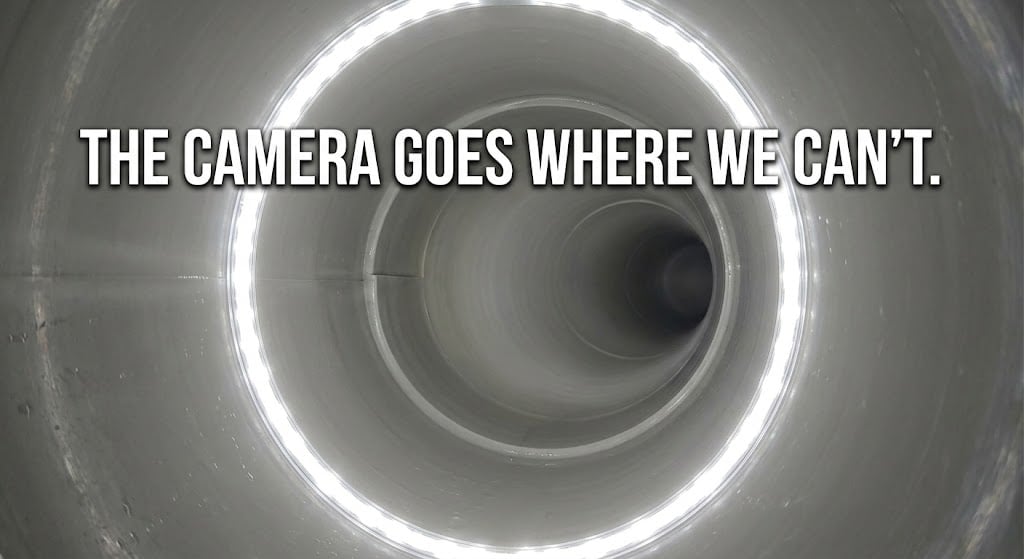
Generally, specialized camera equipment enters through a plumbing access point. Then it travels through accessible portions of the drain or sewer piping.
The exact procedure can vary depending on:
- Property and pipe configuration
- Available access
- Equipment
- Obstructions
- System condition and inspection scope
As the camera moves, it sends back a live image. Consequently, the evaluator can observe conditions inside a component that is normally concealed.
Captain Obvious: “So the camera goes where we don’t.”
Inspector Hindsight: “Preferably.”
Captain Obvious: “Strong preference.”
Why Is the Sewer Line Different From the Rest of the Plumbing?
Much of a home’s plumbing is only partly visible. For example, an inspector can observe fixtures, water heaters, connections, and visible supply or drain piping.
However, underground sewer piping is different. Once the pipe disappears beneath the slab, yard, driveway, or landscaping, its condition is generally concealed.
That is why a sewer camera matters. It offers another perspective: from inside the pipe.
Is a Sewer Scope Inspection Part of a Standard Home Inspection?
Not necessarily. A standard home inspection and a sewer scope have different scopes.
A general home inspection evaluates visible and accessible plumbing conditions. Meanwhile, a sewer scope uses specialized equipment to view piping that would otherwise be concealed.
Therefore, confirm exactly which services are included in the inspection you order. For more on standard scope, see our guide on what to expect at your home inspection.
What Does a Sewer Scope Inspection Look For?
A sewer scope provides visual information about accessible portions of the piping. Depending on what is visible, observations may include:
- Obstructions or debris
- Root intrusion
- Pipe deterioration
- Cracking or separations
- Offsets
- Standing water
- Damage or other unusual pipe conditions
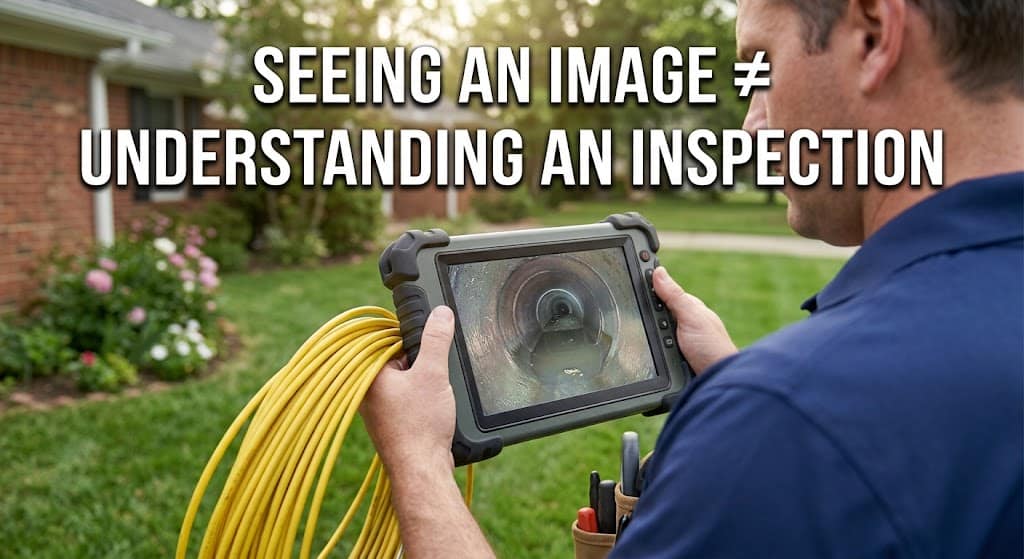
However, the camera image still needs interpretation. Seeing something unusual starts the question. It doesn’t necessarily end it.
Inspector Hindsight: “The camera gives you a view. Experience gives that view context.”
Can a Sewer Scope Find Tree Roots?
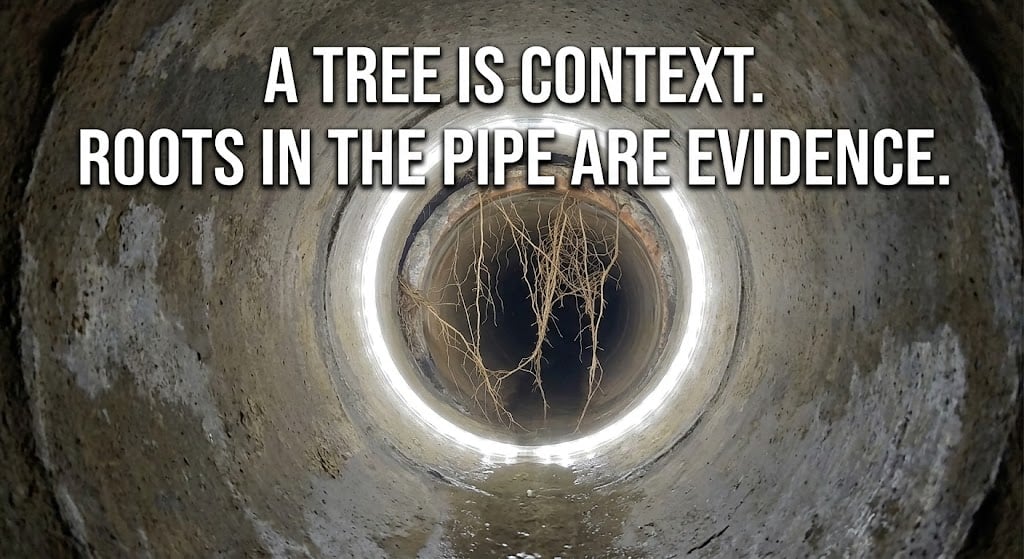
Yes, a camera may reveal root intrusion within the portion of piping that can be inspected. Roots can enter through joints, openings, or defects, depending on the pipe and surroundings.
However, visible roots raise more questions:
- Where are they entering?
- How extensive is the intrusion?
- Is flow affected?
- What is the condition of the pipe?
- Can the entire affected area be viewed?
- Should a qualified plumbing professional evaluate it?
In short, the camera may reveal the evidence. Then the right next step depends on the actual condition.
Captain Obvious: “Tree outside.”
Inspector Hindsight: “Yes.”
Captain Obvious: “Roots inside pipe.”
Inspector Hindsight: “Yes.”
Captain Obvious: “That seems like the tree misunderstood the assignment.”
Does a Tree Near the Sewer Line Mean Root Intrusion?
No. A nearby tree doesn’t prove roots have entered the sewer line. That would be an assumption.
Instead, the better approach is to evaluate the pipe itself when appropriate. After all, a tree provides context, while visible roots inside the pipe provide evidence.
Inspector Hindsight: “Proximity can create a question. Evidence answers it.”
Can a Sewer Camera Find a Cracked Pipe?
A camera may reveal visible cracking when the affected area is accessible and visible. However, not every defect shows clearly on camera.
For example, visibility may be affected by:
- Water or debris
- Obstructions
- Pipe configuration
- Camera position
- Access or damage
Therefore, the scope should document what is actually visible rather than promise complete detection.
What Is an Offset in a Sewer Line?
An offset generally means connected pipe sections are no longer aligned as intended. Depending on severity, an offset may affect:
- Flow and pipe continuity
- Camera passage
- The ability to view piping beyond that point
A visible offset should be documented and interpreted in context. While the camera can show the condition, determining repairs may require a qualified plumbing professional.
What Is a Sewer Line Belly?
“Belly” commonly describes a low area in piping where water stays instead of draining completely. So standing water during a scope may suggest further evaluation is appropriate.
However, there is an important distinction. Seeing standing water is an observation. In contrast, determining the exact pipe geometry and cause may require more information.
In other words, the camera doesn’t automatically explain why the condition exists.
Captain Obvious: “Water is sitting there.”
Inspector Hindsight: “That’s what we can observe.”
Captain Obvious: “And why?”
Inspector Hindsight: “That’s the next question.”
Does Standing Water Always Mean the Sewer Line Is Broken?
No. Standing water alone doesn’t establish that the pipe is broken. Rather, it is a condition that needs context.
For example, the evaluator may consider:
- How much water is visible, and where
- Whether the camera can continue
- Pipe configuration
- Visible defects
- Flow conditions
So “standing water was observed” should never become “the sewer line has failed.” The evidence may not support that conclusion.
Can a Sewer Scope Find a Blockage?
Yes. A camera may reveal material that obstructs or restricts the line. However, an obstruction can also stop the camera from going farther.
That creates an important limitation. If the camera cannot pass, the inspection doesn’t continue on its own.
Therefore, the report should explain where the inspection stopped, what was visible, and why the camera couldn’t continue, when known. It should also note what further evaluation may help.
Captain Obvious: “Camera stopped.”
Inspector Hindsight: “Yes.”
Captain Obvious: “So we saw everything after that?”
Inspector Hindsight: “No.”
Captain Obvious: “I knew that one.”
Can a Sewer Scope Inspection Cover the Entire Sewer Line?
Not always. How much piping can be inspected depends on factors such as:
- Available access
- Pipe configuration, length, and turns
- Obstructions or standing water
- Damage
- Equipment limitations
As a result, the camera may not reach or clearly view every section. That limitation should be communicated. Consequently, no scope can honestly prove an entire sewer line is defect-free.
Where Does the Sewer Line End?
Plumbing configurations and responsibility boundaries vary by property and utility arrangement.
So a residential sewer scope shouldn’t be described as covering everything from the house to the municipal sewer. That may not be accurate.
Instead, the report should identify the segment actually inspected, based on access, layout, and procedure. Also, questions about responsibility boundaries are best confirmed with the local utility.
What Can Prevent a Sewer Scope Inspection?
Several conditions can limit or prevent camera access. For example:
- No suitable access point
- An inaccessible or damaged cleanout
- Obstructions
- Pipe configuration
- Standing water
- Unsafe conditions
- Equipment limitations
If the scope can’t be completed, that limitation is meaningful information. Therefore, it should never be hidden.
Inspector Hindsight: “A limitation isn’t a failure to communicate. Failing to communicate the limitation is.”
What Is a Sewer Cleanout?
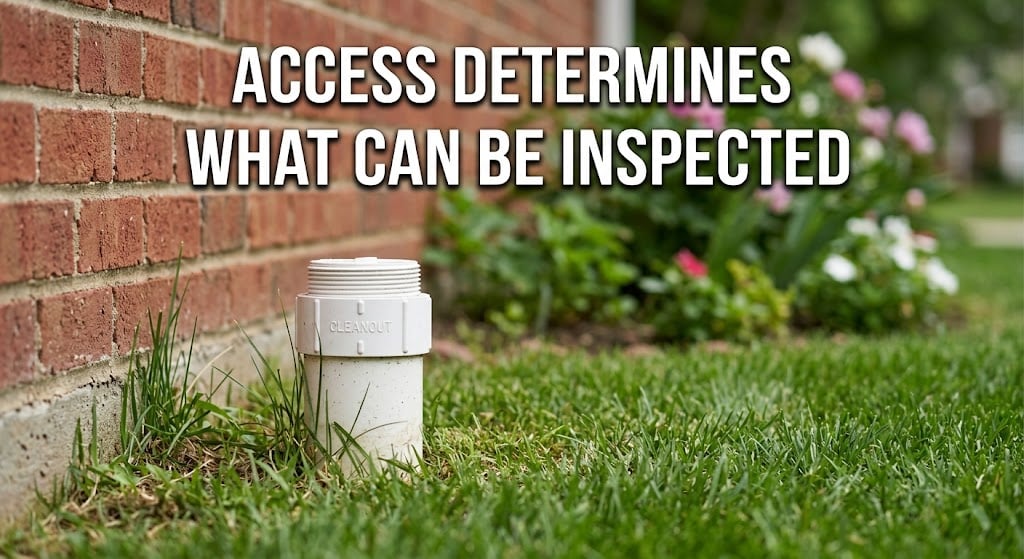
A cleanout is an access point to portions of the drainage system. A suitable cleanout can provide a practical entry point for inspection or service.
However, cleanouts vary. A property may have:
- One accessible cleanout, or several
- A concealed or damaged cleanout
- No readily accessible cleanout
- A cleanout that doesn’t reach the desired section of pipe
In short, a cap in the yard doesn’t tell you everything about the system.
Can a Sewer Scope Be Done Without a Cleanout?
It depends on the plumbing configuration, available access, equipment, and the professional’s procedure. So there’s no universal alternate access method.
Also, homeowners should never dismantle plumbing fixtures to create access. Instead, the inspection professional determines whether a safe, appropriate access point exists.
What Types of Pipe Can a Sewer Camera Inspect?
A camera can be used in different types of accessible drain or sewer piping. However, pipe material, diameter, configuration, condition, and access all affect the inspection.
Besides identifying material, the evaluator may look at:
- Visible condition and interior surfaces
- Joints
- Obstructions or damage
- Flow-related observations
Different materials can present differently. Even so, a repair recommendation shouldn’t rest on pipe material alone.
Does an Old Sewer Line Automatically Need Replacement?
No. Age alone doesn’t establish that a sewer line needs replacement. Older piping may deserve careful evaluation, but old doesn’t automatically mean failed.
Likewise, newer doesn’t automatically mean defect-free. Instead, the actual condition matters.
Inspector Hindsight: “Age is context. Condition is evidence.”
Do Newer Homes Need Sewer Scope Inspections?
A newer home can still have sewer-line conditions worth understanding. For example, new construction doesn’t rule out installation concerns, debris, damage, or alignment issues.
That doesn’t mean every new house has a sewer problem. Rather, age alone shouldn’t be treated as proof of condition.
Captain Obvious: “Brand new pipe.”
Inspector Hindsight: “Yes.”
Captain Obvious: “Perfect pipe?”
Inspector Hindsight: “You’ve been here long enough to know the answer.”
What About Older Homes?
Older properties may contain piping installed at different times. In addition, they may have different materials, repairs, or replacements.
So a buyer may want to know:
- What piping is present?
- Has any of it been replaced?
- Are repair records available?
- Are there known drainage problems?
- Has previous sewer work been performed?
- What does the current visual evaluation show?
Property history provides context. Meanwhile, the camera provides current visual information where accessible.
Can a Sewer Scope Find Previous Repairs?
A camera may reveal transitions suggesting different materials or previous work. However, the image alone may not establish the full repair history.
That is where documentation helps. For example, buyers may ask for:
- Plumbing invoices and repair records
- Permit information, where applicable
- Previous sewer reports
- Warranty information, when relevant
Inspector Hindsight: “The pipe shows today’s view. Records can help explain yesterday.”
Can a Sewer Scope Tell Exactly Where a Defect Is?
Not necessarily. Some specialized equipment can provide location information. However, not every sewer scope includes locating.
A camera shows what it sees. In contrast, determining exact location, depth, repair access, or property boundaries may require additional equipment or professional evaluation.
Is a Sewer Camera the Same as a Pipe Locator?
No. Camera inspection and pipe locating are different functions. Some specialized systems combine them, but many do not.
So don’t assume that seeing a defect means knowing its exact spot underground.
Captain Obvious: “So the camera knows what it sees.”
Inspector Hindsight: “Yes.”
Captain Obvious: “But not necessarily where it is?”
Inspector Hindsight: “Not without the appropriate locating capability.”
Captain Obvious: “Underground is inconvenient.”
Can a Sewer Scope Find a Leak?
A camera may reveal damaged or separated piping. However, it is not a comprehensive leak test. After all, a camera inspection is visual.
Therefore, a sewer scope does not:
- Prove the entire line is watertight
- Replace every other plumbing test
- Detect every leak
- Identify every source of water loss
Instead, the right test depends on the question being investigated.
Is a Sewer Scope the Same as a Hydrostatic Test?
No. They are different procedures that provide different information.
A sewer scope provides visual information from inside accessible piping. Meanwhile, other testing methods evaluate different aspects of plumbing performance or integrity.
Can a Sewer Scope Inspection Find Everything Wrong With a Sewer Line?
No. This is one of the most important limitations for buyers to understand. A sewer scope provides valuable information, but it can’t guarantee finding every condition.
Limitations may include:
- Inaccessible piping
- Obstructions or standing water
- Poor visibility
- Camera positioning or pipe configuration
- Areas beyond camera reach
- Conditions outside the camera’s field of view
So the honest promise is not “we see everything.” Rather, it is gathering more information about a component that would otherwise stay concealed.
What If the Camera Cannot Get Past a Problem?
If the camera can’t pass an obstruction or damaged area, the section beyond it may remain uninspected. That is significant.
In that case, you know what was visible up to that point. You also know the camera couldn’t continue. However, you don’t know the condition of the piping beyond it.
Captain Obvious: “Road closed.”
Inspector Hindsight: “For the camera.”
Captain Obvious: “What’s on the other side?”
Inspector Hindsight: “Unknown.”
Captain Obvious: “That’s annoyingly responsible.”
What If the Camera View Is Cloudy or Underwater?
Poor visibility limits what the camera can reliably show. So if the lens or pipe conditions block a clear view, the evaluator should say so.
No one should guess through a blurry image. In fact, this principle applies to every inspection: if you can’t see it clearly enough to support a conclusion, don’t pretend you can.
Can a Sewer Scope Damage the Pipe?
Inspection equipment should be used according to professional procedures. However, access and pipe condition still matter.
For example, a severely damaged or obstructed system may call for extra caution. That is one reason sewer camera work is best left to trained professionals rather than attempted as a DIY project.
What If the Sewer Line Has a Problem?
If a scope identifies a potentially significant condition, a qualified plumbing professional may be recommended. The next step depends on what was actually observed.
Helpful questions include:
- What is the condition, and where is it?
- Can the affected area be fully viewed?
- Is flow restricted?
- Is damage visible?
- Is additional testing or locating needed?
- Does the condition require repair?
- What portion of the system remains uninspected?
However, the inspector shouldn’t invent a repair plan outside their scope.
Does a Sewer Scope Tell You How Much a Repair Will Cost?
No. A sewer scope provides information about visible conditions within its scope. It is not a repair estimate.
Instead, repair needs and costs depend on the actual condition and the professionals doing the work. So the useful first question is always: what is the condition?
Should You Get a Sewer Scope Inspection When Buying a House?
A sewer scope inspection may add useful information when you want to understand concealed sewer piping. Whether it fits a particular property depends on factors such as:
- Property characteristics and plumbing configuration
- Known history or observed concerns
- Transaction needs
- Available access
- Professional recommendations and service availability
Ultimately, an inspector should educate you about the property, not tell you whether to buy it.
Should You Get a Sewer Scope If the Drains Work Fine?
Working drains during an inspection don’t provide a visual assessment of underground piping. For example, a sink can drain and a toilet can flush.
Those observations show operation at that moment. However, they don’t create a view of concealed piping.
Captain Obvious: “Toilet flushed.”
Inspector Hindsight: “Yes.”
Captain Obvious: “Sewer line perfect?”
Inspector Hindsight: “No.”
Captain Obvious: “I knew that was coming.”
Can a Normal Home Inspection Identify Sewer Problems?
A home inspection may reveal plumbing symptoms that deserve attention. However, it can’t view the inside of underground piping without specialized methods.
Possible clues elsewhere in the property include:
- Drainage concerns
- Backups observed during the inspection
- Visible leakage
- Damaged accessible piping
- Unusual plumbing conditions
Still, a symptom doesn’t automatically identify the underground cause. The same evidence-first approach applies to slab foundation movement: settling vs. heave.
What Should Buyers Ask Before Ordering a Sewer Scope Inspection?
Ask questions that clearly define the service. For example:
- What portion of the system will be evaluated?
- What access point will be used?
- What happens if access is unavailable?
- Will video or images be provided?
- What limitations can prevent a complete scope?
- Does the service include locating?
- Who interprets the findings?
- What happens if a significant condition is observed?
As a result, you avoid assumptions about what “sewer scope” means.
What Should Buyers Ask After a Sewer Scope?
Afterward, ask:
- How much of the line was actually viewed?
- Were there inspection limitations?
- Did the camera reach the intended endpoint?
- Were roots or standing water visible?
- Were offsets, cracks, deterioration, or obstructions seen?
- Were different pipe materials or repairs visible?
- Is additional evaluation recommended?
- What remains unknown?
That last question is especially valuable. After all, good inspection communication includes both findings and limitations.
Does a Bad Sewer Scope Mean You Should Not Buy the House?
No. An inspector shouldn’t make the purchase decision for you. Instead, a sewer-scope finding provides information.
So you may need to understand:
- What was observed
- How much piping was inspected, and what wasn’t
- Whether additional evaluation is recommended
- Whether repair history exists
- What a qualified plumbing professional determines
- What options your real estate professionals can explain
In the end, the inspection informs the decision. It doesn’t make it.
Inspector Hindsight: “You don’t need a perfect house. You need to understand the house you’re buying.”
The Inspector’s Eye: What the Camera Actually Proves
Imagine a sewer camera shows standing water. Captain Obvious sees water in the pipe, which is correct.
Next, Inspector Hindsight asks more questions:
- Where is it, and how much is there?
- Can the camera continue?
- Is there visible damage?
- Does the condition repeat?
- Is the pipe configuration visible?
- What portion remains uninspected?
- Does a plumber need to evaluate it?
That is the difference between seeing an image and understanding an inspection.
Captain Obvious: “Camera sees water.”
Inspector Hindsight: “Yes.”
Captain Obvious: “Then we ask why.”
Inspector Hindsight: “Yes.”
Captain Obvious: “And we don’t invent the answer.”
Inspector Hindsight: “Now you’ve got it.”
What a Sewer Scope Can and Cannot Tell You
A sewer scope provides visual information about accessible piping that would otherwise be concealed. For example, it may help identify visible:
- Root intrusion or obstructions
- Damage, cracking, or separations
- Offsets or deterioration
- Standing water
- Other unusual pipe conditions
However, it does not automatically:
- Inspect every inch of piping
- See through an obstruction
- Prove the entire line is watertight
- Identify every defect or cause
- Locate every condition underground
- Determine every repair
- Guarantee future performance
In short, that distinction is the value of responsible inspection.
What Is a Sewer Scope Inspection? The Simple Answer
A sewer scope uses specialized camera equipment to look inside accessible portions of a home’s drain or sewer piping. That matters because much of that piping is underground or concealed.
Still, remember these points:
- The camera only shows what it can access and see.
- An obstruction creates a limitation.
- Standing water is an observation, not a diagnosis.
- A nearby tree doesn’t prove root intrusion.
- An older pipe isn’t automatically failed, and a newer one isn’t automatically perfect.
- A sewer scope doesn’t guarantee discovery of every defect.
Captain Obvious: “So the sewer line is underground.”
Inspector Hindsight: “Yes.”
Captain Obvious: “And the camera lets us see inside it.”
Inspector Hindsight: “Yes.”
Captain Obvious: “But only where the camera can actually go.”
Inspector Hindsight: “Yes.”
Captain Obvious: “It was obvious.”
Inspector Hindsight: “Until it wasn’t.”
Sewer Scope Inspection FAQs
What is a sewer scope inspection?
It uses specialized camera equipment to view accessible portions of drain or sewer piping that would otherwise be concealed.
How does a sewer scope work?
A camera enters through a plumbing access point and travels through accessible piping while the interior is viewed.
What can a sewer scope find?
It may reveal root intrusion, obstructions, cracking, separations, offsets, deterioration, standing water, or other pipe concerns.
Is a sewer scope included in a home inspection?
Not necessarily. The two have different scopes, so confirm exactly which services are included.
Can a sewer scope find tree roots?
Yes, when roots are present in the accessible portion of the piping.
Can a sewer scope find a cracked pipe?
It may, when the affected area can be accessed and clearly viewed.
What is a sewer line belly?
It is a low area where water may remain instead of draining. Standing water is an observation that may warrant further evaluation.
Can a sewer scope inspect the entire line?
Not always. Access, obstructions, pipe configuration, standing water, damage, and equipment can prevent complete viewing.
Can a sewer scope locate the exact position of a defect?
Not necessarily. Exact underground locating may require separate capabilities.
Can a sewer scope find every problem?
No. Inaccessible or poorly visible conditions can remain undiscovered.
Does a new house need a sewer scope?
A newer home can still have sewer-line conditions worth understanding. New construction doesn’t guarantee defect-free installation.
Does an old sewer line automatically need replacement?
No. Age provides context, but actual condition is what matters.
Should I get a sewer scope if all the drains work?
Working fixtures show operation at that moment. However, they don’t provide a view inside the underground sewer line.
What happens if a sewer scope finds a problem?
Potentially significant findings may warrant evaluation by a qualified plumbing professional.
Should I buy a house with a sewer-line problem?
The inspection provides information, not the decision. So understand the finding, limitations, recommendations, and property history first.
Schedule Your RedFish Home Inspection
Most of the sewer line is out of sight. However, that doesn’t mean it has to be out of the conversation.
Understand the visible property, understand the inspection limitations, and know when additional information may help.
Schedule your RedFish home inspection.
RedFish Inspections
Inspecting To A Higher Standard.
Call (866) 218-6699
