

East Harris County foundation concerns come up often for buyers and homeowners in communities across the east side of the Houston area. The region’s clay soils, flat terrain, and mix of older and newer homes all shape the questions worth asking.
However, a foundation question isn’t a foundation diagnosis. The goal is to understand what the visible evidence shows about a specific house, and to know which questions need a specialist.
Captain Obvious: “Old house, sloping floor, foundation failure.”
Inspector Hindsight: “Old house, sloping floor. Let’s find out why.”
Clay Soils: The Short Version
Much of the Houston area sits on expansive clay soils, which swell when wet and shrink as they dry. When moisture around a house changes unevenly, parts of a foundation can move differently from others.
For a deeper look at how clay works, common signs, moisture management, and post-tensioned slabs, see our guide to foundation concerns in expansive clay soils. For heave versus settling, see slab foundation movement: settling vs. heave.
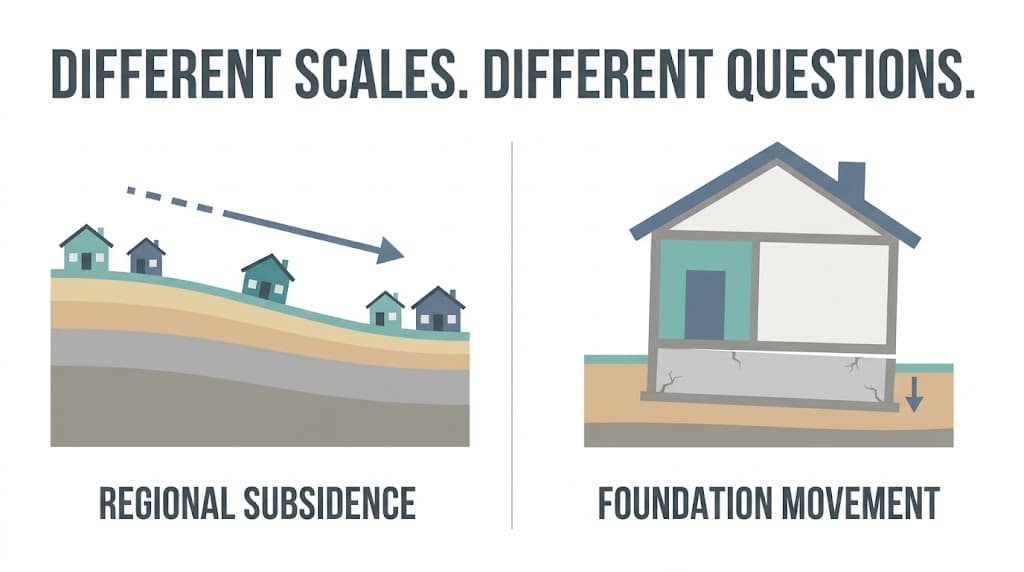
Regional Subsidence vs. Foundation Movement
Parts of the Houston–Galveston region, including areas on the east side of Harris County, have experienced land subsidence over the decades, largely tied to groundwater withdrawal. Today, groundwater use is regulated regionally to help reduce it.
It’s important to separate two different ideas:
- Regional subsidence is the gradual lowering of land across a wide area. It can affect drainage and flood exposure over time.
- Foundation movement is uneven movement within a single house, where one part of the foundation moves differently from another.
A home inspection looks for visible clues of movement within the house. However, it can’t measure regional subsidence or determine its effect on a property. For flood and water-history questions, see our guide to flood awareness and drainage on the Gulf Coast.
Older Pier-and-Beam Homes
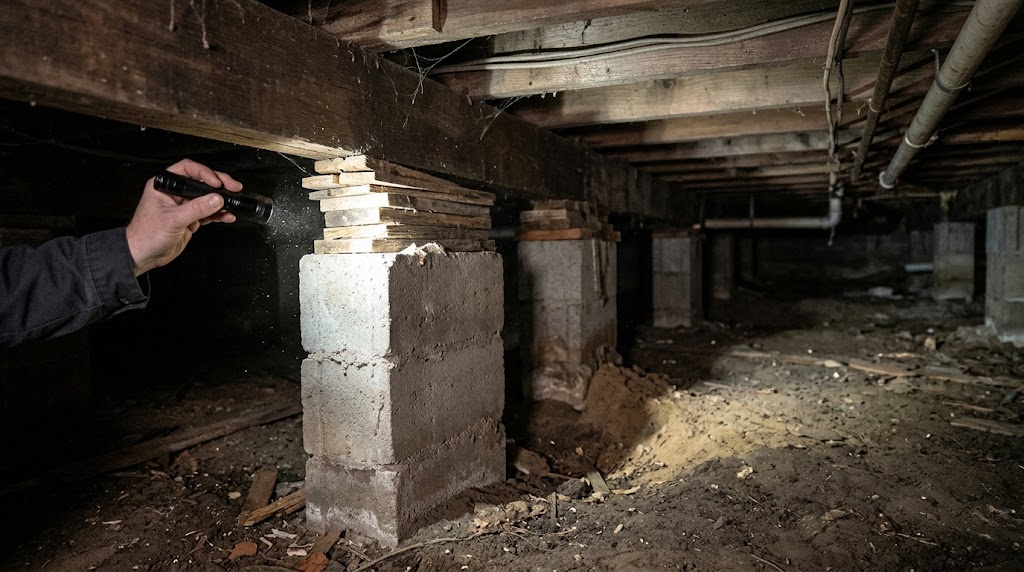
Some older homes in East Harris County sit on pier-and-beam foundations, with a crawl space beneath the floor. That design gives an inspector something slab homes don’t: a chance to see the support system directly.
When the crawl space is safely accessible, an inspector may observe:
- Piers and their visible condition
- Beams and floor joists
- Shims between piers and beams
- Soil erosion or moisture at pier bases
- Wood deterioration or damage
- Plumbing and ductwork running under the floor
Shims aren’t automatically a problem, since adjustment is part of how pier-and-beam homes are maintained. However, they’re part of the story, especially alongside sloping floors, sticking doors, or other clues. For more, see crawl space moisture and what inspectors look for.
Older Slab Homes and Under-Slab Plumbing
On a slab foundation, the drain and supply piping often runs beneath the concrete. In older homes, that piping may be decades old.
A leak under a slab can add moisture to the soil beneath the house, which matters on expansive clay. However, under-slab piping isn’t visible during a standard home inspection. The inspector may note visible clues inside the home, such as slow drains, staining, or unusual moisture, but determining what’s happening under the slab requires specialized evaluation, such as plumbing testing or a sewer scope.
Inspector Hindsight: “What’s under the slab matters. It’s also the one place we can’t see.”
Additions on Different Foundations
Older homes are often expanded over time. When an addition sits on a different foundation from the original house, such as a slab addition on a pier-and-beam home, the two sections can move differently.
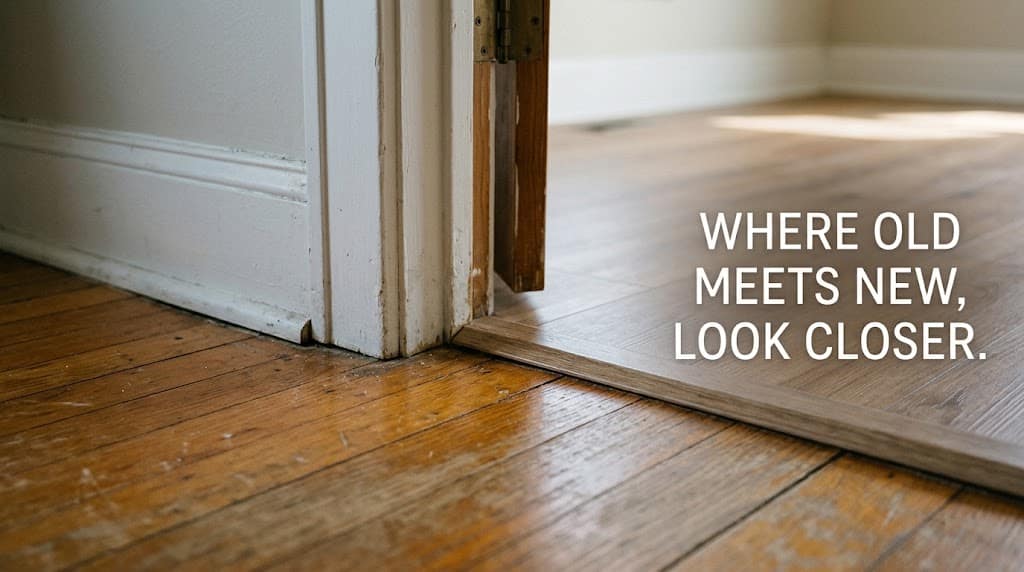
So the transitions deserve attention. An inspector may look at floor height changes at doorways, cracks where old and new walls meet, roofline transitions, and how the two sections drain. A transition isn’t automatically a defect, but it’s where differences tend to show up first.
Reading the Clues
Cracks, sticking doors, sloping floors, and gaps at trim can all raise foundation questions. However, each has more than one possible cause, so one clue raises a question, while a consistent pattern tells more of the story.
That’s why an inspector looks at the house as a whole, including the foundation, the structure above it, and the drainage around it. For more on what an inspection covers, see what is checked during a home inspection.
When to Call a Structural Engineer
A home inspector documents visible conditions. A structural engineer evaluates whether a foundation is performing as intended and what, if anything, should be done.
It may be time for an engineer when several clues appear together, when cracks show displacement, when conditions seem to be changing, or when an inspection report recommends further evaluation. For help with next steps, see what happens after a home inspection.
What a Home Inspection Can’t Do
A home inspection is visual and limited to accessible conditions within scope. It can’t see under slabs, measure regional subsidence, guarantee every concealed condition will be found, or predict future foundation performance. It also doesn’t replace a structural engineer’s evaluation.
Instead, it gives you better information and points you toward the right next question. Buying in Baytown? See our guide to what your Baytown home inspection should cover.
Captain Obvious: “Shims under the house. Bad sign.”
Inspector Hindsight: “Shims under the house. Now let’s see the rest of the story.”
Captain Obvious: “It was obvious.”
Inspector Hindsight: “Until it wasn’t.”
East Harris County Foundation FAQs
Is land subsidence the same as foundation movement?
No. Regional subsidence is the gradual lowering of land across a wide area. Foundation movement is uneven movement within a single house.
Can a home inspection measure subsidence?
No. A home inspection looks for visible clues within the house. It can’t measure regional land subsidence.
Are shims under a pier-and-beam home a problem?
Not automatically. Shims are part of how pier-and-beam homes are adjusted. However, they’re worth understanding alongside other clues.
Can a home inspector find leaks under a slab?
Not directly. Under-slab piping isn’t visible. An inspector may note visible clues inside the home, but under-slab questions need specialized evaluation.
Why do additions sometimes show cracks at the transition?
An addition on a different foundation can move differently from the original house, so transitions are where differences often show up first.
When should I call a structural engineer?
When several clues appear together, cracks show displacement, conditions seem to be changing, or an inspection report recommends further evaluation.
Schedule Your RedFish Home Inspection
Buying or owning a home in East Harris County? Understand what the foundation evidence actually shows.
Schedule your RedFish home inspection, or call (866) 218-6699 to confirm service in your area.
RedFish Inspections
Inspecting To A Higher Standard.

