
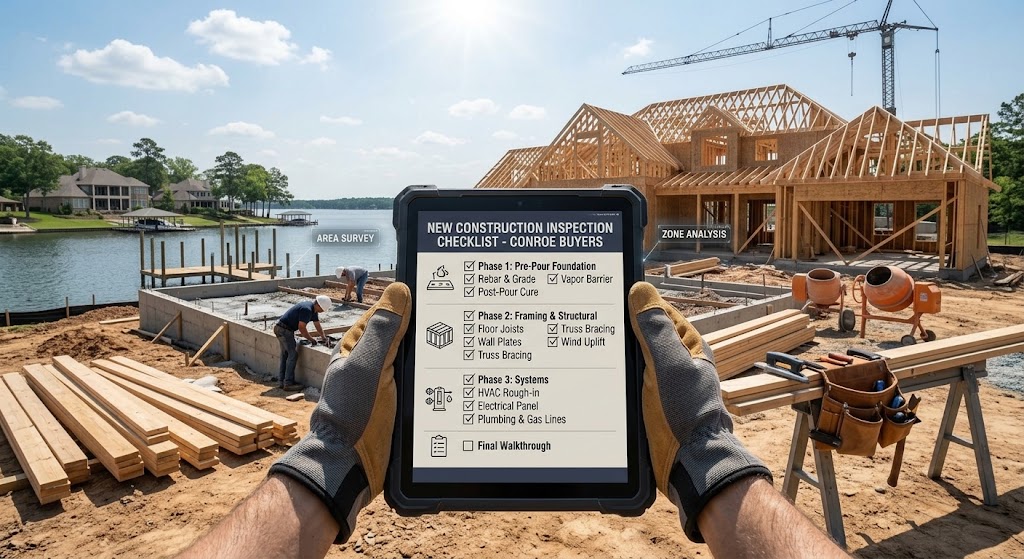
New Construction Inspection Checklist for Conroe Buyers
There’s a belief that costs Conroe buyers real money every year: it’s brand new, so there’s nothing to inspect.
We understand where it comes from. The house is spotless. The paint is fresh. It passed municipal inspections. It comes with a builder warranty. What could possibly be wrong?
Quite a lot, as it turns out — and not because builders are careless. Montgomery County has been one of the fastest-growing markets in Texas for the better part of a decade. Communities like Grand Central Park, Harper’s Preserve, Ladera Creek, and Woodforest have put thousands of homes in the ground on aggressive timelines, built by dozens of rotating subcontractor crews working through Southeast Texas heat, humidity, and rain. Volume plus speed plus weather produces defects. It always has.
A new construction home inspection in Conroe isn’t an insult to your builder. It’s quality control on a six-figure purchase. At Redfish Inspections, we inspect new builds across Conroe, Montgomery, Willis, and the surrounding communities at every phase of construction. This guide walks through exactly what to check, when to check it, and why timing matters more than almost anything else.
Why New Homes Still Need Independent Inspections
🏛️ Municipal Inspections Aren’t What Buyers Think
City and county inspections verify minimum code compliance — brief, narrowly scoped, pass/fail, and performed across many homes in a day. Code is a floor, not a standard of quality. It says nothing about whether your ductwork was crushed, your insulation was installed evenly, or your grading will drain water away from the slab.
🤝 The Builder’s Rep Works for the Builder
Your sales agent may be genuinely helpful and kind. They also don’t represent your interests, aren’t trained to evaluate framing connections, and have production schedules to meet. You need someone whose only obligation is to you.
🔧 Trades Damage Each Other’s Work
The single most common source of new construction defects. The plumber cuts a structural member to route a drain. The HVAC installer crushes a duct getting through a joist bay. The electrician drills through a top plate and no one installs the nail plate. Each trade does its job and moves on — nobody is looking at the whole.
🌡️ Conroe’s Conditions Add Risk
Expansive clay soils demand careful soil prep and drainage. Newly graded lots involve fill that must be properly compacted. And our climate means framing lumber routinely gets soaked during construction — which becomes a problem only if it’s sealed behind drywall before it dries.
The Four-Phase Inspection Strategy
Most buyers schedule one inspection, right before closing. That’s better than nothing — but by then, roughly 80% of the home is permanently hidden behind concrete, drywall, and insulation. Here’s the schedule that actually protects you.
Inside Phase 2: The Pre-Drywall Framing Inspection
This is the most important inspection of the build, so it’s worth detailing exactly what gets evaluated while the structure is still open.
🏗️ Structural Framing
Missing or improperly installed joist hangers, straps, and hurricane connectors; over-notched or over-drilled studs, joists, and beams; missing jack studs, cripples, or headers at openings; truss modifications (a cut or altered truss is a serious defect requiring engineer sign-off); and inadequate bracing, blocking, or bearing support.
💨 Weather Barrier & Exterior
House wrap laps, seams, and flashing integration; window and door flashing — improperly shingled flashing is one of the most common and most consequential defects we find; and roof underlayment, valley and penetration flashing, and step flashing at wall intersections.
🚰 Plumbing
Drain line slope and support; kinked, unsupported, or improperly secured supply lines; missing protection where lines pass through framing; and evidence of pressure testing.
⚡ Electrical
Missing nail plates where wiring passes through studs and plates — extremely common and potentially dangerous; box placement, secure mounting, and adequate box fill; proper support and stapling of cable runs; and panel location, sizing, and clearances.
❄️ HVAC
Crushed, kinked, or disconnected ductwork; undersized returns and poorly sealed plenum connections; duct routing and support in the attic; and combustion air and venting clearances where applicable.
💧 Moisture (The Conroe Piece)
We take moisture readings on framing lumber before it’s enclosed. Wet framing sealed behind drywall and insulation is a direct path to concealed mold growth — and it’s entirely preventable if caught at this stage.
Understanding Your Builder Warranty: The 1-2-10 Structure
Most Texas builders provide a limited warranty commonly structured as 1-2-10. Terms vary by builder, so read yours — but the framework usually looks like this:
| Coverage Term | What It Typically Covers | Why It Matters to You |
|---|---|---|
| 1 Year | Workmanship and materials | Broad coverage that expires fast — this is what the 11-month inspection protects. |
| 2 Years | Mechanical and electrical systems (plumbing, HVAC, electrical) | Covers system performance problems that often only surface under a full season of load. |
| 10 Years | Major structural components | Long-tail protection for the foundation and load-bearing structure. |
That first-year workmanship coverage is the one buyers lose by default. An 11-month inspection catches settlement and drywall cracking, nail pops, separated trim, foundation movement indicators, washed-out grading, roof issues after a full storm season, HVAC problems that only appeared under load, plumbing leaks, sticking doors, and failed caulking — all while it’s still the builder’s responsibility to fix.
The Defects We Find Most Often in Local New Builds
Buyers frequently ask what actually turns up. Every home differs, but certain findings repeat across builders and communities in Montgomery County.
| Common Defect | Why It Matters |
|---|---|
| Grading that slopes toward the foundation | Final grade is often rushed or hidden under sod. In expansive clay, this is a foundation problem waiting to happen. |
| Attic insulation applied unevenly | Blown insulation is frequently thin near eaves, around decking, and above interior walls. Thermal imaging makes the gaps obvious. |
| Ductwork problems in the attic | Crushed flex duct, disconnected boots, unsealed connections, and undersized returns quietly cost comfort and energy every month. |
| Missing electrical nail plates | A wire run through a stud without protection sits inches from where you’ll one day hang a picture. |
| Improper window flashing | Reverse-lapped flashing directs water into the wall assembly rather than out of it — invisible after siding and expensive to correct. |
| Condensate drain & secondary pan defects | Improper slope, missing pans, or drains terminating in the wrong place cause interior water damage in year one. |
| Roof flashing shortcuts | At valleys, sidewalls, and penetrations — where most roof leaks begin. |
None of these are exotic. All of them are cheaper to fix before closing.
What to Do With Your Inspection Report
Finding defects is only half the process.
• Submit findings in writing, through your builder’s official warranty channel — not verbally to a superintendent on site.
• Keep everything documented, with dates, photographs, and copies of every submission and response.
• Request a re-inspection after repairs. Verification matters as much as the original finding.
• Prioritize clearly. Separate structural, safety, and moisture concerns from cosmetic punch-list items so the important issues don’t get buried.
• Don’t close on unresolved major items without a written, dated commitment.
If a Builder Resists Third-Party Inspections
Some builders push back, citing site access or liability. Address this before you sign. Ask directly during the contract stage whether independent inspections are permitted at each phase, and get the answer in writing. A builder confident in their work rarely objects — and reluctance is itself worth noting.
Your Conroe New Construction Checklist
Frequently Asked Questions
Do I really need an inspection on a brand-new home?
Yes. New construction is assembled quickly by rotating subcontractor crews, and trades routinely damage each other’s work — a plumber cuts a structural member, an HVAC installer crushes a duct, an electrician forgets a nail plate. Municipal inspections only verify minimum code compliance, and the builder’s representative works for the builder. An independent inspection is quality control that answers only to you.
What is the most important new construction inspection phase?
The pre-drywall framing inspection. It’s the last time the home’s structure, wiring, plumbing, ductwork, and flashing are fully visible before insulation and drywall permanently conceal roughly 80% of the home. If you only schedule one inspection during construction, make it this one.
When should I schedule the pre-pour foundation inspection?
After the forms and reinforcement are set but before concrete is placed — a window that is often less than 48 hours. Coordinate early with your builder so the inspection happens before the pour, because once concrete goes down, the vapor barrier, reinforcement, and plumbing rough-in are buried for the life of the home.
What is an 11-month warranty inspection and why does it matter?
It’s an inspection performed around month ten or eleven of your first year, before the builder’s one-year workmanship warranty expires. After a full Texas cycle of drought, slab movement, heavy rain, and HVAC load, new issues surface — drywall cracks, nail pops, grading washout, HVAC problems under load. Submitting a documented list before the deadline routinely saves buyers thousands in repairs the builder would otherwise no longer cover.
What does a builder’s 1-2-10 warranty cover?
Most Texas builders structure limited warranties as roughly one year on workmanship and materials, two years on mechanical and electrical systems, and ten years on major structural components. Terms vary by builder, so read your specific warranty documents — the broad first-year workmanship coverage is the one most buyers lose simply by not inspecting before it expires.
Can a builder refuse to let me bring my own inspector?
Some builders push back citing site access or liability, which is why you should raise it before signing. Ask during the contract stage whether independent inspections are permitted at each phase and get the answer in writing. A builder confident in their work rarely objects, and reluctance is itself worth noting.
Why does new construction in Conroe carry extra risk?
Montgomery County’s expansive clay soils demand careful soil preparation, compaction of newly graded fill, and drainage that slopes away from the slab. The regional climate also soaks framing lumber during construction, which becomes a concealed mold risk if it’s sealed behind drywall before drying. These local conditions make pre-pour and pre-drywall moisture evaluation especially valuable here.
Buy New With Confidence — Not Assumptions
New construction in Conroe is a genuinely good decision for a lot of families. Modern efficiency, current building standards, warranty coverage, and a home nobody has worn out first — those are real advantages.
But “new” and “flawless” are different words. Every home is assembled by people working quickly, in difficult conditions, alongside other trades. The buyers who end up happiest are simply the ones who verified rather than assumed — and who did it while problems were still visible and still someone else’s responsibility to fix.
Redfish Inspections provides phase-by-phase new construction inspections throughout Conroe, Montgomery, Willis, and Montgomery County — pre-pour, pre-drywall, final, and 11-month warranty — with thermal imaging, moisture diagnostics, and clear, photo-documented reports you can hand directly to your builder.
Building or buying new in Conroe? Make sure the home you’re paying for is the home you’re actually getting.
Legal Disclaimer: This article provides general educational information, not engineering or legal advice. A home inspection documents visible, accessible conditions at the time of service and does not replace municipal code inspections, the builder’s warranty obligations, or evaluation by a licensed structural engineer where structural concerns are identified. Warranty terms vary by builder; buyers should read their specific warranty documents and confirm inspection access rights in writing before signing a construction contract.
